Abe Parangi once made a game that declined to explain itself. There was a plant, a moving cursor and a golden creature. The player had to discover how they belonged together. No helpful menu appeared to rescue the confused. For a certain kind of software designer, this is an invitation. For a person trying to finish a quarterly report, it might be grounds for closing the laptop.
The game was Phyta, released in 2008. Its creator would study computer science at Cornell, work on 3D-printing technology at Markforged and co-found Akkio in 2019. Today, Parangi shares the chief executive role with Jon Reilly at a company building AI tools for media teams. Somewhere along that route, the question of what to ask of the user changed. The fascination with the interface remained.
A game with no instruction menu
In Phyta, you guide the growth of a black plant by positioning a black sun. The plant catches golden creatures. Growth becomes a kind of drawing, with the player steering an unfolding form rather than commanding a character through a conventional adventure. Later creatures can break through the vegetation. The image is spare; the interaction takes time to learn.
Discussing the game while at Cornell, Parangi described his interest in systems that generate their own forms. He had started coding around twelve, at a summer camp where programming shared the timetable with dodgeball. He admired quiet interactive work and cited game designer Jenova Chen as an influence. The interviewer noticed that he paused to consider his answers. This was a young programmer thinking carefully about what his programs allowed another person to experience.
“It’s created by a process.”
Abe Parangi, on procedural creation
There is a useful distinction between an exploratory game and a working tool. A game can reward uncertainty. A tool has to earn the time it takes. Parangi’s subsequent career would put him in settings where the software needed to guide people toward an outcome they could recognize: first a manufactured part, then a business decision.
The browser and the factory floor
His route included a software engineering internship at Apple in 2012 and Cornell studies from 2009 to 2013. At Markforged, where he worked from 2014 to 2019, his responsibilities included the title Director of Technology & Creative. Those words make an interesting pairing. They put the behavior of the machinery and the experience of using it on the same business card.
In January 2015, Parangi walked a reporter through Eiger, Markforged’s cloud-based software. It ran in Google Chrome. There was no local installation to negotiate, and users received the current version when they logged in. Teams could work on iterations with tracked changes. The demonstration included automatically adding reinforcing fiber to a part and adjusting where that fiber went.
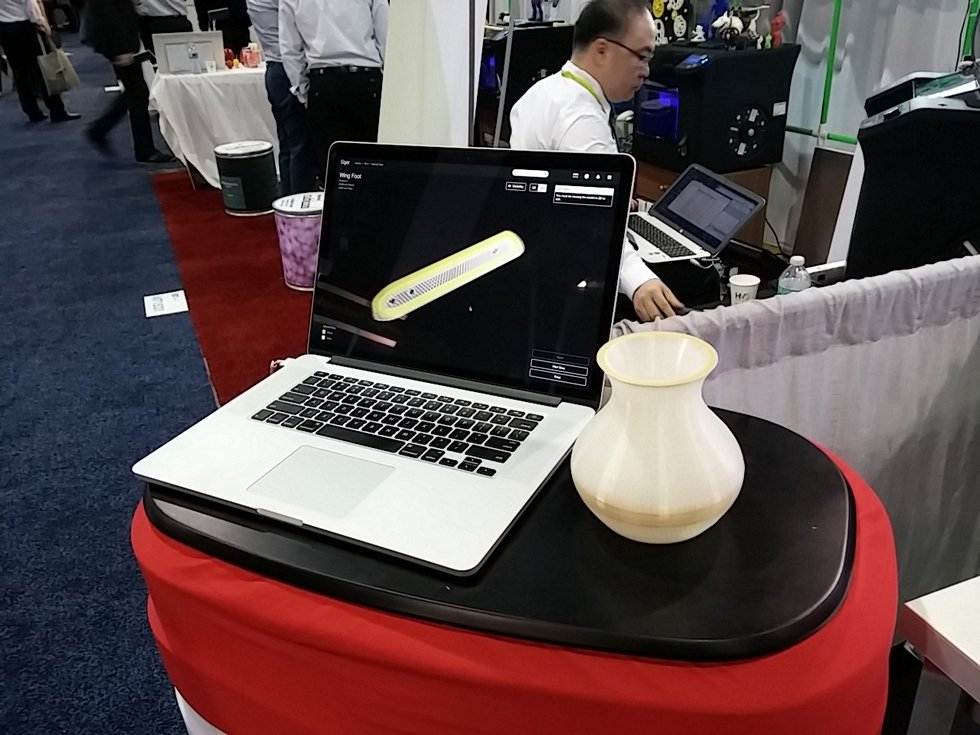
The reporter found the sequence easy to follow. That small observation matters in a field where a software decision can become a physical object. A browser could give the user a comprehensible route through a specialized process. The engineering still had to happen; the person operating the system did not have to confront every detail at once.
Parangi’s patent listings also connect him to the work underneath the interface. They include applications concerning composite-filament printing, fiber reinforcement and deviations in printed and sintered parts. His career was taking shape across both the visible controls and the technical systems those controls served.
The queue that became a company
At Markforged, Parangi worked with people who would become his Akkio co-founders: Reilly, Craig Wisneski and Ekin Keserer. The shared problem that led them toward a new company was surprisingly ordinary. They wanted to use business data to improve such work as handling sales leads and responding to customer requests. Machine learning appeared well suited to those tasks. Getting it into everyday operations was harder.
The founding account describes efforts that included hiring data scientists and commissioning custom work from consultants. Promising projects still accumulated. The team wanted a way for departments to work with their own data without having to commission a substantial technical undertaking each time. There is a particular frustration in seeing a useful question reach the back of a queue. The question does not become less useful while it waits.
Akkio, founded in 2019, grew out of that gap between knowing what a business needed and having the means to build it. The people closest to a workflow often understand its awkward cases. They know which records are misleading and which outcomes matter. A tool that lets those people participate directly has a different starting point from a project handed over with a specification.
The interface has to connect all three. A promising model alone leaves the job unfinished.
In 2021, Akkio announced a $3 million seed round led by Bain Capital Ventures. Parangi framed the ambition through the history of personal computing: graphical interfaces had made computers approachable to people who did not want to type commands. He wanted to “open the world of artificial intelligence” to a wider audience. The comparison placed usability at the center of the company’s purpose.
When the spreadsheet learned to answer
An early Akkio feature called Data Stories addressed another obstacle: understanding a prediction once a model had produced it. The company described helping users examine the factors associated with business outcomes. Producing a number and making that number useful are separate jobs. Someone has to decide what to do with it, and that decision needs more than a result floating in a box.
By 2023, Akkio was adding conversational tools around the data workflow. Chat Data Prep handled instructions for cleaning and transforming information. Chat Explore let people ask questions and create visualizations. Forecasting addressed patterns in outcomes such as sales and marketing performance. In August, the company announced a $15 million Series A with participation from Bain Capital Ventures and Pandome.
Parangi’s public product posts kept returning to the working experience. Introducing Chat Data Prep on Product Hunt, he compared giving an instruction to chatting with a coworker. Announcing Generative Reports on LinkedIn, he emphasized customized dashboards and quicker access to useful information for smaller businesses. The phrasing was practical: people have data, they need to understand it, and the tool should shorten the trip.
That is a long way from leaving a player to discover what a vine wants. It also reveals why a single rule about simplicity will never serve every program. The person playing Phyta is there to explore. The person preparing a report has a deadline. A designer has to know which kind of patience the task deserves.
A smaller brief, a larger room
Akkio’s current focus is media companies. The broad ambition of making AI useful has acquired a more specific working day: audiences, campaign planning, performance analysis and client reporting. The terminology gets narrower, while the organizations involved become larger. Parangi now leads that business alongside Reilly; Wisneski remains its founder and head of product, and Keserer is listed as a founder and advisor.
Horizon Media announced a multiyear partnership with Akkio in 2024, centered on developing its blu. platform. The plan included natural-language interactions across complex datasets for agency and client users. This placed Akkio inside an existing working environment, where people already had information, tools and routines. The interface needed to join those pieces together.
LG Ad Solutions announced its partnership in June 2025. Its focus was automatic content recognition data from connected televisions: information about viewing behavior that advertisers could explore conversationally. LG described processing 1.45 terabytes in minutes. That figure belongs to the partner’s account of the system. It illustrates the distance between the size of a dataset and the size of the question someone wants to ask.
- 2024Horizon Media
Co-development around blu. - 2025LG Ad Solutions
Conversational access to viewing data - 2026Havas
Agentic capabilities for Converged.AI
At CES in January 2026, Havas highlighted its recently announced Akkio partnership as part of developing Converged.AI. By June, Havas described the collaboration in terms of faster scenario modeling and analysis of more granular data. These are company partnerships, involving work across teams. For Parangi, they mark a new setting for the accessibility problem that helped launch Akkio.
Leave room for the person at the keyboard
Parangi’s January 2025 essay about DeepSeek offers a view of how he thinks that setting should work. He urged agencies to keep their model choices flexible. He also emphasized the value of specialized applications built around their own information, client knowledge and workflows. A change in the underlying model should become an opportunity for the application rather than a new course of study for every customer.
Read alongside his earlier work, that argument suggests a consistent interest in the space between a technical system and its user. The system can be intricate. The encounter should suit the task. At Markforged, it was a guided sequence toward a part. At Akkio, it is increasingly a conversation inside a familiar business workflow.
The young creator of Phyta was happy to let people wander through an experience. The co-founder of Akkio is helping them get somewhere. Both jobs require attention to the person at the keyboard. It is a modest place to begin a technology story, and a demanding place to keep working.
Follow the work
Read Parangi’s essay on DeepSeek and media agencies, visit Akkio, or follow his LinkedIn profile.