A handshake is a small piece of machinery. No batteries, no witnesses required, very little paperwork. Jon M. Huntsman Sr. liked to think it could carry the weight of a chemical company. In a story he told about selling a stake in his business, he agreed to a price of $54 million. By the time the lawyers finished their work, he reckoned the stake was worth $250 million. He kept the original price.
The arithmetic was spectacularly unhelpful to the seller. Huntsman treated it as settled. “My word was my bond,” he said. For someone who spent his working life buying businesses other people wanted to unload, he had a surprisingly expensive attachment to keeping things simple.
His career began with eggs, passed through the Nixon White House, and expanded into an international chemicals business. Along the way came a hamburger box, a Christmas-record venture, and a series of educational gifts. The interesting question is how the same person came to enjoy both a hard bargain and the act of giving money away.
The scholarship before the fortune
Huntsman was born in Blackfoot, Idaho, on June 21, 1937. His father taught school. His childhood home lacked indoor plumbing. When the family moved to Palo Alto so his father could pursue graduate study at Stanford, their accommodation was a wartime Quonset hut shared with other families, with cardboard doing service as interior walls.
He worked as a dishwasher, waiter and janitor, and took a job at J. C. Penney while in high school. A scholarship took him east to Wharton, where he graduated in 1959. The education mattered; so did the experience of somebody making room for him. An institution that could seem impossibly distant from rural Idaho had become an address he could actually reach.
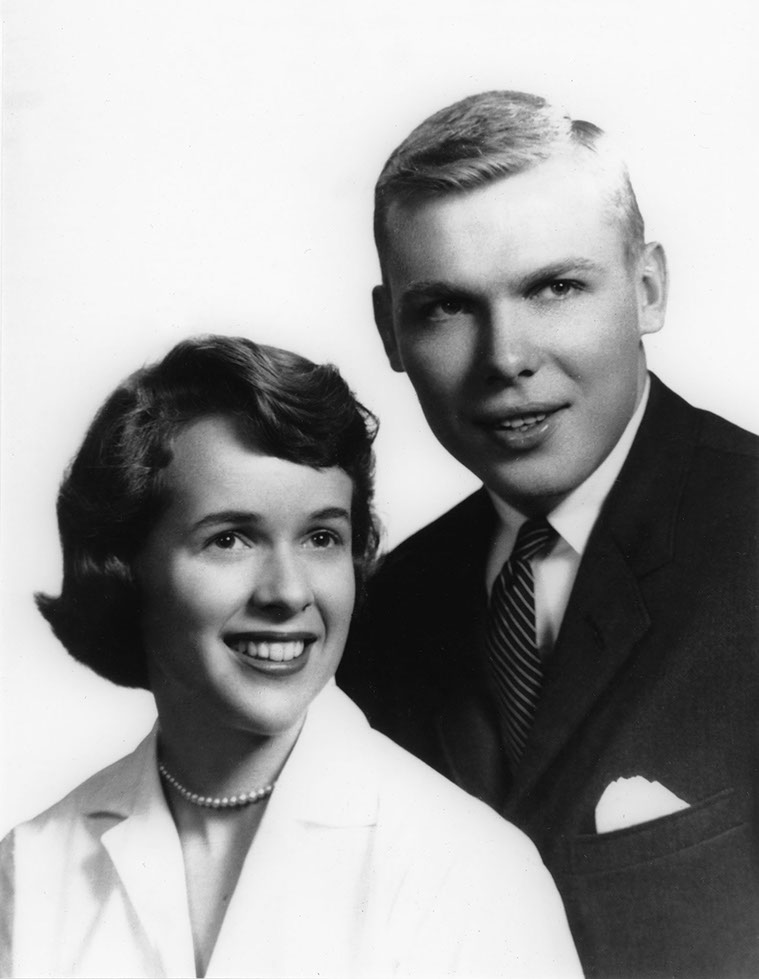
That June he married Karen Haight. The following month, he began two years as a Navy officer, serving aboard the USS Calvert. Later he earned an MBA at the University of Southern California. The sequence has the neatness of a respectable résumé. The photograph of the newlyweds offers something less formal: two young people at the beginning of a life whose eventual scale neither face needs to explain.
A fortune with a fragile beginning
In 1961, Huntsman joined Olson Brothers, a California egg business connected to Karen’s family. Broken eggs were a commercial problem with a particularly literal bottom line. Better packaging offered a way to keep more of the product intact. He helped develop plastic egg cartons and rose into management.
By 1967 he was president of Dolco Packaging, a joint venture involving Olson Brothers and Dow Chemical. Three years later he left to establish Huntsman Container Corporation. Starting his own business meant mortgaging his home. An egg carton may be modest in appearance; financing a factory to make one is a rather more committed expression of interest.
The business supplied a fast-food economy that needed containers by the enormous order. In 1974 came the foam clamshell for McDonald’s Big Mac. The product became an everyday encounter with Huntsman’s work, usually opened by someone with more immediate concerns than the identity of its manufacturer.
There was another, less industrial beginning. In 1963, Huntsman and a friend started Continental Productions, selling nostalgic Christmas records. The venture supplied much of his first million dollars. Long before his name appeared on business-school walls, some of his money arrived to a seasonal soundtrack.
- 1970Huntsman Container
A founder’s own packaging business - 1982Huntsman Chemical
A move into the materials themselves - 2005Public listing
The business reaches the stock market
Buying the problem next door
Huntsman sold the container business in 1976 and continued running it for several years. In 1982 he formed Huntsman Chemical in Salt Lake City. The new chapter took him deeper into the materials that packaging businesses consumed. Instead of concentrating only on the finished container, he bought operations making the substances from which such products were formed.
He was willing to look at assets whose owners had lost enthusiasm for them. When Hoechst wanted to close polystyrene facilities in the 1980s, Huntsman negotiated an acquisition with payment deferred for five years. He also bought into polypropylene, widening the company’s exposure beyond a single product cycle. The deal structures were part of the engineering.
This kind of expansion asks an awkward question of a buyer: what do you see here that the seller has stopped seeing? Huntsman’s answer involved acquisition prices, operating costs and businesses that could fit together. Growth came through repeated transactions, followed by the less photogenic work of making the acquired operations function.
Between 1986 and 2000, he acquired 36 companies. His name became attached to a chemical group whose reach extended far beyond takeaway packaging. The company went public in 2005. A customer could still recognise the old hamburger box; the business behind the name had travelled a considerable distance upstream.
The fine print had a boundary
Huntsman’s position on business ethics left room for competitive bargaining. He enjoyed negotiating. His 2005 book, Winners Never Cheat, argued that familiar childhood rules remained useful when the sums grew larger. “Trust is a greater compliment than affection,” he wrote. It is an arresting line from somebody whose customers did not have to find him lovable.
In his account of a Thai joint venture with Mitsubishi, he described being asked to contribute to payments for government officials. He refused and sold the company’s interest at a discount, taking a short-term loss of about $3 million. The incident gave his argument a price tag. Abstaining from a practice could mean surrendering a business.
His time in Washington supplied a different education. As Nixon’s staff secretary, he worked close to power and later spoke critically about the management example set by chief of staff Bob Haldeman. Public office became part of his thinking about how authority should be exercised. An impressive title offered no guarantee of an example worth following.
“I was born sunny side up.”
Jon M. Huntsman Sr.
That was Huntsman’s own description of his disposition. It suits a former egg-business executive almost too conveniently. In conversation, he credited luck and colleagues with abilities beyond his own. His optimism was accompanied by a readiness to borrow, buy and try again. The cheerfulness had an industrial workload.
Sending the scholarship back out
For a scholarship student who became wealthy, education offered a particularly direct way to return the favour. In 1997, Huntsman and his family gave $10 million to endow Penn’s program combining international studies and business. Its curriculum joined business study with languages, regional knowledge and time abroad. A global company needs people who can understand more than its accounts.
In 1998 came a $40 million unrestricted gift to Wharton. The unrestricted part deserves attention. The school could decide how to use the money. Donors often have elaborate instructions; here was a businessman accustomed to making decisions who also made room for other people’s judgment.
The same interest reached Utah State University. A $26 million gift from Jon and Karen was recognised in 2007 when its business college became the Jon M. Huntsman School of Business. In 2017, the Huntsman Foundation and Charles Koch Foundation announced a joint $50 million gift supporting an expanded scholar program and a new Center for Growth and Opportunity.
From Wharton graduate to a family gift endowing international studies and business at Penn.
The gifts made his name conspicuous on campus, but their practical subject was the student: who gets admitted to opportunity, who can afford to stay, and what kind of preparation follows. The scholarship that had moved an Idaho schoolteacher’s son across the country kept finding new beneficiaries.
Concrete, with a purpose
After the 1988 earthquake in Armenia, Huntsman became involved in relief and rebuilding. His response had the instincts of a manufacturer. A concrete plant could provide building materials and employment. The project connected the immediate need for homes with the longer task of giving people work.
He returned to the country repeatedly and supported schools and scholarships as well as reconstruction. In 1998 he announced plans for an interest-free $10 million loan to help build housing. The commitment continued years after the earthquake itself had disappeared from daily headlines.
There is something revealing in the choice of concrete. It is difficult to turn into a sentimental object. It does, however, make a useful wall. Huntsman’s experience buying and operating factories had given him a vocabulary of assistance in which production, employment and shelter could belong in the same sentence.
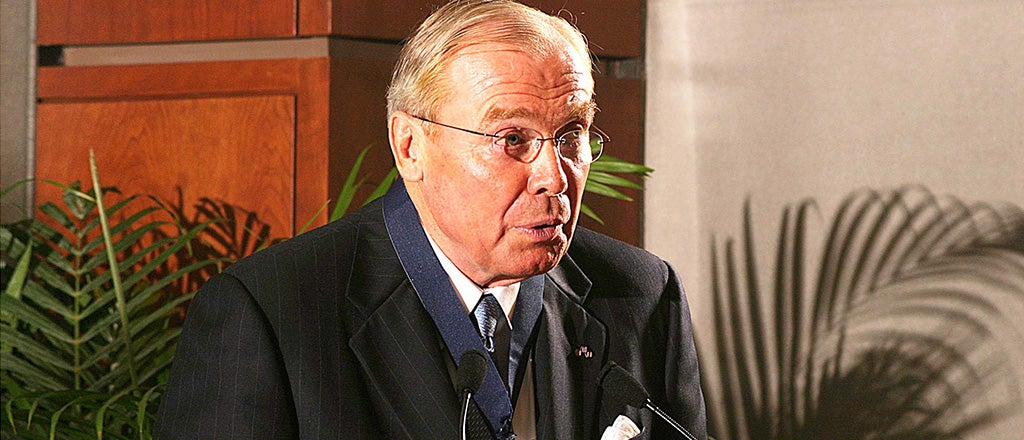
A name on the door
Writing about that life took patience of a different kind. While preparing his autobiography, Barefoot to Billionaire, he repeatedly revised the manuscript and consulted family members about its personal passages. The businessman who could move quickly across a negotiating table was willing to proceed carefully when other people’s memories were involved. A family story belonged to more than its most publicly recognisable participant.
The family remained closely involved in the business. Peter Huntsman succeeded his father as chief executive in 2000. Jon Huntsman Jr. pursued a separate public career as a governor and diplomat. Their father continued as executive chairman before becoming chairman emeritus at the end of 2017. He died on February 2, 2018, aged 80, at home in Salt Lake City.
His life resists a tidy division between earning and giving. The same habits recur: remember who helped you, take an unfashionable proposition seriously, and accept that a commitment may eventually become inconvenient. The handshake story endures because inconvenience can be measured in dollars.
Egg cartons, chemical plants, scholarships, concrete walls: these are serviceable things. Huntsman spent his life around them. For all the size of the later transactions, his idea of an agreement remained small enough to fit between two hands.
Keep reading. Hear him speak.
Books, conversations and the institutions that carry the story forward.