Jon Darbyshire arrived at an early customer meeting carrying a floppy disk. On it were HTML mockups of software he had yet to build. The customer, IT outsourcing company EDS, wanted help managing security obligations. Darbyshire wanted to show how those obligations could become an ordinary business process. There was one awkward detail: the convincing thing on the screen was still a proposal.
The meeting produced a customer before it produced a product. Development followed, with Darbyshire working from a small office at EDS, collecting feedback and passing requirements to his developers. He remembers writing requirements at night and seeing changes arrive within a day or two. The glamorous beginning of an enterprise software company can look remarkably like someone borrowing a cupboard.
The episode contains a useful clue to his career. Darbyshire keeps returning to the distance between an organization's formal processes and what its employees actually do. That distance gave him a business at Archer. Years later, after the sale, investing and another round of conversations with founders, it gave him a reason to build SmartSuite.
His subject is the work beneath the work: the permissions, records, approvals and handoffs that rarely appear in a company's grand declaration of purpose. Someone has to make them fit together. Darbyshire has spent much of his working life volunteering for the assignment.
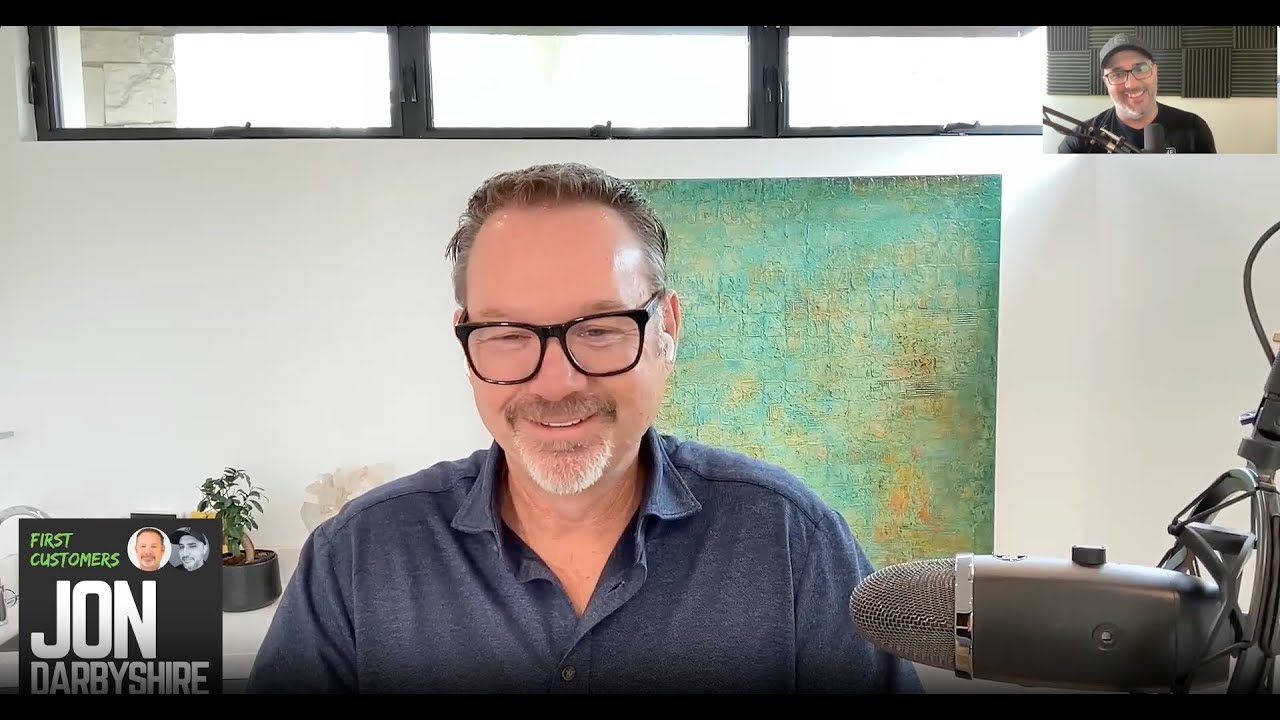 ▶ WATCH THE CONVERSATION
A consultant notices the repeat visit
Before Archer, he worked in consulting at Price Waterhouse and EY. At EY, he became a partner and led the global cybersecurity practice. It was a useful education in how large organizations think: which problems reach senior management, which require a budget, and which become somebody's recurring assignment.
Cybersecurity sounds technical, and much of it is. But governing it also means assigning responsibility, gathering evidence and keeping track of decisions. A control without an owner is rather like a meeting without an agenda: its existence tells you surprisingly little about what will happen next.
Archer began taking shape around 2000, initially from a home office. Tara Darbyshire, his wife and co-founder, led sales and business development. Her work securing early customers, including EDS and financial institutions, was part of the company's foundation. This was a household with two people building the same business, from different sides of the customer relationship.
The product gave companies a configurable framework for risk and compliance processes. Its appeal was practical. Organizations could adapt the platform to their own requirements instead of keeping every adjustment trapped in a manual process. By 2008, Archer's offering included a framework and eight core products. The original problem had acquired a considerable amount of software.
Thirty banks, a deliberately small world
The sales strategy was unusually concentrated. Archer pursued major financial institutions, a demanding audience with complicated systems and little appetite for casual experiments. The team eventually sold to 29 of the top 30 US banks, a record Canapi Ventures would later cite when backing SmartSuite.
The attraction of that market was also its difficulty. A bank's approval carries weight because obtaining it requires work. Once several institutions trusted the same platform, each customer became evidence that the next conversation was worth having. Darbyshire's consulting background and Tara's sales work mattered alongside the software.
By January 2010, Archer had reached 25 percent of the Fortune 100. EMC announced an agreement to acquire it and place it within RSA, its security division. The plan kept Archer in Overland Park, Kansas. A company that began in a home office was joining an organization with relationships across nearly the entire Fortune 100.
The change in distribution was central to Darbyshire's explanation of the deal. Archer could reach customers through a much larger organization while gaining resources for development and support. For a founder who had spent years earning access one institution at a time, that was a substantial change in the size of the room.
The sale closed in 2010. He later described its value as $200 million. By May 2011, Kansas State University listed him as general manager of RSA Archer's eGRC Solutions and invited him to speak at its business college commencement. The founder had become an executive inside the buyer, with a graduation audience to address along the way.
- ~2000Archer begins
- 2010EMC acquires Archer
- 2022SmartSuite public launch
- 2025Series A announced
The investor who wanted a job
After Archer came investing and advising. Darbyshire described exposure to roughly 400 companies, directly and through venture groups. That distinction matters: it was a mixture of investment routes, rather than hundreds of startups all receiving an individual cheque and a seat at his kitchen table.
The arrangement gave him a view of other founders' problems. It also revealed a mismatch in temperament. In a 2022 talk, he admitted that advising did not entirely suit him: “I always wanted to actually do the work.” A founder seeking advice might reasonably prefer that the adviser leave a little of the company available to run.
Those conversations also supplied a recurring frustration. Founders were spending time discussing the tools needed to operate their businesses, alongside the products they were trying to sell. Software for organizing the company had become a subject large enough to compete with the company itself.
In Newport Beach, he enjoys the outdoors and time near the beach. He and Tara have a long business partnership and two grown children. There was a life available beyond another software launch. He chose a project that would once again require product decisions, customers and a team. That choice gives the return its human dimension: the freedom to stop building did not settle the question of what he wanted to do next.
“I always wanted to actually do the work.”
Jon Darbyshire, on his time as an adviser
This time, build before opening the doors
SmartSuite reunited Jon and Tara with Peter Novosel, another Archer veteran. The new venture widened the scope from risk processes to work across an organization. Its ambition included projects, ongoing operations and the information that connects them. It was a familiar concern with a broader set of users.
The development strategy changed. At Archer, the early customer relationship helped pull the product into existence. With SmartSuite, Darbyshire chose to develop a more complete platform before a broad public launch. He discussed that decision in a 2022 conversation about minimum viable products, the startup habit of releasing a small first version and learning from use.
Nearly three years went into development. That patience came with costs and requirements of its own. A broad platform needs many parts to function together; a missing connection can undermine the convenience promised by all the others. Waiting longer gives a team time to build those connections, while postponing the larger market's verdict.
There was also the less abstract business of finding people to build it. Development partner Gearheart describes Darbyshire discovering its previous work-management project, Transpose, and flying to Ukraine to meet the team. Gearheart then worked on SmartSuite from requirements through development, testing and deployment, coordinating with other teams across time zones.
The visit is a small but telling detail. A founder designing software for collaboration still had to travel, meet people and decide whether they could work together. The diagrams describing connected work begin with relationships that cannot be installed from a menu.
The ambition hiding in the handoff
SmartSuite combines tools for managing projects and processes with a shared foundation for data, documents and automation. Its no-code approach lets business users configure workflows. The intended customer benefit is easy enough to describe: information entered for one part of the business should remain useful when another team needs it.
Consider a supplier approval as an illustration. Procurement gathers information, a risk team reviews it, legal checks terms and an operating team waits to begin. Each person may have an excellent application. The trouble arrives between applications, where an approval becomes an email and an updated record becomes someone else's old attachment.
That example explains the attraction of a shared system, and the difficulty of selling one. Teams have their own habits and requirements. A common platform must accommodate those differences while preserving enough consistency for information to travel. Darbyshire's experience with regulated organizations gives him a particular interest in that balance between flexibility and control.
In February 2025, SmartSuite announced $38 million in funding, including a $13 million Series A led by Canapi Ventures, with Sorenson Capital and High Alpha participating. The company also reported 300 percent growth in 2024. Those are dated milestones in the venture's development, rather than a running score for every subsequent year.
Darbyshire's explanation of the Series A emphasized product development, onboarding, training and support. These are workmanlike priorities for a company selling a new way of working. A customer has to learn the system, move information into it and trust colleagues to use it. The purchase is only one event in that process.
Another answer to the same question
His more recent writing brings the story back toward risk and governance. In March 2026, Darbyshire set out his vision for GRC in 2030: continuously updated information, connected evidence and AI assisting teams with interpretation. These are his expectations for the field, and a direction for the company he leads.
The prerequisite, in his account, is structured information. AI needs consistent definitions and connected records before it can offer useful help. That concern fits the rest of his career. Before asking a system to produce a better answer, he wants the people, processes and information inside it to have a working relationship.
His current title is co-founder and CEO of SmartSuite. Archer belongs to the earlier chapter, the business he helped establish and sell. Keeping the two roles distinct makes the continuity more interesting: he returned with the experience of building a platform, and with more questions about what such a platform should encompass.
There is an appealing lack of finality to the whole enterprise. A successful sale supplied room to step away; investing supplied new conversations; those conversations supplied another operating job. The floppy disk is gone. The preoccupation survives. Somewhere between the record, its owner and the next person waiting for an answer, Darbyshire still sees work to do.
Keep the conversation going
Meet the businesses, read his thinking and hear the longer conversation.
- Jon Darbyshire at SmartSuite Official biography
- Jon on LinkedIn Public profile
- Archer The earlier venture
- First Customers video interview Watch on YouTube
- The SmartSuite creation story Code Story conversation
- GRC 2030 Darbyshire’s March 2026 essay
- Why Canapi invested in SmartSuite February 2025