Before governance, risk and compliance became the three-letter software category GRC, Jon Darbyshire was watching companies do the work the hard way. Audits lived in one file. Security controls lived somewhere else. Policy exceptions moved through email. Nobody could quite tell whether two departments were measuring the same risk or merely using the same noun. In 2000, Darbyshire left consulting, landed an early $1.5 million deal with EDS and began building Archer from a home office in Kansas. His wife, Tara, helped lead sales and marketing; Pete Novosel led technology and product. The proposition was modest enough to sound durable: put the mess in one configurable system.
That system became one of enterprise software's quieter institutions. Archer says more than 1,200 organizations in 48 countries use its products, including more than half of the Fortune 500. Its named customers span TIAA, Dell Technologies, Intuitive Surgical, Turkcell, Sallie Mae and First National Bank of Omaha. The people inside those companies are not casual app users. They are internal auditors, compliance officers, cyber-risk teams, vendor managers and resilience planners - professionals whose work becomes interesting precisely when something has gone wrong.
The product is a shared grammar for bad news
At its core, Archer is a configurable database, workflow engine and reporting layer for risk. That description sounds plain because the useful part is organizational, not theatrical. A company can catalog its business units, systems, vendors, regulations, controls, incidents and recovery plans, then describe how they connect. A failed control can point to an application; the application can point to a vendor; the vendor can point to a business service; the service can point to the customers harmed if it stops.
The platform's breadth is the pitch. Archer sells applications for enterprise and operational risk, audit management, IT and security risk, regulatory compliance, third-party governance, business resilience, ESG, AI governance and the public sector. Archer Engage gives employees and outside vendors a simpler doorway for questionnaires and requests. Archer Exchange supplies extensions and integrations. Customers can run the platform as SaaS or on-premises, a choice that still matters to governments and heavily regulated firms.
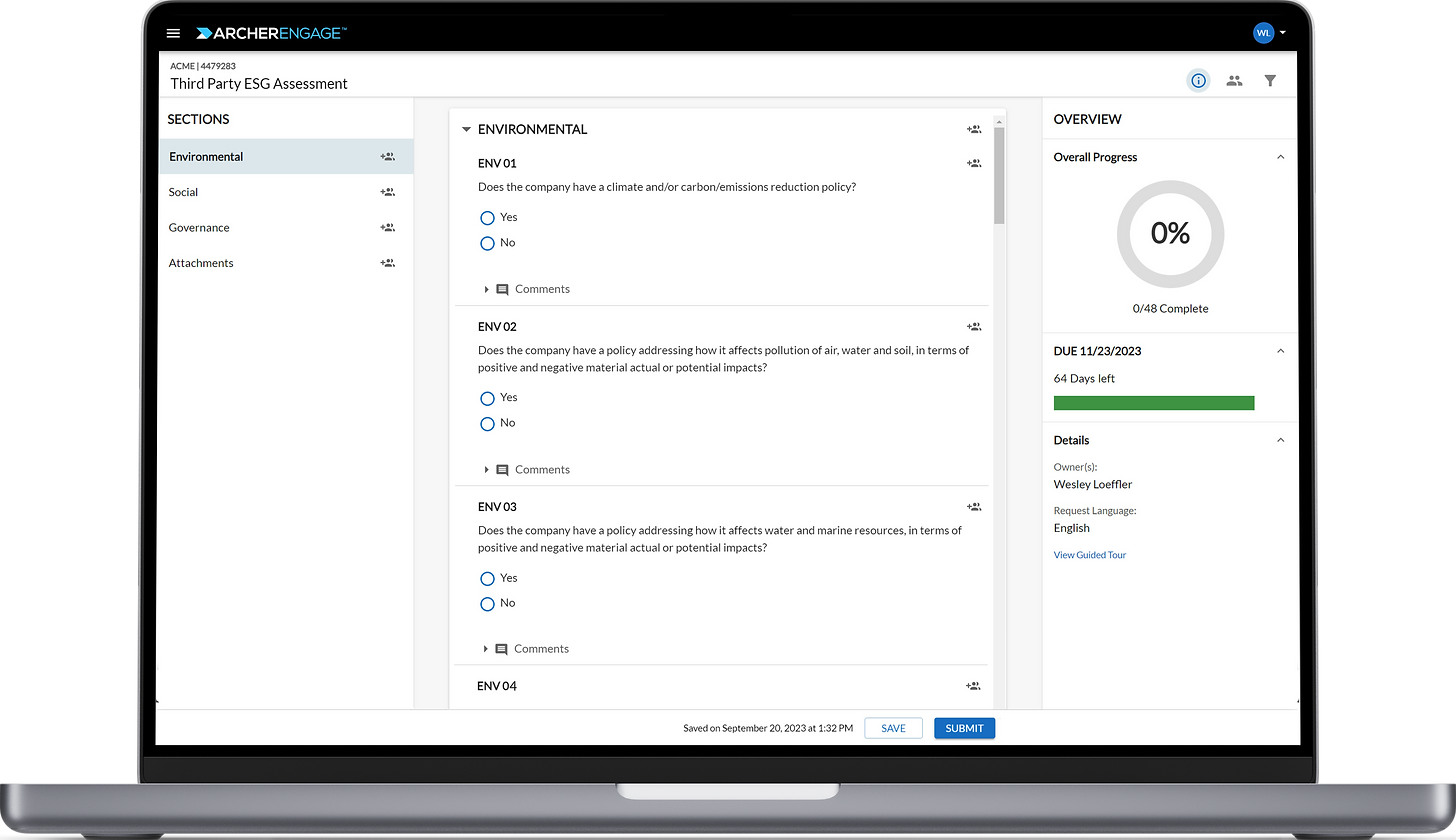
What can a customer actually do with it? A bank can inventory third parties, tier them by inherent risk, send assessments, collect evidence and track remediation. An audit team can plan work, document findings and preserve approvals. A resilience team can map critical services to the people, systems, facilities and suppliers that keep them alive. An insurer or corporate risk office can capture incidents and claims, then ask whether insurance spend matches the losses the company is actually experiencing.
“Incidents and losses are critical inputs to inform and evaluate an operational risk program.”Bill Diaz, Archer CEO, explaining the Flisk acquisition
Three purchases reveal the change of mind
Archer's original genius was the system of record. Its present anxiety is that records arrive too late. A quarterly heat map can be carefully prepared and still describe yesterday. Regulations change, suppliers wobble and cyber exposures propagate while the committee deck is being formatted. The company's response was not one sudden conversion but three acquisitions that form a neat loop.
In 2023 Archer bought Atlas, a policy and document-governance product incubated by PNC subsidiary numo. Atlas added controlled authoring, approvals, version history and audit trails. In February 2024 Archer acquired Compliance.ai, whose machine-learning system monitors regulatory updates and maps new obligations to policies and controls. One month later it bought Flisk, an Austin startup for incidents, claims, insurance policies and exposure data. The financial terms of all three deals were not announced.
This is the strategic shift: from documenting the risk program to feeding it new signals and closing the loop with real outcomes. Archer Evolv, introduced in 2025 and expanded since, packages that ambition into Compliance, Risk and Intelligence products. The company says its AI operators work from authoritative sources and customer data, preserve versioned lineage, score confidence and send uncertain judgments to human reviewers. They are designed to update registers and open assessments, not merely produce a plausible paragraph in a chat window.
Archer's 2026 benchmark sharpened the contrast. On a narrow regulatory-date extraction task across six jurisdictions, the company reported 95 percent verified accuracy, work completed 80 times faster and 92 percent lower cost than a general-purpose large language model. Those are Archer's own test results, not an independent bake-off, so they deserve the usual vendor-benchmark caution. Still, the test choice is revealing. In compliance, the flashy failure is a hallucinated rule. The expensive failure is a confidently wrong effective date quietly copied into a calendar.
What failed first was participation
The first thing to break in a risk program is rarely the database. It is participation. A business manager receives another questionnaire and rushes it. A vendor emails a PDF instead of using the portal. A cyber team invents a severity scale that finance cannot translate. Local spreadsheets return because they are faster than negotiating shared definitions. Soon the central dashboard is beautifully consistent and only partially true.
Archer's history suggests it learned this problem early. The platform was point-and-click and configurable because enterprises would not abandon their peculiar processes for a rigid template. Its 2008 marketplace let customers reuse applications instead of rebuilding every workflow. Engage later simplified the interface for frontline workers and vendors. The current partner network - including Deloitte, EY, Crowe and Optiv - acknowledges that deployment is as much operating-model work as software installation.
This places Archer in the heavyweight end of the market beside ServiceNow IRM, MetricStream and IBM OpenPages. Riskonnect overlaps in insurance, claims and incidents. LogicGate, AuditBoard and Onspring offer lighter alternatives. Archer's difference is the combination of maturity, configurability and breadth. Its cost is also configurability and breadth: someone must own the taxonomy, integrations, permissions, upgrades and change program.
There is no public list price. Archer sells quote-based enterprise subscriptions or licenses, and the meaningful bill includes selected modules, users, deployment, data migration, integrations, configuration, training and ongoing administration. Cinven's 2023 purchase of Archer was also undisclosed. The widely reported $2.075 billion figure belongs to the 2020 sale of the much larger RSA portfolio - not Archer alone.
The copyable part is smaller than the software
Most readers should not copy Archer's acquisition strategy. They can copy its information architecture. Begin with one business service that matters. Name the assets and vendors it depends on. Agree on a risk taxonomy. Give every risk and control an owner. Attach evidence to the decision, not to somebody's inbox. Only then automate the handoffs. A common risk language makes dashboards useful; automation before agreement merely moves confusion faster.
Choose a critical service and map its systems, suppliers, controls and failure scenarios end to end.
Every assessment, exception and remediation needs a named person and an explicit due date.
Keep source, version, reviewer and rationale beside every AI-assisted conclusion.
Use money and ranges where they improve a decision, not as decoration over weak assumptions.
Archer Insight offers a useful provocation here. Traditional risk matrices compress likelihood and impact into colors, inviting false precision and endless debates over whether something is orange or red. Insight instead asks questions that produce expected loss, value at risk and conditional value at risk. Quantification will not rescue bad data, but it lets leaders compare unlike risks in a common unit and test whether a mitigation costs more than the exposure it reduces.
The approach would not work everywhere. A 40-person company with one compliance framework and no dedicated risk staff may spend more time administering Archer than learning from it. A larger company will also fail if executives want a dashboard but refuse common definitions, if business units will not maintain their records, or if nobody funds implementation after the license is signed. Human-in-the-loop AI does not help when the designated human lacks time or authority to challenge the output.
A company accustomed to changing surnames
Archer has passed through enough owners to make corporate lineage its own risk register. EMC acquired the startup in 2010 and put it inside RSA. Dell later inherited RSA. In 2020, a Symphony Technology Group-led consortium bought RSA from Dell, and Archer re-emerged under its own name. Cinven acquired Archer from RSA in 2023, again without disclosing terms, promising investment in technology, go-to-market execution and European expansion.
Through those changes, the durable asset was not a particular owner or acronym. It was the installed base and the accumulated model of how large organizations describe risk. That history gives Archer credibility, reusable content and a sizeable community. It also creates the classic incumbent's test: modernize without turning every existing workflow into a migration project.
The company's answer is an adaptive loop - listen, decide, act, assure, learn - with human judgment kept inside it. Whether Evolv can make a mature platform feel genuinely faster will matter more than another AI label. Archer already taught thousands of risk teams where to put the boxes. Its next chapter depends on whether those boxes can notice a changing world, carry the evidence and summon the right person before the quarterly slide turns red.