There is a peculiar kind of software that never appears on the purchase order. It lives in a spreadsheet, travels through an inbox, and depends on somebody remembering which version is right. Nextworld has given this arrangement a name: Shadow ERP. The name is useful because it makes an ordinary office habit look like what it has become: a second operating system, maintained by human attention.
- Build applications for the work your core systems leave behind.
- Connect the handoffs, with business rules and approvals intact.
- Measure one process before expanding the platform.
The company sells a cloud platform for turning those improvised arrangements into applications. Teams can define data, assemble business logic, automate workflows, and connect existing systems. Its current pitch starts with the gaps around an ERP. That is an appealing place to look: the official system can be perfectly functional while the people surrounding it are exhausted.
The family resemblance
Nextworld’s background explains its preoccupation with enterprise software’s long afterlife. Founded in 2016, it counts JD Edwards co-founder Ed McVaney among its founders. Kylee McVaney is founder and CEO; fellow founders Konrad Rogers, Axel Allgeier, and Vito Solimene hold operating, product, and technology leadership roles. These are people working on a problem with a substantial family history.
The architectural bet concerns what survives a change. Nextworld stores application definitions in metadata: descriptions of fields, rules, screens, and processes interpreted by the platform. In the company’s design, the underlying technology can change while those definitions remain useful. Its promise of preserving customizations through upgrades deserves scrutiny in a buyer’s own environment, but the underlying question is sensible: why should a new technical foundation require rebuilding the business logic upstairs?

There is operational substance beneath that abstraction. Packaged applications cover financials, sales, procurement, manufacturing, projects, and master data. The 2022 acquisition of Cloud Inventory added mobile inventory capabilities spanning warehouses, manufacturing materials, and the field. At acquisition, that business served thousands of customers across 50 countries. That historical footprint should not be confused with a current count of Nextworld platform deployments.
Six months, then a shorter close
Consider Velociti, a technology services business. Its old financial system left accounting staff mailing invoices and processing work orders manually. Salesforce handled other operational work. According to Nextworld’s customer account, Velociti considered Epicor and Oracle NetSuite, then chose Nextworld for the flexibility to customize.
The implementation took six months. Work orders entered in Salesforce became projects in Nextworld, connecting operational activity with costing and accounting. Velociti reported finishing on time and on budget, and avoiding two additional accounting hires. Tim Kats described his own month-end close work falling from three or four days to one. Those are customer-reported outcomes, with a clear mechanism: fewer manual handoffs.
“I used to spend three to four days on month-end close. Now, it only takes me one day.”
Tim Kats · Velociti
That example places Nextworld between buying another packaged application and commissioning bespoke software. The attraction depends on how much distinctive process a business needs to preserve. A standard application may be sufficient for a standard task. An application platform becomes interesting when changing the task is part of everyday work.
The prototype they put away
Nextworld’s own engineering offers a useful complication. Its earlier machine-learning interface was already no-code, yet customers still needed experts to choose algorithms and tune models. Data scientists spent weeks embedded with customer teams. Easier buttons had left the difficult decisions untouched.
The team explored building automated machine learning itself and produced a prototype. It also evaluated outside tools. AWS SageMaker Autopilot met its requirements for programmable access, on-demand computing, and reduced infrastructure work. Nextworld shelved the internal approach. Its engineering account reports model delivery moving from more than four weeks to roughly two days, with a 95% reduction in build time. That is a company-reported result for this capability, rather than a general deployment guarantee.
The revealing decision was where to spend expertise. Building every component internally would have consumed the same people needed to improve the platform. Buying a component gave them time back. The lesson travels well beyond software: keep asking which part of the job actually needs your team’s judgment.

Teach the system the rules
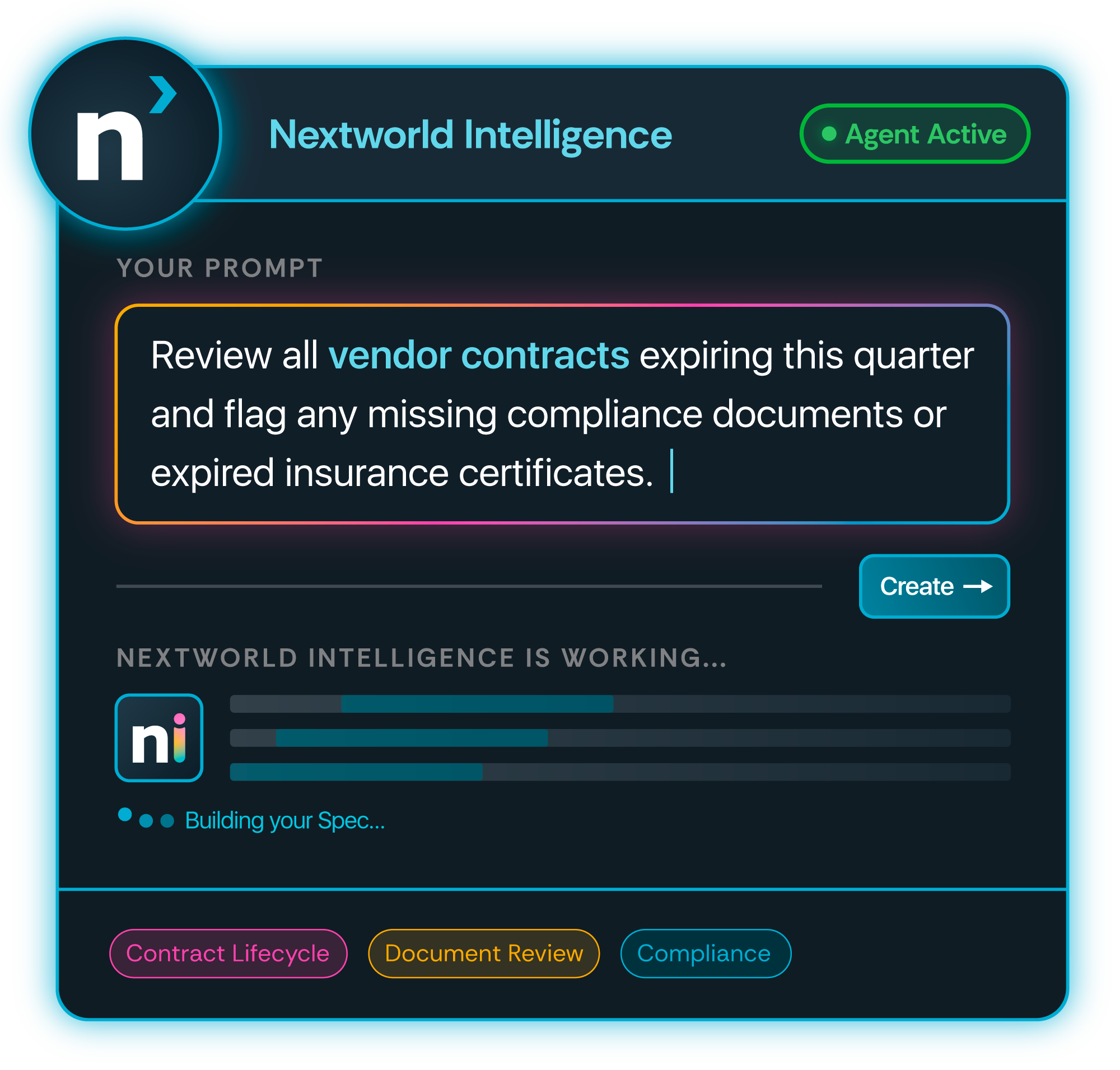
In June 2026, Nextworld announced general availability of Agentic Development. Product-owner agents turn requests into specifications; other agents design, build, and test applications against them. The specification persists as the application changes. It is an attempt to make the requirement itself an asset that can be revised and reused.
At runtime, the platform combines agents with structured workflows. An agent can interpret incoming information; a workflow can route it through defined approvals. Nextworld describes shared access controls, audit trails, and review gates across applications and agents. That distinction matters when a plausible answer needs to become an authorized business action.
Start small. Count everything.
Nextworld announced a $65 million Series F in February 2025, led by the McVaney Investment Partnership. Its route to market includes implementation and software partners; FastClose supplies a financial-reporting partnership. In September 2026, Nextworld announced “Accelerator” placement in Nucleus Research’s low-code application platform matrix.
For an evaluator, the immediate economics are more prosaic. The free tier offers one user, one development environment, 150 monthly AI credits, and 2 GB of storage. Enterprise deployments have custom pricing. AI activity consumes credits, additional usage is metered, and unused credits do not roll over. A trial can test a workflow; an enterprise budget must include integration, implementation, and ongoing consumption.
A practical reading of the evidence suggests starting with one troublesome handoff. Record its elapsed time, exceptions, and repeated entry. Define who can approve what. Then test whether the new application reduces the work. Poor source data or an unresolved argument about process ownership will travel into the new system. Nextworld can give a process a better home. The business still has to agree on the house rules.