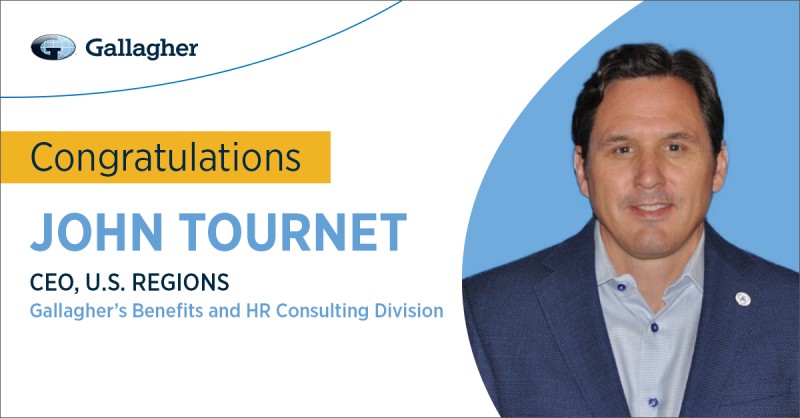
A promotion announcement is a peculiar kind of portrait. It tells you where someone has arrived, usually in a larger font than it uses to explain the work. When John Tournet became CEO, U.S. Regions, of Gallagher’s Benefits and HR Consulting Division in November 2022, the useful detail was in the smaller print: sales, client retention, mergers and acquisitions, and innovation. Four responsibilities, each capable of spoiling the other three if handled badly.
Grow too quickly and service can suffer. Concentrate entirely on keeping existing business and tomorrow’s opportunities may pass by. Buy a firm and the transaction still leaves people to bring together. Introduce technology and someone has to make it useful. Tournet’s appointment put these questions on the same desk. It also gave a national remit to an executive who had spent roughly two decades inside Gallagher.
Based in Charlotte, North Carolina, Tournet now leads the division’s U.S. business. His work concerns the relationship between employers and their employees: the benefits they offer, the advice behind those decisions, and the reasons people choose to remain. For an insurance executive, that makes staying an unusually productive subject.
Before the national title, a long apprenticeship
Tournet attended the University of South Carolina’s Moore School of Business from 1994 to 1998. His career then moved into employee benefits. The sequence of roles is refreshingly comprehensible: account executive, producer, area president, regional president, U.S. CEO. There is enough progression here without improving it with a childhood prophecy.
His early employment included Planned Administrators, Inc., followed by Gallagher in 2002. He subsequently moved through client and production roles before becoming an area president in 2009 and a regional president in 2017. Those titles describe an expanding field of responsibility. They also place his later national appointment in the context of years spent working within the same organization.
The attraction of such a career, from a reader’s point of view, is its accumulated context. Clients, colleagues and operating practices can become familiar over time. That does not automatically make every decision correct. It does mean that the next promotion arrives with a history attached. In Tournet’s case, the national role followed a succession of jobs closer to individual accounts and regional operations.
A regional job, with names attached
In May 2021, Gallagher acquired Garner & Glover, an agency in Rome, Georgia. The announcement placed its continuing operations under Peter Doyle for the region’s property and casualty business and Tournet for employee benefits consulting and brokerage. Matt Sirmans, Chuck Shaw and their associates would continue working from their existing location.
It is a small but revealing piece of the career. Acquisitions are often described through purchase prices and market share. This one also sets out a human arrangement: a continuing local office, existing leaders, and a reporting structure. Tournet’s responsibilities included receiving an established business into a larger organization. The people did not become a spreadsheet merely because ownership changed.
His public congratulations to colleagues give the regional work more texture. When Kevin Murphy was promoted to area president for Georgia and Florida, Tournet praised his humility and his commitment to colleagues, clients and the community. He pointed to Murphy’s work in Georgia and welcomed the extension of that responsibility into Florida.
Elsewhere, he celebrated Sommer Mason, a regional area vice president in HR consulting, for recognition as a 2022 BenefitsPRO Luminary. These are professional messages, written for public view. Their particularity is still useful. He names people, identifies what they have done, and gives their achievements room. The executive title takes up surprisingly little space in those posts.
The CEO appears on the team sheet
A 2023 presentation in the Town of Garner’s council materials lists Tournet as an executive sponsor on a Gallagher consulting team. Alongside his name are 25 years of experience and 20 years with Gallagher. Around him are named consultants with responsibilities including client management, technology and compliance.
That team sheet offers a different view of seniority. A CEO can appear at the top of an organization chart; here he appears within a proposed service arrangement. The title is connected to a function. An executive sponsor provides a point of senior involvement in work that other specialists help deliver. The document does not need a grand statement about leadership to make that structure visible.
It is also a useful check on how to read a long career. Years served are easy to display and harder to interpret. Put beside a specific client team, experience becomes part of an offer to an employer. The question becomes what that organization can do with it. A handsome anniversary number has to earn its place like everyone else.
The employer’s promise needs a measuring stick
Tournet’s public work increasingly addresses how employers judge their own decisions. He coauthored a guide to people analytics with Robby White. Its recommendations include using information specific to an organization, securing leadership support, making data accessible, understanding employee demographics and connecting analysis to business strategy.
The underlying problem is easy to recognize. A dashboard can tell an employer how it compares with other organizations. It cannot, by its mere existence, decide what the employer ought to do next. Tournet and White argue for the harder step of connecting information to action. That requires cooperation among HR, technology and operations leaders, with responsibility for the decisions that follow.
There is a practical modesty to that sequence. An organization needs to know what it is trying to accomplish before admiring the machinery intended to help it. Otherwise the report becomes office furniture: expensive, respectable and largely stationary. Read as a statement of working method, the guide favors decisions that can be examined over impressive piles of information.
His public calendar has also included a wider conversation about leadership. Gallagher promoted him as a speaker for a session called The Power of Joining Forces at the 2025 Corporate Citizenship Conference. The session brought corporate and nonprofit perspectives together around collaboration. It extends the professional picture beyond the immediate business of benefit selection, toward how organizations learn from working across their usual boundaries.
Retention is the result employers can recognize
Gallagher’s employer benchmarking work gives Tournet another way to discuss the employment relationship. The firm’s 2025 Best-in-Class analysis emphasizes practices including career mobility, development, retirement benefits, communication, and the place of inclusion in an organization’s values. These are recurring decisions about what working somewhere will actually feel like.
When conveyor manufacturer Hytrol received Gallagher’s employer recognition, Tournet connected employees feeling valued and supported with retention and business performance. The recognition looked at such matters as planning, employee turnover, engagement surveys and retirement support. The commercial argument is straightforward: the experience of working for a company belongs in the discussion of how well that company operates.
There is a reason this subject suits a profile of Tournet. His own career has unfolded largely within one firm, across changes in scope and responsibility. That does not establish why anyone else stays with an employer. It does give a pleasing symmetry to his present work. An executive with a long institutional history now helps frame the questions employers ask about keeping their people.
“What matters is how technology is applied.”John Tournet, May 2026
A new tool still needs a useful answer
In May 2026, Gallagher introduced AI capabilities within its Benefits & HR Consulting advisory model. Built on the Avante platform, the offering was designed to give employees conversational guidance and help employers examine how their programs were being used. Tournet’s explanation concentrated on application: technology earns attention through the decisions it helps people make.
The proposed experience includes plain language, comparisons and support beyond a single annual decision. Those are stated capabilities and intentions, rather than a record of results. The distinction matters in understanding his role. A national executive can help articulate the direction of an offering without being credited as its inventor or assigned every outcome it might eventually produce.
For Tournet, this adds another item to the original appointment’s list. Innovation sits beside sales, retention and acquisitions. The new tool belongs to the same business problem: how to provide advice people can understand and use. Software has a splendid talent for multiplying options. The more interesting test is whether it makes choosing less laborious.
October’s question: did the benefit help?
By October 14, 2026, Tournet was discussing retirement outcomes as Gallagher released its latest financial benchmarking findings. His comments emphasized plan design, governance and more individualized support. The direction was toward judging what financial benefits accomplish for employees, beyond whether an employer offers them.
This follows his September remarks on workforce pressures, which put effective managers, manageable workloads and a clear connection to organizational goals at the center of the discussion. Taken together, the comments suggest an emphasis on how arrangements work in daily life. The observation is an editorial reading of his public work, rather than a claim about a private philosophy.
Growth plans outpace hiring plans
Tournet’s career has brought him from individual accounts to responsibility across the United States. The scale has changed substantially. The question underneath his recent work remains close enough to ask across a desk: when an employer promises support, can the employee make use of it? Answering that well would give both sides a reason to continue the conversation.