The interesting thing about an employee benefits package is how much of it happens somewhere else. The broker has the proposal. The carrier has the policy. Payroll has the deductions. An employee has a question. Each may be perfectly sensible on its own. The trouble begins when they have to agree.
GIS Benefits has made a business out of that agreement. Based in Morris, Illinois, it works with brokers, carriers, and employers on the practical journey from choosing coverage to keeping it running. The insurance brochure gets the attention. The connections, explanations, and reconciliations get the assignment.
- What it does: connects benefits placement with implementation, education, enrollment, and ongoing operations.
- Who uses it: brokers and carrier partners serving employers, with HR teams and employees on the receiving end.
- What to copy: give the handoffs an owner, and budget attention for what happens after enrollment.
The business hiding between the boxes
There is an appealingly tidy version of benefits: select good coverage, put it on a platform, invite people to enroll. GIS’s service menu suggests a more crowded reality. A proposal must become a configured plan. Enrollment information must reach carriers. Deductions must reach payroll. Someone must answer the employee who cannot decipher the choices.
The company reports 20,000 employer groups and $1.6 billion in ancillary premium on its current homepage. Those figures describe its stated reach and insurance volume. The premium number is not company revenue. It is nevertheless a useful clue to where GIS sits: close to the distribution and operation of coverage, rather than merely selling a software login.
Its customers include brokers who want more service capacity without adding every specialty to their own payroll. Employers need working administration; carriers need workable connections and payments; employees need understandable choices. GIS places itself between these demands. Calling that arrangement a “Benefits Operating Partner” is the company’s current positioning, rather than an independently established industry category.
Six platforms, and somebody to do the work
On its technology page, GIS offers a compact promise: One partner. Six platforms.
The supported names are ADP, Ease, PlanSource, Employee Navigator, Selerix, and bswift. The choice matters. An employer can need help running an existing system just as much as it needs help choosing a new one.
GIS lays out six stages: select, build, deploy, connect, train, maintain. Dedicated platform builders configure the system; an in-house electronic data interchange team handles connections; support staff help brokers, HR, and employees. The sequence is a useful corrective to the notion that implementation ends when the screen looks finished.
Alongside its 2025 connection figure, GIS reports more than 1.7 million connected lives, 1,100 payroll connections, and 700 custom 834 files. The latter are benefits enrollment data files, an unromantic but consequential part of moving information between organizations. These are company-reported figures. Their value here is descriptive: GIS’s technology work involves considerable attention to the pipes.
- 01Select
- 02Build
- 03Deploy
- 04Connect
- 05Train
- 06Maintain
GIS’s published process follows the platform beyond launch.
“No cost” has a guest list
One of the company’s more concrete promises concerns price. Its published technology-support page says platforms can be available at no cost for groups with at least 25 employees and six or more lines of core non-medical coverage placed with its exclusive carrier partners. The same page says most customized platforms are ready for enrollment within 15 business days or less.
Both statements deserve their conditions intact. The price offer depends on group size and insurance placement. The timetable says “most,” and concerns readiness for enrollment. A broker should establish whether the particular group, coverage mix, and implementation fit before building a client promise around either number.
The commercial structure becomes clearer in GIS’s 2024 enrollment brochure. Preferred and Premier packages have different eligibility rules; Preferred Plus specifies a 50/50 split on a minimum of two new heaped-commission worksite products. That is evidence of a commission-linked distribution model. It also explains why “free platform” alone is an inadequate description of the transaction. Technology, insurance, and service are being arranged together.
The price offer depends on group size and insurance placement.THE CONDITION IS PART OF THE OFFER
The paperwork queue gets a product
The workload begins before employees see anything. GIS’s DropQuote targets requests for proposals, quote checking, and client presentations. The company advertises automated RFP generation, AI-assisted scrubbing to catch errors and carrier deviations, and an Employee Navigator API connection that moves quotes toward plan building.
The inputs are familiar office clutter: employee census data, existing contracts, renewal packets, and carrier documents. GIS says the tool structures that material and flags gaps. The practical ambition is to make the analyst’s starting point more useful than a pile of attachments.
Here is the first pressure point GIS itself identifies: quoting can squeeze capacity before the case reaches implementation. Its answer is to automate preparation and checking. That describes a targeted workflow change; it should not be mistaken for proof that every proposal takes seconds or that a human review has become unnecessary.
A phone screen still needs an explanation
Enrollment introduces a different problem. Having access to a plan does not mean understanding it. GIS Communications offers licensed, non-commissioned Benefit Coaches who answer questions and help submit enrollment onsite or by phone. It also provides online meetings, educational materials, employer-specific portals, and onboarding support.
The distinction between placing coverage and explaining it matters. An employer buys a package; an employee must make decisions inside it. A portal can collect those decisions. A conversation can help someone reach them. GIS combines both, rather than assuming that a digital form will carry the entire educational burden.
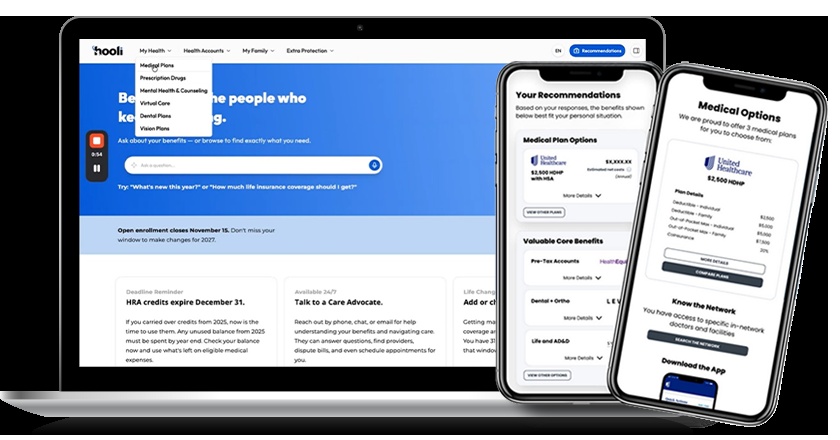
Its current engagement page adds digital guides and microsites under DecideGuide, plan comparisons, network search, and a running cost total. It also advertises an AI assistant that draws cited answers from an employee’s own guide through channels including Slack, Teams, and SMS. The useful detail is the proposed source of the answer: the relevant guide, rather than an answer detached from the employer’s benefits.
The invoice is part of the experience
After enrollment comes a less photogenic test. Do the payroll deductions, benefits records, and carrier invoice match? GIS’s Self Bill Plus service audits deductions against elections and policy, reconciles the records, produces reporting, and prepares a consolidated bill for payment.
This is where the operating-partner description earns practical meaning. A proposal can look splendid while monthly administration remains awkward. GIS identifies partial payments and late remittances as recurring carrier problems. Checking the numbers is a service to the employer and carrier, and a way to protect the broker’s client relationship.
The same attention to boundaries appears in leave support. GIS describes evaluating programs, interviewing carriers, placing coverage, supporting implementation, and connecting payroll with carriers. Its executive-benefits offering addresses gaps in ordinary group coverage with specialized disability, life, long-term care, and key-person options. A 2022 GIS Healthcare brochure extends the educational role to employees considering a transition from employer coverage to Medicare.
A new name for an old assignment
Founder profiles identify Mark Mettille as GIS’s founder and CEO and date the business to 2006. His earlier career included regional sales leadership at MetLife. The company’s older materials emphasized non-medical products, carrier relationships, and simplified administration. Its current language gathers those activities into the operating-partner identity.
That is an observable change in presentation. It places continuing execution at the center of the pitch. The practical alternative for a broker is to build this capacity internally or assemble separate providers for quoting, technology, enrollment, and service. GIS proposes one relationship across much of that work, while still using multiple platforms and carriers.
The lesson a reader can borrow is modest and useful: map the journey after a benefit is selected, then identify who owns each transition. For a small team, external support may supply missing skills. For an organization with mature internal operations, the value will depend on where duplication can be avoided. And an employer outside the published no-cost criteria needs different commercial terms.
GIS’s paid internship materials offer a fitting last detail. Interns encounter sales, account management, customer service, and the sales cycle from start to finish. Even the training crosses the organizational boundaries. Benefits may arrive in separate boxes. Somebody still has to make the contents fit.
Visit GIS Benefits, follow the company on LinkedIn, or explore GIS Communications.
See DropQuote and its embedded product demonstration, the digital-guide experience, and Self Bill Plus.