Alex Cyriac was helping his mother reckon with health costs that Medicare did not neatly erase. His friend Shobin Uralil, newly a father, was looking at medical bills from the other end of a family’s life. The two problems had a common shape: you could have coverage, behave responsibly, and still discover that paying for care demanded a second education. The question they carried into Lively in 2016 was less glamorous than most Silicon Valley pitches. Why was the account meant to help so awkward to use?
- Lively began with a portable health savings account for people with qualifying health coverage.
- It now runs HSA, FSA, HRA, lifestyle, commuter, medical travel, COBRA and direct-bill benefits for employers and their workers.
- The company says its HSA platform holds more than $2.5 billion for over 500,000 account holders.
- Its best practical lesson: watch what happens after enrollment, when someone actually needs to use the benefit.
A health savings account, or HSA, sounds simple. Eligible people put money aside, receive tax advantages, and spend it on qualified medical expenses. The account belongs to the person, so it can travel across jobs. But a good rulebook is not the same thing as a good afternoon at the pharmacy. Someone must move money in, remember what is eligible, save the receipt, understand a declined card, and decide whether to leave funds in cash or invest them. Employers must get contributions and records right. Lively made that paperwork its product.
The first thousand calls
Cyriac says he and Uralil spoke with more than 1,000 early account holders, plus prospective customers who called their information line. That is an unusually laborious way to discover the interface of a financial account. It also gives the origin story a useful correction: the thing that failed first was not the tax benefit. It was the experience wrapped around it. An account could be valuable and still feel like a filing cabinet with a debit card attached.

The first version answered the small questions. An individual could open an account online without a minimum opening balance or monthly maintenance fee, use a debit card, track transactions, store receipts and transfer an old HSA. Employers got a dashboard for enrollment and contributions. Optional investing gave the account a second life as a way to prepare for future care, through a self-directed Charles Schwab brokerage account or a guided Devenir portfolio. These choices did not repeal the complexity of American health care. They put fewer errands between a person and their own money.
Then the receipt met the HR department
The consumer HSA was an opening move, not the final map. Employers also administer flexible spending accounts, reimbursement arrangements, commuter benefits and continuation coverage. Each has its own rules, files and anxious questions. By 2021, Lively was pushing further into business customers and financial institutions. That year it announced an $80 million Series C led by B Capital Group, with Telstra Ventures and Costanoa Ventures participating. Total funding rose above $120 million. The money bought room to hire, build and distribute; it did not make plan rules any less fussy.
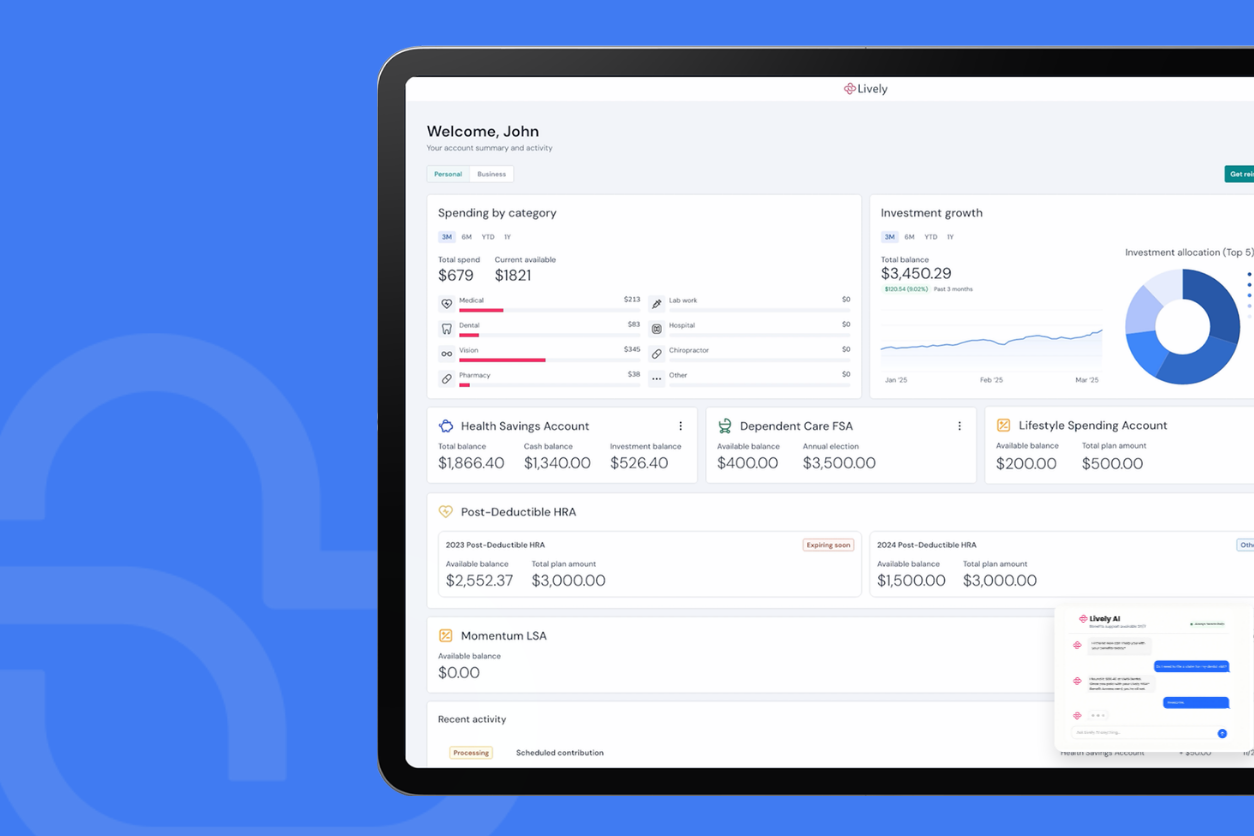
The expansion is visible in the current catalog. An FSA helps with eligible health or dependent-care expenses. An HRA lets an employer configure reimbursable costs. Lifestyle accounts follow a company’s chosen rules; commuter and medical travel accounts address other categories of spending. COBRA and direct bill deal with coverage after a change in employment or payment status. A single employee might encounter several of these in one year. Lively’s answer is one app, one administrator dashboard and, for eligible card-based benefits, one card that can route a purchase to the appropriate balance.
That last step is the real test. A dashboard can look serene while a failed enrollment file, a missing receipt or a reimbursement delay sends a worker back to HR. Lively’s employer pitch now includes file tools that identify errors inside the dashboard, connections to payroll and benefits systems, and transition support when a company switches providers midyear. The company says a single product can launch in as few as 30 days and a bundle in 60. Those are vendor claims, but they point to the dull work on which a benefits switch succeeds or stalls.
Free, with a footnote worth reading
Lively’s price is part of its argument. The published individual HSA has no monthly maintenance, opening, closing or transfer fee. That does not mean every possible feature is free. Access to the Schwab brokerage option costs $24 a year unless the account meets a $3,000 cash-balance threshold; the guided Devenir portfolio carries an annual fee of 0.50% of invested assets. Other investment costs may apply. The detail matters because a saver choosing between cash and investments should be able to see the price before making the choice.
For a small employer, the $200 monthly minimum is material. For a larger one, the question is less the sticker price than the time spent cleaning enrollment files, answering the same questions and reconciling vendors. Lively has not published enough about every product contract to reduce its whole business to one rate card. Its broad model is clear enough: bring in individuals with an accessible HSA, sell administration to organizations, offer optional investment paths, and provide co-branded technology to partners. BMO, for example, uses a Lively-powered HSA in its banking offer. A bank gets a health account without having to build the full experience itself.
A platform is a promise made in boring moments
Lively calls its shared infrastructure Axis. It says balances, plan rules, claims and support live in one system it built and owns. Its 2026 release adds an AI Benefits Assistant that can answer questions and carry out some account tasks. That makes it part of a crowded market of HSA custodians, benefits administrators and payroll-connected software, including HealthEquity, Optum Financial, Fidelity and WEX. Lively’s distinction is the attempt to make several benefit types behave as one product, with human support still available when the software reaches its limits.
Scale gives that claim some weight, though it is worth keeping the dates on the numbers. Lively reported more than $2 billion in HSA assets in May 2025, along with more than $5 billion in funds processed and over $32 million in fees saved by account holders. Its current HSA page puts assets above $2.5 billion and account holders above 500,000. In August 2026 the company announced its third straight appearance on the Inc. 5000. None of those figures proves that every reimbursement is effortless. They show that the experiment has passed well beyond a tidy startup demo.
The copyable idea is almost embarrassingly plain: study the task that arrives after the sale. For Lively it was not opening an HSA; it was what happened when a card was declined, a receipt disappeared, a worker changed jobs or an HR manager found one wrong cell in a file. The lesson applies to any service that looks complete at signup and reveals itself only in use. Of course, a shared platform makes sense only if the accounts and rules can truly be maintained together. A company with a single benefit and no administrative burden may find a specialist simpler. Lively’s larger bet depends on the messy employer who has neither that luxury nor the appetite to become an expert in benefit plumbing.
The founders began with bills arriving at home. The company they built now works in the space between household anxiety and corporate process. That may be the right place to judge it. The impressive moment is not when a benefits page looks easy. It is when a person pays for care and, for once, has no story to tell about the account.