A benefit can be generous and still be strangely difficult to collect. Consider the familiar office ritual: an employee buys a gym class or a desk chair, locates a receipt, opens a form, guesses which expense code applies, and waits. Somewhere else, a payroll specialist decides whether the claim fits a policy written for another year. The money is real. So is the trouble of getting to it.
Tripadvisor lived with a version of this problem. Its wellness allowance sat beside a travel stipend and office equipment budgets, each with its own rules and paperwork. Outside the United States, employees submitted claims that staff handled manually across 15 countries. The arrangement had once been manageable. As the workforce spread, the administration became the perk's most reliable user.
The short version
- Forma lets employers design flexible spending accounts, then handles access, payments, claims and reporting.
- Tripadvisor gathered existing benefit budgets into a global lifestyle account, without asking for a new program budget.
- Tripadvisor reports that utilization rose from 70% in year one to 90%; that is its result, not a general forecast.
- The useful lesson is to map the money and the rules before choosing the software.
Where the budget was hiding
Patti Petrella, Tripadvisor's senior director of global benefits, had a difficult sales pitch to make. A more flexible account sounded appealing, but Finance did not want another open-ended expense. Her response was to look for money the company was already spending. Wellness dollars from a medical carrier, office equipment allowances and parts of real estate budgets could be redirected into one lifestyle spending account, or LSA. Payroll and HR had another contribution to the case: the hours they were spending on receipts.
This is the point at which Forma enters the story. The company sells a platform on which an employer can specify who qualifies, how much money appears in an account, which categories are eligible and how rules differ by location. Employees can use the Forma Store, pay with the Forma Card or submit a reimbursement claim. Administrators get a view of budgets, spending and approvals. A benefit no longer needs a separate vendor and login for every new idea.
“Finally, it was like, we couldn’t do it anymore.”Patti Petrella, on Tripadvisor's manual reimbursements
The cost question has two answers. Tripadvisor says it found the program budget in existing allocations, so the launch did not require a fresh benefits budget. Forma itself charges employers under contracts that can use a per-employee or per-member monthly rate; its public terms do not publish a standard price. Employers also fund the underlying purchases. A $600 allowance is therefore a promise of available money, while actual spending depends on use. Platform fees, taxes and account design still belong in the calculation.
The account became a policy
Tripadvisor's LSA was deliberately broad. The company says eligible employees can spend on a range of needs, and even use a purchase for a family member if the employee makes it. Part-time workers were included. But broad did not mean identical everywhere. Australia received a different funding level to accommodate medical reimbursements; in Canada, transit passes were eligible. One interface could hold several local decisions.
The program kept changing after launch. Anniversary rewards now let employees with 10, 15 or 20 years of service spend on travel. Tripadvisor also put a UK travel insurance wallet and its US health savings account on Forma. Its benefits team began asking a productive question of every separate vendor: could this be easier to run and easier to find in the same place?
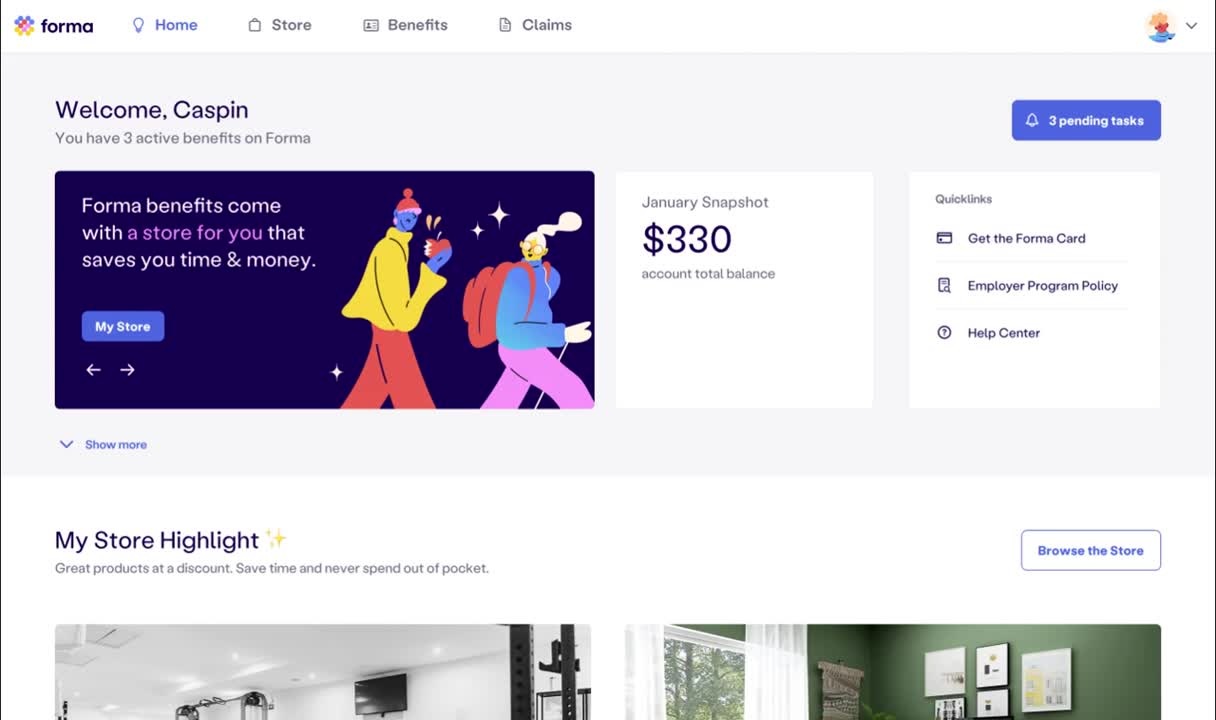
Forma's unusual position is between several markets. It is benefits software for HR, a payment and claims experience for employees, and a way for companies to distribute funded allowances. It handles post-tax lifestyle accounts alongside tax-advantaged HSAs, FSAs, HRAs and commuter plans. That breadth helps explain the customer list: a technology company such as Zoom, a retailer such as New Balance and a global travel business have different workforces but similar problems with scattered programs.
The company began in 2017 as Twic, founded by Jason Fan and Max Hsieh. By its March 2022 Series B announcement, it had adopted the Forma name and raised $40 million led by Ribbit Capital. At that time it reported more than 125 company customers, fourfold revenue growth over the previous year and a 330% increase in its customer base. Those are dated company claims, useful as a snapshot rather than a description of its present size.
Choice has an operations department
Competitors can sell a wellness stipend, a reimbursement tool, a pre-tax account or a recognition system. Forma's pitch is that an employer can put several of those jobs under one roof. The difference is less theatrical than it sounds. It is an eligibility rule that survives a move to another country; a claim that does not need a payroll analyst to decipher it; a dashboard that shows whether money is being used. Software makes choice visible, but the employer still chooses what counts.
That last distinction matters. A broad account can make a workforce feel included, but tax treatment, local law and company priorities set boundaries. A US HSA is not interchangeable with a post-tax LSA. A transit benefit in Canada may need different terms from one in Australia. Forma's 2026 benchmark, based on 300 employers and nearly one million employees across more than 110 countries, found that half the employers with LSAs now offer them in multiple countries. That makes local design a routine job, not an edge case.
Forma is also expanding the idea of what can sit in the account. It launched Rewards & Recognition in 2025, allowing appreciation and monetary awards to connect with the benefits experience. One customer, UKG, uses a group of purpose-built wallets for well-being, tuition, fertility and other needs across a workforce in 21 countries. The pattern is clear: instead of one enormous pot with vague rules, employers are often choosing several accounts with specific purposes.
Find allowances, vendor fees and staff hours hiding in separate departments.
Decide eligibility, funding, tax treatment and local exceptions.
Watch actual use and claims, then revise the account rather than guessing.
The useful part to steal
Tripadvisor's example is a sequence, not a promise of 90% utilization for everyone. First, its benefits chief counted manual work. Next, she assembled money already assigned to adjacent purposes. Then she won support from Payroll, HR, Recruiting, Legal and Finance. Only after that did the single account become a credible substitute for the old arrangement. The platform simplified execution, but the argument was made in a spreadsheet before it reached an app.
A company with no fragmented budgets, no employee appetite for wider choice or strict rules that leave little room for eligible spending might see a smaller gain. So would a team that moves old allowances into a new interface without revisiting the policy. Flexible accounts work when the rules reflect real lives and someone watches what employees actually use.
Forma's achievement is to make that work look less like work. It cannot decide whether an anniversary trip, a standing desk or a caregiver expense belongs in a company's idea of fairness. It can give the decision a place to live, a way to be spent and a number that tells the employer whether the decision mattered. That is a more modest promise than reinventing benefits. It may also be the more useful one.