Rick McKenney began his career in a manufacturing management program. The year was 1991, the company was General Electric, and his degree was in mechanical engineering. Thirty-five years later, he runs an insurer. The distance between those two jobs looks considerable until you consider what each requires: a system that works when somebody depends on it.
Insurance has an awkward relationship with storytelling. Its central achievement often takes place long after the sale, far from the person who approved the budget. A promise made in one year has to be funded in another. The paperwork is abundant. Applause tends to be scarce. For an executive, that creates a particular test: can the organization remain dependable after the excitement of a new plan has worn off?
McKenney’s route into that work began in Maine. A native of Eliot, he attended Marshwood High School, where he was a multi-sport athlete and the valedictorian of the class of 1987. At Tufts University, he studied mechanical engineering and graduated summa cum laude. The early record contains both team sports and academic distinction, a combination that makes his later move between operations and finance easier to follow.
His first employer offered room for both. At GE, McKenney moved from manufacturing into financial leadership. He joined GE Financial Assurance in 1996 and became its chief financial officer in 2002. By then, the engineering graduate was responsible for a different set of calculations. Capital, earnings, and risk had become the components on his desk.
- 1991Joins GE’s manufacturing management program
- 1996Moves to GE Financial Assurance
- 2002Becomes CFO of GE Financial Assurance
- 2004Becomes Genworth CFO during its IPO from GE
- 2007Becomes Sun Life Financial CFO
- 2009Joins Unum; becomes executive vice president and CFO
- 2015Becomes president in April and CEO in May
- 2017Joins the U.S. Bancorp board in October
The long way to the corner office
In 2004, McKenney became CFO of Genworth Financial as part of the team that took the business public from GE. That is a useful detail in a career that can otherwise read like a procession of initials. An initial public offering puts a company’s finances before a new audience. The executive helping carry it out must understand the business and explain it to people being asked to own a piece of it.
He later moved to Sun Life Financial in Toronto, serving as executive vice president before becoming CFO in 2007. Unum announced his appointment in June 2009. Its announcement made a point of his operational experience as well as his financial record. Thomas Watjen, then chief executive, was hiring someone whose career had already crossed the boundary between running things and accounting for them.
At Unum, the CFO remit extended across treasury, investments, strategic planning, acquisitions, investor relations, and enterprise risk. McKenney also chaired the Operating Committee overseeing business operations in the United States and United Kingdom. The title on the business card was compact; the list underneath it was less considerate.
This mattered when the succession came. McKenney had spent years inside the company’s financial and operating decisions before taking responsibility for the whole enterprise. His promotion followed an established leadership development process. It was a handover with several moving parts, including a new CFO and a continuing role for the outgoing chief executive.
Two dates, one handover
The transition happened in stages. McKenney became president and joined the board on April 1, 2015. He became CEO at the annual meeting in May. Watjen moved into the non-executive chairman’s role, while Jack McGarry succeeded McKenney as CFO. There was continuity in the arrangement, and a visible effort to preserve experience as responsibilities changed.
Asked about the prospect of taking over, McKenney said, “I’ve got some big shoes to fill.” It was a modest answer to a large promotion. Watjen had led the company since 2003. McKenney would inherit both an operating business and relationships built over many years, with employees, customers, intermediaries, and investors all watching the transition.
At his first annual meeting as CEO in 2016, he emphasized the opportunity to extend financial protection to more workers. Unum had paid $6.8 billion in benefits in 2015, with sales and premium each up 5 percent. Those figures belonged to the company and its workforce, rather than to any individual victory lap. They also gave the new chief executive a concrete starting point.
By the time Watjen retired from the board in 2017, McKenney had been CEO for two years. He publicly credited his predecessor’s vision. Such acknowledgments can sound ceremonial, but here the dates give them substance: the departing leader had stayed through the handover. McKenney’s first chapter in charge had included the person whose work he was being asked to continue.
A promise made in one year has to be funded in another.The arithmetic behind the job
The people inside the system
The financial record explains how McKenney reached the job. His public comments about employees offer another view of how he approaches it. In a 2020 conversation about remote work, he urged managers to make room for contributions from people beyond their familiar circle. His advice included giving everybody access to meeting materials and a way to join the discussion. Even an ordinary phone call had a place.
There is something pleasingly practical about that list. A manager can announce a culture of participation in a magnificent presentation and still forget to invite somebody to speak. McKenney’s examples brought the problem down to the level where it happens: a meeting, a shared document, a colleague who needs an opening. Participation has administrative requirements.
His public activity also includes town halls in Portland, Chattanooga, and Columbia, alongside colleagues joining virtually. In a separate post, he described signing the Employer Support for Guard and Reserve pledge in support of Unum’s military and veteran employee network, weSERVE. Both activities put him in contact with groups whose working experiences differ.
That attention to conduct appears in the less glamorous parts of corporate life, too. In a 2022 interview, Unum’s compliance and ethics chief, Beth Simon, described McKenney encouraging staff to complete mandatory compliance training. Nobody is likely to commission a bronze statue of an annual training reminder. Yet those routines are among the ways a chief executive makes expectations visible.
The distinction matters in a financial business. Values have to survive the trip from a statement to a decision. Training, access to leaders, and opportunities to contribute are mechanisms for making that trip. McKenney’s public record offers examples of those mechanisms, without requiring a reader to turn them into a personality test.
A bank board, an airport, and a holiday tree
His responsibilities extend beyond Unum. McKenney joined the U.S. Bancorp board in October 2017. He now chairs its Governance Committee and serves on its Compensation and Human Resources and Executive committees. Banking adds another setting in which his experience with capital, regulation, and corporate oversight is relevant.
An Engage biography also lists board service with the American Council of Life Insurers and the Chattanooga Metropolitan Airport Authority. The combination places him in national industry discussions and the civic infrastructure of his adopted city. Chattanooga is where he is based; the organizations around his work reach considerably further.
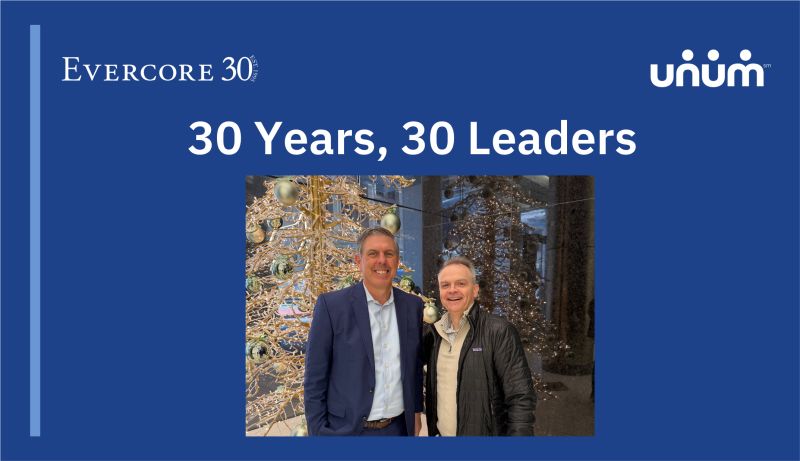
A photograph shared through his LinkedIn account supplies a lighter image of those professional connections. At an Evercore gathering celebrating its thirtieth anniversary, McKenney appears with Tom Gallagher beside a decorated holiday tree. McKenney’s accompanying message congratulated the team and thanked it for the recognition. Even institutional finance occasionally finds a reason to stand next to the ornaments.
The picture is a small counterpoint to the formal biography. Much of a chief executive’s public life is conveyed through titles, committee names, and quarterly remarks. Here there are two people at a gathering, marking an ongoing business relationship. The work has a social geography as well as an organizational chart.
Making a promise easier to keep
More recently, McKenney has been describing the connections between Unum and its customers in technological terms. At the September 2026 KBW Insurance Conference, he said about 70 percent of the U.S. business had some form of digital connection added since 2023. He linked those connections to customer retention and the company’s ability to deliver its services.
The engineering parallel becomes useful again here. A connection between systems is easy to overlook when it functions. When it fails, somebody has to supply the missing information, repeat a task, or find another route. For a benefits company working with employers and intermediaries, reducing that friction is a business proposition with fairly ordinary human consequences: less chasing, less repetition, more time.
Unum’s 2025 annual report puts the scale around that work at more than 178,000 employers and nearly 11,000 colleagues, with over $8 billion in benefits paid during the year. These are company measures, not a score for one executive. They describe the number of relationships and obligations that sit behind the CEO title.
Company figures for 2025. Rounded as reported.
McKenney has continued to work through leadership changes as well. In April 2026, Unum announced Steve Jones as the next president of Colonial Life, succeeding Tim Arnold following a 41-year career with the group. Jones would report to McKenney. Another handover, another occasion to carry experience forward while giving someone new responsibility.
His stated capital priorities have remained recognizable: invest in the existing business, consider selective acquisitions that add capabilities, and return capital to shareholders. That ordering connects the former CFO to the current chief executive. The available money has several competing uses, and choosing among them is part of the job.
The path from GE to Chattanooga has taken McKenney through several versions of the same responsibility: engineering, manufacturing, financial management, operating oversight, leadership. The enduring question is practical. Can an organization keep doing what people have been told they can expect from it? After decades of changing responsibilities, that remains a task an engineer can recognize.