The trouble with the prairie was that it would not let go. Illinois farmers dragged cast-iron plows through sticky soil, stopped, scraped them clean, and started again. The land was fertile. The interruption was expensive. In 1837, a blacksmith named John Deere made a plow designed to shed that soil. His company’s origin story begins with a broken sawmill blade. Its subject is wasted time.
- The job: equip farms, building sites, forests, and lawns.
- The bet: sell precision alongside horsepower.
- The catch: savings must cover equipment, software, and support.
Nearly two centuries later, the green machines face a more selective task. A field contains crops, weeds, and plenty of space that does not need the same treatment. Deere’s See & Spray uses cameras and machine learning to decide where to apply herbicide. Once, the machine had to learn how to pass through the earth. Now it has to decide what to leave alone.
The trouble was the stopping
The early plow’s achievement was practical: fewer stops to scrape. Deere’s own history also makes room for a less tidy detail. Smithsonian testing of an 1838 plow found wrought iron as well as steel. The familiar steel-plow story compresses a mixture of materials and design into one memorable object. What mattered to the farmer was whether the thing worked.
That distinction helps explain a later decision. Deere did not begin as a tractor company. Before 1918, it experimented with tractors while its president, William Butterworth, had misgivings about manufacturing them. Then the company bought Waterloo Gasoline Engine Company for $2.25 million. Its archives preserve the final $2.1 million check. Buying working expertise became part of the company’s repertoire.
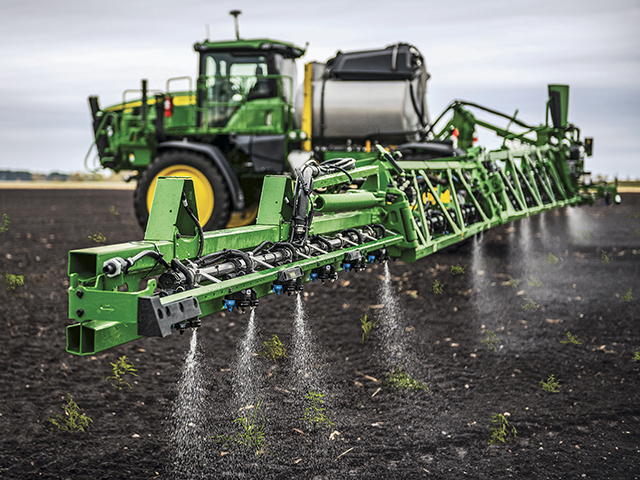
A machine that knows when to hold back
In 2017, Deere paid $305 million for Blue River Technology, a business working on machines that could recognize plants. In 2021, it paid $250 million for Bear Flag Robotics, whose technology enabled autonomous tractor work. Those purchases bought capabilities with immediate relevance to farming: identify a target, move through a field, perform a job.
The reported spraying results are substantial. Deere says customers used See & Spray across more than five million acres in 2025, reducing non-residual herbicide use by nearly 50% on average and saving nearly 31 million gallons of herbicide mix. That last word matters. The volume includes the application mixture; it does not mean 31 million gallons of concentrated chemical.
Nearly 50% less non-residual herbicide on average. Field results vary.
The comparison also has boundaries. It concerns non-residual herbicide, rather than every chemical a farmer applies. Weed pressure, crop canopy, and field conditions affect the result. Model year 2027 brings See & Spray Gen 2, with upgraded cameras and additional supported crops. Each expansion has to make the system useful in another real farming situation.
The dealer comes with the idea
Deere serves grain growers, livestock producers, contractors, forestry operators, landscapers, golf courses, and homeowners. Its expertise joins engines and hydraulics to agronomy, guidance, machine vision, and service. Tractors and harvesters share a corporate portfolio with excavators, commercial mowers, Gator utility vehicles, and roadbuilding equipment. John Deere Financial helps customers and dealers finance equipment.
There is a commercial logic to that breadth. A farmer can buy the machine, finance it, obtain parts, install precision upgrades, and ask a local dealer for help. Deere’s free Operations Center account organizes machine and field information. Paid capabilities sit alongside it: Gen 2 in-crop spraying requires a renewable software license, while targeted fallow spraying has no additional software charge.
Alternatives include CNH’s Case IH and New Holland, AGCO’s brands, CLAAS, and Kubota. Deere competes through the combination of equipment, technology, financing, and dealer support. The comparison is local as well as technical: a nearby service team can matter considerably when the weather leaves a narrow working window.
A camera earns its place on the boom when the farmer’s arithmetic works.THE BUYER’S TEST
For an operator, the entry point can be modest. Create an Operations Center account, gather compatible machine data, and choose which advisers or dealers can see it. Deere’s documentation allows data from supported equipment beyond its own brand. The practical benefit is a shared view of the work already happening.
The machine needs permission, too
Support becomes contentious when customers cannot choose who repairs their equipment. In January 2025, the FTC sued Deere over alleged restrictions on electronic repair tools. Deere disputed wrongdoing. In July 2026, the agency and five states announced a settlement and filed a proposed order requiring equivalent dealer repair resources on fair and reasonable terms for ten years.
A separate proposed private settlement includes $99 million in cash. As of October 22, 2026, its final approval hearing was scheduled for January 2027. These agreements address access to the tools behind the machinery. They also expose a weakness in an otherwise attractive connected system: a stopped tractor can turn dependence on software into dependence on someone else’s timetable.
Count the hours you get back
Deere’s autonomy announcements at CES 2025 covered tillage, orchard spraying, quarry hauling, and commercial mowing. Repetition runs through the list. “Autonomy can help address this challenge,” CTO Jahmy Hindman said of scarce skilled labor. The Starlink partnership tackles a related obstacle: connected services need a workable connection, including in places terrestrial networks serve poorly.
There is a sensible order to evaluating that promise. Start with the task and its bottleneck, then check the machine and field requirements. A technology demonstration shows that a job can be automated. A purchase decision requires knowing how often that job occurs and what happens when something interrupts it.
Inputs saved + useful hours recovered−Equipment premium + licenses + running costs
Compare over the same ownership period. Count only savings your operation can realize.The economics remain unforgiving. Too few acres, limited avoidable chemical spending, or an unsuitable crop can weaken the case for targeted spraying. Even Deere’s scale offers no immunity from customers’ purchasing cycles. Fiscal 2025 sales and revenues fell 12% to $45.684 billion; third-quarter 2026 revenues subsequently rose 5% from a year earlier.
A buyer can ask for a field demonstration, a complete equipment and license quote, and a support plan before making the calculation. Savings in a company’s customer average are a starting point. The relevant comparison uses the buyer’s acreage, existing machinery, chemical program, and ability to keep the equipment working.
The useful lesson for anyone building a product is concrete. Watch where the customer stops. Measure what that interruption costs. Fit the solution into the work, then make it serviceable. Deere’s published purpose is “We run so life can leap forward.” On a farm, progress can be measured more simply: the work gets done before the rain.