The neighbor’s farm
Eric Hansotia’s route to running a farm-equipment company began on somebody else’s farm. Growing up in central Wisconsin, he worked for a neighboring dairy farmer, a person he would later single out as an early influence on his understanding of agriculture. There were youth projects, too: 4-H, FFA and the Wisconsin Junior Dairymen’s Association. Long before the board appointments and earnings calls, farming supplied both the work and the people worth learning from.
That distinction matters to the story he tells about himself. The neighbor taught him the industry; his FFA adviser helped teach him leadership. When Hansotia described those influences in 2019, he gave each a place in his development. The practical education and the experience of organizing people arrived together. His later career would require both, often in the same conversation.
Now chairman, president and chief executive of AGCO, Hansotia oversees a business whose brands include Fendt, Massey Ferguson, Valtra and PTx. Its machinery works across continents. Yet one of the more revealing ideas associated with his tenure concerns equipment that is already sitting in a farmer’s yard. Can you give an existing machine useful new capabilities without insisting that its owner replace the whole thing? It is an engineer’s question with a farmer’s purchasing decision attached.
A degree with room for detours
At the University of Wisconsin-Madison, Hansotia studied mechanical engineering, completing his bachelor’s degree in 1991 and his master’s in 1992. Five John Deere internships gave the academic work an industrial counterpart. He added an MBA at the University of Iowa in 1998. The sequence provided a durable combination: how a machine works, how a business works, and opportunities to discover where the two can disagree.
His Wisconsin years also included teaching skiing with Hoofers and competing in Formula SAE, the collegiate challenge of designing, building and racing a small open-wheel car. Alongside engineering, he took classes beyond his principal subject. A student who can discuss a drivetrain and coax another student down a slope has at least encountered two different kinds of resistance.
Returning to address Wisconsin business students in 2022, Hansotia made breadth a central part of his advice. Expertise mattered, but so did having enough experience outside a specialty to approach a problem from several directions. It is a useful clue to his career: he kept moving among functions that a large manufacturer might otherwise place in separate boxes.
“It helped me learn how things work.”Eric Hansotia on his engineering education
Twenty years, then a different badge
Hansotia spent 20 years at Deere before joining AGCO in 2013. His responsibilities ranged across engineering, quality, advanced technology, manufacturing and product management. A posting in Mannheim, Germany, formed part of that international career. Agriculture remained the subject; the scale of the questions changed.
At AGCO, he initially led global harvesting and advanced technology solutions, then took responsibility for the global crop cycle and Fuse Connected Services. He became chief operating officer in January 2019. That role brought regional commercial operations together with product management, engineering, manufacturing and supply chain oversight. He succeeded Martin Richenhagen as chairman, president and CEO on January 1, 2021.
He had already explained why AGCO maintained several equipment brands: different farmers wanted different combinations of machinery, support and buying experience. His argument was about matching those requirements rather than stretching one badge across every customer. For an engineer accustomed to specifications, it was a commercial version of a familiar discipline: establish what the user needs before declaring the design finished.
The combine and the missing chip
One project gave Hansotia an unusually tangible measure of that complexity. Reflecting on his career in 2023, he described the opportunity to develop a combine from a clean sheet. It became AGCO’s largest new-product development project to that point. His inventory of the machine included 10,000 parts and 43 computers. The project received a Red Dot: Best of the Best design award.
A combine is a useful corrective to the idea that agricultural technology is simply a screen added to an old mechanical business. The electronics and the hardware must perform together, in working conditions that keep changing. Hansotia’s enthusiasm for the project lay in applying that engineering effort to farmers’ problems. In 2023, Wisconsin recognized his career with its Mechanical Engineering Distinguished Achievement Award.
The same dependence on electronics could produce rather less agreeable arithmetic. In a March 2023 interview, Hansotia recalled a batch of semiconductor chips costing $1,400 each when the usual price was $10 to $20. AGCO paid to keep machines moving through production. A very small component could hold a very large product hostage. Farm machinery had joined the digital economy, including its least charming procurement experiences.
Autonomy, one task at a time
Hansotia’s descriptions of automation have often been more granular than the familiar image of an empty tractor cab. In 2023, he discussed a list of roughly 150 machine functions AGCO was working to automate. The approach was to let equipment sense changing conditions, calculate adjustments and take over particular tasks when the operator chose.
He had made the same distinction in 2022: steering assistance left plenty for the person in the cab to do. Operators still adjusted equipment, connected implements and moved between fields. Automating those activities could bring benefits before the entire job became driverless. It also widened the potential audience beyond farms ready to hand a whole operation to an autonomous system.
At a 2023 demonstration on the Bolinger family’s farm in Pembroke, Kentucky, AGCO showed autonomous grain-cart and baling systems as well as precision spraying technology. Retrofit kits were central to the presentation. Existing equipment, including competing brands, offered a route for new technology to reach farms. In this version of agricultural progress, the old machine gets another chapter.
A $2 billion way into somebody else’s tractor
The strategy acquired a larger corporate form in April 2024, when AGCO and Trimble completed the transaction creating PTx Trimble. AGCO took an 85 percent stake; Trimble retained 15 percent. The venture combined Trimble’s precision-agriculture business with AGCO’s JCA Technologies. The announced purchase price for AGCO’s stake was $2 billion.
Hansotia described the ambition in terms of access: farmers should be able to obtain precision tools regardless of the tractor and implement brands they operated. Guidance, autonomy, precision spraying and connected farming all sat within the offering. A mixed fleet became a customer to serve, with factory-installed equipment and retrofits both part of the plan.
That decision changed the company’s boundaries in another way. In November 2024, AGCO sold the majority of its Grain & Protein business to American Industrial Partners in a transaction valued at about $700 million. Hansotia framed the sale as part of concentrating the portfolio on agricultural machinery and precision technology. Buying capabilities and selling businesses were two sides of the same effort to decide what AGCO should become.
The part still has to arrive
A technology strategy has an awkwardly physical test: the farmer’s machine must keep working. In 2021, Hansotia described planting windows that could last only four to ten days. Remote monitoring offered a way to spot trouble earlier. Support crews and replacement parts supplied the other half of the answer.
He also recalled receiving a message from a farmer after AGCO staff traveled a long distance with a needed part and got the machine running again. The anecdote is modest beside a corporate acquisition, but its unit of success is clear. Work resumed. The customer had something more useful than a sympathetic explanation.
FarmerCore, launched in January 2024, put that service question into AGCO’s distribution strategy. Working with dealers, the initiative brought mobile sales and service closer to the farm and connected them with digital tools. Physical dealerships remained anchors. Online research and on-farm support were intended to let farmers handle more of the ownership experience on their own terms. Even a sophisticated machine occasionally requires somebody to turn up.
The cycle refuses to read the strategy
The business has supplied a stern test of Hansotia’s plans. AGCO reported 2025 sales of $10.082 billion, down 13.5 percent from 2024. Its second-quarter 2026 sales were about $2.6 billion, down 1 percent from a year earlier. In July, management reduced its full-year outlook as equipment buyers remained cautious.
Hansotia pointed to input costs, uncertain demand and uneven crop economics. The response included aligning production with retail sales, managing dealer inventories and controlling expenses. Those are consequential decisions for a manufacturer and its workforce. Precision technology can address operating problems; it cannot compel customers to make a capital purchase.
The tension gives his tenure its unfinished quality. He is trying to expand the usefulness of AGCO’s technology while managing a business tied to the willingness and ability of farmers to invest. The appeal of upgrading an existing machine is easy to understand in that setting. Whether the strategy delivers its intended results remains a matter for customers, execution and the next turns of the equipment cycle.
Member number 1,000 has a reading list
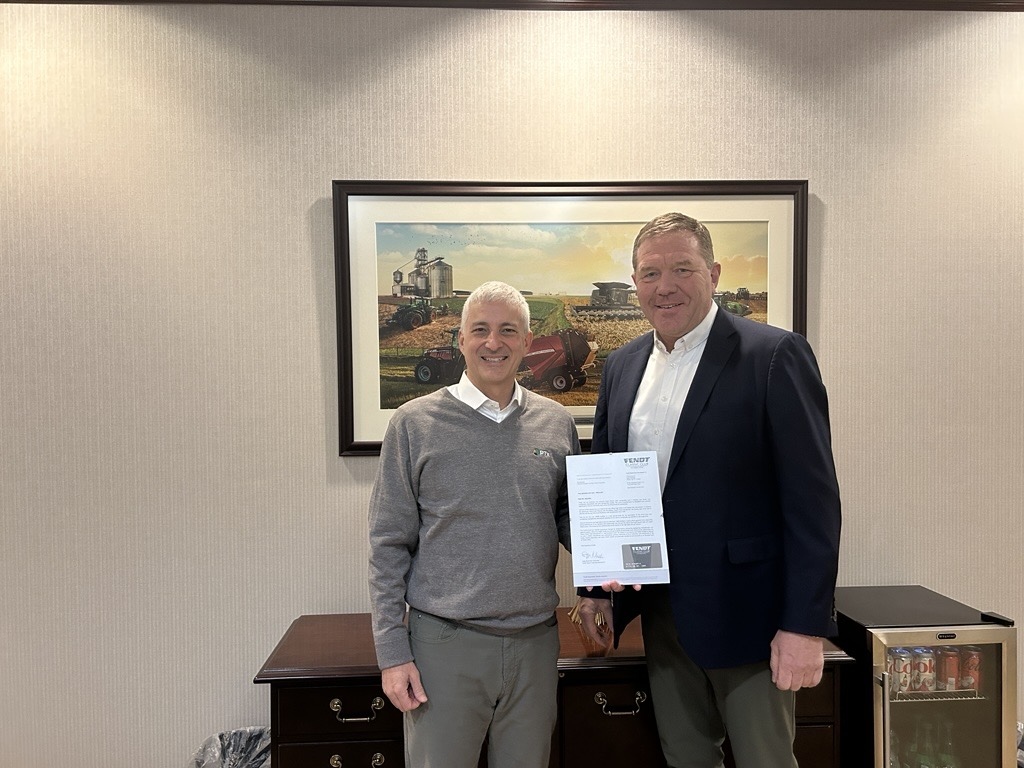
There is another register to Hansotia’s public life. In early February 2026, Fendt’s Christoph Gröblinghoff presented him with membership card number 1,000 for the Fendt Classic Club International at AGCO’s Duluth headquarters. The club preserves the brand’s history and brings together collectors, enthusiasts and employees. A chief executive pursuing autonomous machinery had joined a society with a fondness for its ancestors.
Away from machinery, his reading ranges across business books, news and accounts of historical leaders. In a public post, he described reading Magic Tree House books with his son when travel allowed, and reading college essays with his wife and daughter. The reading list travels a considerable distance between corporate endurance and the next bedtime chapter.
When Wisconsin asked about his influences, Hansotia identified his wife, Nicole, as his “biggest supporter, coach, and partner.” He has also described the value of meeting farmers at their tables and riding along during planting and harvest. Those details bring the story back to the neighbor’s dairy farm: useful knowledge arrives through other people. For all the computers in the combine, Hansotia keeps returning to the person who has to use it.