Before John Baylouny was responsible for a defense company, he had to answer questions about a design. Could it be smaller? Could it cost less? Could it do the job better? The people asking included David Gross and Leonard Newman, the founders of DRS. For a young engineer, a meeting like that offered a fairly efficient education. The examination came attached to the work.
Baylouny remembered those encounters years later, after he had become chief operating officer. Gross pressed the engineering. Newman also pressed the management of the program. Between them, they made technical ambition answer to practical delivery. “They challenged me as a young engineer,” Baylouny recalled in 2019. He said he carried their method into his own management, asking about processes, risks and opportunities alongside the technology.
On January 1, 2026, he became president and chief executive officer of Leonardo DRS. The promotion put someone who had learned inside the business in charge of its next decisions. His career supplies an unusually long view of the distance between drawing up a promising piece of equipment and getting it into service. His public agenda as CEO keeps returning to the time that journey takes.
“They challenged me as a young engineer.”
John Baylouny, recalling the DRS founders, 2019
An electrical engineer takes the long route
Baylouny earned his electrical engineering bachelor’s degree at Fairleigh Dickinson University in 1983. Early work at ITT Avionics involved communications-system design for American defense programs. He joined the business that became Leonardo DRS in 1986, and completed a master’s in electrical engineering at Stevens Institute of Technology in 1991. The education and the employment overlapped; his technical training continued while his working life was already under way.
His later assignments crossed engineering, technology strategy and responsibility for whole businesses. He managed the Land Systems and Advanced ISR operations, the latter concerned with intelligence, surveillance and reconnaissance. From January 2017 to October 2018, he was chief technology officer. Then he became chief operating officer, overseeing business operations and technical strategy. These were jobs with different questions attached: which technology to pursue, how to develop it, how to organize the work and how to pay for it.
A career diagram can make that progression look almost automatic. Each new title, however, enlarged the part of the problem he had to own. Designing a component gives way to managing a program; managing a business adds customers, schedules and financial responsibility. By the time he reached the CEO’s office, his experience included both the engineering decisions and the operational consequences.
- 1986Joins the DRS business as an engineer
- 2017Becomes chief technology officer
- 2018Becomes chief operating officer
- 2026Becomes president & CEO
For two years, the problem was the ocean
There was a detour. Between 2005 and 2007, Baylouny worked at Ocean Power Technologies in New Jersey. On September 18, 2006, he appeared before a House subcommittee as the company’s senior vice president of engineering. The hearing concerned renewable ocean energy: tides, currents and waves. His subject was the prospect of turning the sea’s movement into usable electricity.
His testimony argued that wave energy was commercially viable and deserved federal support. He described its density, availability and predictability, and the value of forecasting waves several days ahead when planning electricity production. Ocean Power Technologies, he explained, had moved its attention toward commercialization and was working on projects in the United States and overseas.
The episode adds something useful to his professional portrait. Long before his CEO discussions of naval power, he was addressing lawmakers about electrical engineering in a marine setting. The commercial claims in that testimony belonged to their moment in 2006. The enduring biographical fact is the assignment itself: Baylouny had stepped outside defense contracting to argue for an emerging energy business, with engineering and commercialization in the same conversation.
Speed has a paperwork problem
His return to DRS eventually brought him to the succession announced in October 2025. Bill Lynn was retiring after fourteen years leading the company. Baylouny would take the chief executive role and join the board in January; Frances Fragos Townsend would become board chair. The company described the change as part of its long-term succession process. An internal promotion carried substantial continuity into the new year.
Baylouny’s initial priorities included expanding in markets connected to the company’s strengths, increasing the pace of research and development, and serving defense, intelligence and international customers. Those goals came with a practical demand: the organization needed to deliver more quickly. By summer, he was describing an internal effort called Accelerate.
The examples were refreshingly unglamorous. Hiring, contract reviews, nondisclosure agreements, proposals, manufacturing and subcontracts all offered opportunities to reduce delay. He wanted ideas from the employees doing those jobs, including changes to policies and procedures that slowed them down. Asked about the transition, he said the market’s pace had been more surprising than the company itself. His emphasis fell on shortening familiar tasks while preserving quality and customer satisfaction.
There is a certain mercy in this list. An executive can talk about the future of warfare for an hour without improving anyone’s Tuesday. A quicker contract review gives the ambition somewhere to land. For an engineer who has moved into management, these administrative delays belong to the system too.
The ship, the chassis and the power supply
At the Surface Navy Association’s symposium in January, Baylouny discussed future ships through an analogy borrowed from car manufacturing. Automakers build different vehicles around common foundations. He wanted the Navy to consider an adaptable architecture that could serve different classes and sizes of vessel, rather than treating each new class as an entirely separate design exercise.
In his account, electric propulsion helps make that flexibility possible. Power could be directed toward sensors, weapons or computing as requirements change. Leonardo DRS had designed, manufactured and tested propulsion-system components for the Columbia-class submarine. Baylouny saw that work as relevant to the debate over what the next surface fleet should look like. His proposal was an argument for a design approach, rather than a claim that the Navy had adopted his preferred fleet.
He also connected shipboard computing to a less glamorous requirement: cooling. Faster processing creates physical demands that a ship must accommodate. Discussing more integrated systems, he pointed to work on liquid immersion cooling, in which processing equipment sits in oil. His vision of a vessel able to combine sensor information therefore reaches down to the machinery needed to keep its computers operating. Even an ambitious naval concept eventually needs someone to deal with the heat.
Conceptual illustration of Baylouny’s argument; no power allocations or performance data implied.
A willingness to spend before certainty arrives
Baylouny has been direct about the risks a supplier must take. In January, asked about pressure on defense companies to invest in production capacity, he argued that DRS had already been investing in capacity and innovation. He acknowledged how helpful a clear, long-term customer commitment would be, while saying it was not a prerequisite for action. His language was unusually domestic for a defense interview: the demand signal need not arrive on a “silver platter.”
That position puts responsibility on management to judge where customers are going and commit resources before every question is settled. It also gives his calls for speed a commercial cost. Moving early means accepting the possibility that the judgment will be wrong. The useful question becomes how closely a proposed investment follows capabilities the business already understands.
On July 28, 2026, DRS announced an agreement to acquire Raft for $450 million in cash. The McLean, Virginia, software company specializes in open architecture, data fusion and artificial intelligence for national security customers. Baylouny described its software expertise as complementary to DRS’s sensing and computing work. The announcement anticipated a fourth-quarter closing, subject to approvals and other conditions.
The proposed combination gave a concrete expression to his interest in joining hardware, software and data. A sensor produces information; software helps organize it for a decision. Bringing those skills together is a management task as well as a technical one. An acquisition agreement can assemble the ingredients, while the work of making them function together still lies ahead.
Announced all-cash agreement, subject to approvals and closing conditions.
The lesson has to travel
Baylouny’s interest in passing on a working culture appears in smaller public moments. In a post about leadership training with the Association of the United States Army, he welcomed a planned June session in Gettysburg for the company’s next generation of leaders. He connected the training to maintaining a focus on customers, innovation and speed. The venue offered history on a scale that makes an ordinary management case study seem rather lightly staffed.
In another account, he described hosting more than 150 senior leaders at the company’s annual leadership conference. He also mentioned a visit to the Melbourne, Florida, facility for an employee town hall and lunch, emphasizing the opportunity to listen to people close to the work. These are modest details, but they give a more concrete picture of his approach than a list of executive adjectives could.
His commitments also include the board of the Marshall Legacy Institute, support for STEM education and professional mentorship, and executive sponsorship of Homes for Our Troops. Alongside his corporate responsibilities, those affiliations connect him to educational and veteran-focused organizations. They extend the circle of people his working life brings him into contact with beyond the customer and the factory.
An award, and another set of questions
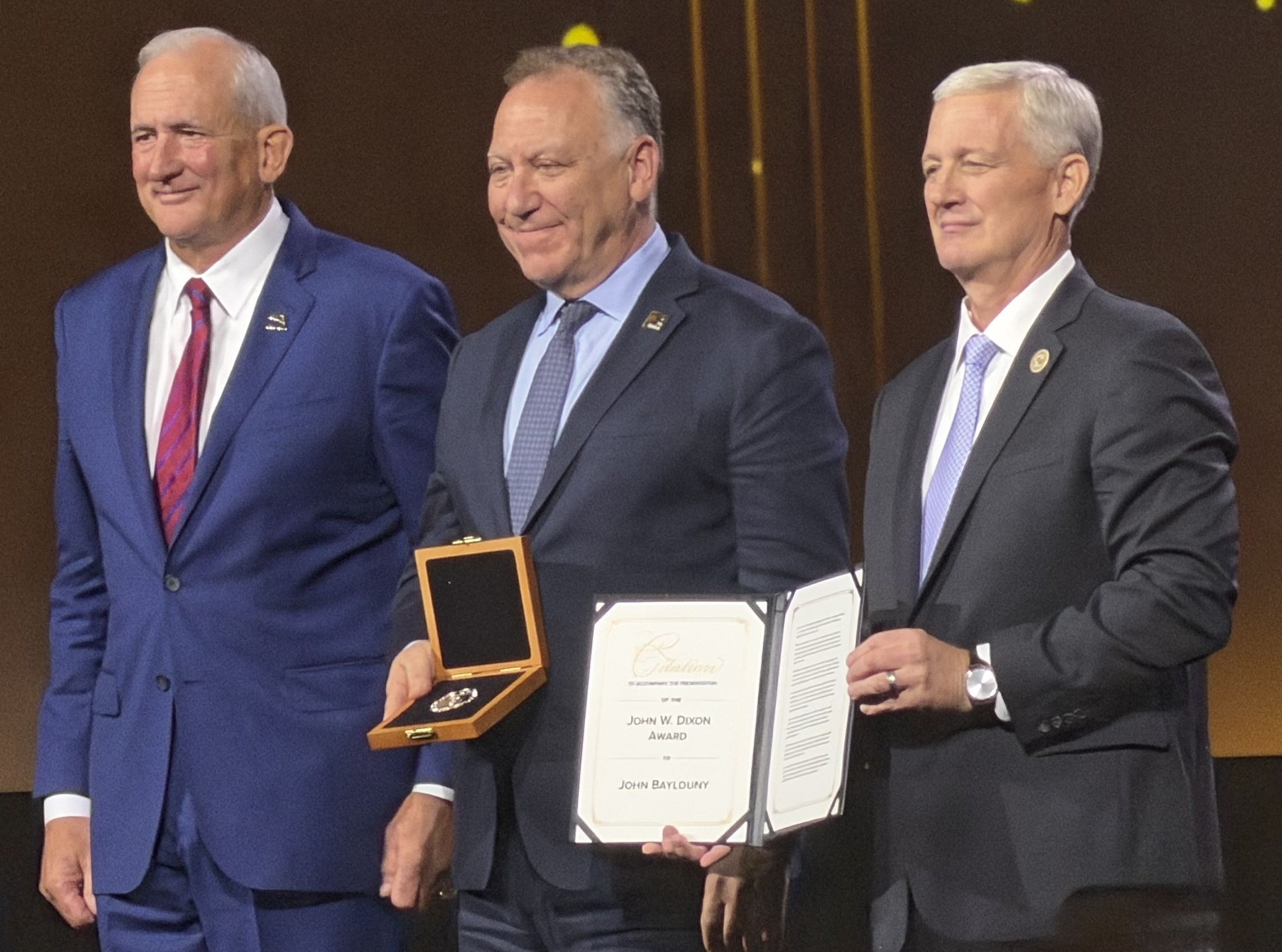
On October 12, 2026, Baylouny received AUSA’s John W. Dixon Award in Washington. Established in 1989, it recognizes contributions to national defense from the industrial community. He appeared with AUSA president and CEO Robert Brown and vice president Jack Haley, holding the recognition in a photograph that marked his first year as chief executive.
The award also drew attention to a longer relationship with AUSA’s Greater Los Angeles chapter. Baylouny advises its Space Symposium and supports its Army Ball and “Give a Soldier a Night Out” program. These activities place him in the less visible work of maintaining an institution: contributing time, helping programs and keeping industry connected to the people it serves.
For Baylouny, the next examination is already built into the job. Can a business with decades of accumulated engineering knowledge move quickly enough for changing military requirements? Can it combine technologies without adding another layer of delay? His apprenticeship began with founders asking him to account for a design. Now the design under examination is the company’s way of working. He has spent much of a career learning where to ask the questions.