In July 2018, Joel Gascoigne’s company spent $3.3 million to make its future less eventful. Buffer bought back shares from seven Series A investors. There would be fewer competing expectations about where the business should go, less pressure to arrange an exit, and more room for its co-founder to remain exactly where he was: running Buffer.
Startup money usually arrives with an invitation to imagine the next stage. This money went in the other direction. Gascoigne was paying for the right to keep working on the current one. Independence, it turned out, came with a sizeable invoice.
That choice makes more sense when you follow the small decisions that preceded it. Buffer began as a way to spread tweets across the day. Over time, its founder became equally interested in the arrangements around the software: who could work there, what they knew about their pay, and whose timetable the company was following.
A very small product, a very useful deadline
In 2010, Gascoigne wanted a simpler way to schedule his own Twitter posts. He resisted the satisfying part of the job long enough to test whether anyone else cared. Before building an application, he made a two-page website explaining the idea and collecting interest.
He then inserted pricing options into the route through the site. People could signal interest in paying before there was a working product to buy. It was an inexpensive way to expose an expensive assumption. A programmer can spend months improving an answer to a question nobody has asked.
Gascoigne initially thought the first working version would take a week. Validation and development occupied seven weeks of evenings and weekends. Even a deliberately small project had managed to acquire a programmer’s estimate.
A Hacker News challenge called November Startup Sprint supplied a deadline. He launched on November 30, 2010. Within four days, he had a paying customer. The first version supported Twitter; the broader social media toolkit would come later.
- 01Explain the idea
- 02Test a price
- 03Build & launch
- 04Earn a customer
Seven weeks of validation and building. A paying customer within four days of launch.
During 2011, he reduced his contract development work as Buffer’s revenue grew. Co-founder Leo Widrich finished his college year, and they travelled to San Francisco. It was Gascoigne’s first visit to the United States. They joined AngelPad and raised funding. The project was acquiring the familiar equipment of a startup.
The office disappears. The numbers stay visible.
Some of Gascoigne’s preferences had a longer history than Buffer. Born in Sheffield, England, he spent three and a half childhood years in Utsunomiya, Japan. Later, he lived in several countries during the company’s early years. His working life had room for movement.
In 2012, he committed Buffer to being fully distributed. Advice from entrepreneur David Cancel helped clarify the choice: bring everyone together or distribute the whole team. A mostly office-based company with a few distant colleagues risked leaving those colleagues on the edge of things.
Buffer hired remotely to balance a team that had been gathering in San Francisco. The practical benefit included wider time-zone coverage for customer support. The larger attraction for Gascoigne was access: capable people should be able to find good work without first arranging their lives around an office address.
Pay became another arrangement to examine. Buffer began publishing salaries in 2013. Its current directory still lets anybody inspect individual compensation and the company’s approach to setting it. A job candidate can arrive with an unusual amount of information already in hand.
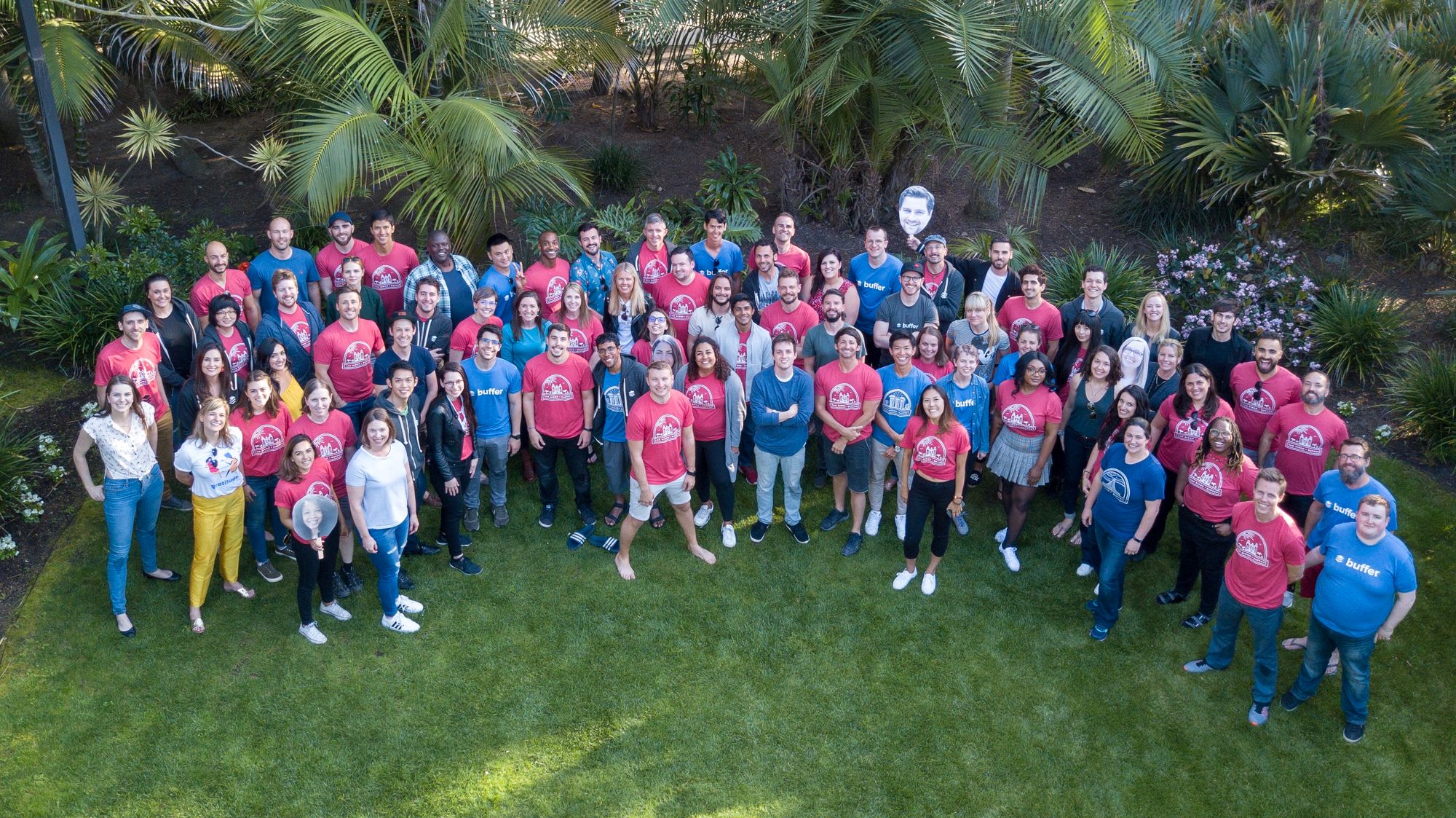
Openness becomes more consequential when the news is unwelcome. It also makes a convenient claim about culture easier to check. Publishing the numbers gives the audience something sturdier than a photograph of cheerful colleagues, however agreeable the palm trees.
The bill for optimism
Gascoigne has repeatedly treated company design as something to try, observe and revise. In 2015, Buffer experimented with a flat, self-managed structure after the team read Reinventing Organizations. The initial sense of freedom gave way to uncertainty about direction and accountability. The company eventually restored more hierarchy.
The following year brought a much harder correction. Hiring had outpaced revenue growth. Buffer had $1.3 million in the bank and was heading towards running out of cash within five months. In June 2016, it announced ten layoffs, affecting 11 percent of the team.
Gascoigne’s account assigned responsibility plainly. He described overaggressive growth choices, inadequate financial scrutiny and hiring ahead of proven needs. He and Widrich cut their own salaries by 40 percent and each committed a $100,000 loan to the business. An upcoming retreat was cancelled.
“I put the company in this position.”
Joel Gascoigne, June 2016
There is no charming version of that episode. Ten people lost their jobs. The transparency made the decisions inspectable; it could not reverse their effects. Any account of Gascoigne’s principles has to leave that fact in the room.
It also helps explain the weight he later placed on financial stability. The freedom to experiment with work depends on being able to keep paying for it. An organization can have sincere values and insufficient cash at the same time.
Buying time, quite literally
By 2017, Widrich and chief technology officer Sunil Sadasivan had left. Gascoigne was trying to establish a sustainable direction while adjusting to leading without his co-founder. The venture investment Buffer had welcomed in 2014 now sat awkwardly alongside its slower-growth plans.
The 2018 buyback involved more than sending a wire transfer. Gascoigne worked with finance director Caryn Hubbard on negotiations, shareholder approvals and a tender offer. Seven of sixteen Series A investors sold. The transaction also changed provisions that had constrained the company’s ability to provide liquidity to other shareholders.
Spent by Buffer on the Series A investor buyback in 2018.
7 investors sold shares / a company transactionThis distinction matters to the personal story. Keeping a business indefinitely creates a problem for people whose shares were supposed to produce a return. A founder’s enthusiasm for another decade does little to pay an early investor’s bills. The buyback offered a practical answer.
Gascoigne had begun angel investing himself after receiving liquidity from Buffer in 2014. He describes wanting to support founders with patience and a longer view. His own experience had given him plenty of material to bring to those conversations.
Independence left him with responsibility for the next set of decisions. It offered room to choose a direction, together with fewer people to blame if that direction proved unhelpful.
A return journey to $20 million
The following years supplied a fairly stern examination. At his 2025 Business of Software talk, Gascoigne described Buffer’s annual recurring revenue declining by about 20 percent over four years, to $17.1 million. The business eventually returned to growth after renewing its focus on creators, entrepreneurs and small businesses.
By May 14, 2026, Buffer had crossed $25 million in annual recurring revenue. Gascoigne marked the occasion by pointing out how long the company had hovered around $20 million. It had reached that neighbourhood, fallen away, and made the journey back.
Elapsed periods as Gascoigne described them in May 2026. Milestones, rather than a continuous revenue chart.
A less expected development concerned customers who were paying without using the product. In 2025, Buffer cancelled 1,361 inactive annual legacy subscriptions. Those customers could use its free plan or subscribe again. The expected effect was roughly $14,000 less monthly recurring revenue.
The exercise exposed a second question. Buffer’s metrics were continuing to count cancelled subscriptions until the end of their paid periods. The team changed its approach to recognize cancellations immediately, accepting smaller reported numbers in exchange for a faster signal about customer behaviour.
Gascoigne later connected decisions like these to a strategy of generosity. A useful free plan could encourage recommendations and allow people to become paying customers when their needs grew. API access belonged in that same generous approach. He explicitly linked the freedom to make such choices with Buffer’s ownership structure.
That is his argument for the arrangement he spent so much to secure. The business can give up some revenue today and allow a longer period for the decision to prove itself. Whether it works remains a question for customers and the accounts.
A deadline for somebody else
Gascoigne’s current interests include making Buffer work more easily with AI and giving customers greater scope to connect and customize it. The new API entered public beta in February 2026. By June, he was describing an emphasis on interoperability and extensibility.
In October, he announced Buffer Commit, a contest for projects built on that API. Sixteen winners would receive $1,600 each, with a build window from October 28 to November 13. Engineers would offer office hours and support. The deadline deliberately echoed the challenge that helped him launch Buffer nearly sixteen years earlier.
There are smaller returns to unfinished projects, too. In July, he described practicing Japanese again with flash cards and subtitled television. At the Barcelona team retreat, his attention went to personal stories over dinner, employee-led sessions and karaoke. Learning and company-building still involved other people.
The next batch of builders will have until November 13 to submit their work. Gascoigne knows what a deadline can start. He has spent the years since his own finding out what it takes to keep going.
Follow the work
More writing, conversations and the numbers behind the company.
- Joel’s personal writing Essays, experiments and current updates
- The investor buyback, in detail The 2018 account
- Buffer’s public salary directory The compensation system in practice
- The decline and recovery Business of Software talk and transcript
- Watch: a conversation with Joel Founders fireside chat, 2015 / YouTube
- Watch: serving customers JFDI.Asia interview, 2012 / YouTube
- Buffer Commit The 2026 build contest