Around the 150th phone call, Marcus Räder began to hear something useful. Travel had stopped, reservations were disappearing, and the customers of his vacation-rental software company were trying to work out whether they could keep going. He had arranged to speak personally with those who had financial worries. The calls were difficult. Then a difference emerged: managers of large holiday properties in Florida, Texas, Arizona and the Carolinas sounded more hopeful.
Hostaway followed that difference. Räder and his colleagues redirected the business toward those American vacation markets. The decision required changes across the company. His account of it contains a revealing concession: perhaps there was luck involved. But luck had quite a long appointment book. Someone still had to sit through the conversations before a pattern became audible.
It is an unusually practical origin for the chapter that followed: a software business attracting hundreds of millions of dollars, with Räder still explaining its progress through things customers had told him. “So that’s where we went,” he said of the American pivot. Six words, after a great deal of listening.
A bank with a rather small branch network
Räder had tested the limits of a business model well before he encountered vacation rentals. At eleven, he lent money to schoolmates and charged interest. The enterprise closed when teachers and other parents discovered it. His early banking career had achieved the difficult combination of finding customers and displeasing the authorities.
The anecdote suits his adult impatience with being directed. In conversation with entrepreneur and interviewer Katie Zeppieri, he described disliking the prospect of going somewhere every day and being told what to do. Business offered room to make decisions, provided he could persuade someone else that those decisions were useful.
Born in Sweden and raised in Finland, he studied marketing at Hanken School of Economics from 2002 to 2007. He later lived in Amsterdam and moved to Canada. He credits Hanken with professional connections and, more broadly, encouragement to explore beyond familiar surroundings. The lasting lesson he describes is intellectual independence: question assumptions and keep asking questions.
That education helps explain his interest in markets rather than just individual properties. In 2015 he saw several large shifts converging around vacation rentals: more international travel, changing working arrangements, rising property prices and more flexible ways of living. He took an economics student's curiosity to a business full of keys, calendars and late arrivals.
The outsiders tried the job themselves
Hostaway began in 2015 with Räder, Saber Kordestanchi and Mikko Nurminen. The founders were spread between Toronto and Helsinki. Distance was an operating condition from the beginning, long before a distributed company required much explanation. In an early partner interview, Räder described the benefits in straightforward terms: flexibility and the ability to support customers across time zones.
The founders came from technology. They interviewed property managers about the tools they lacked, and they also rented out properties themselves. That matters to Räder's account of the business. A software developer can imagine a tidy workflow; a guest is perfectly capable of introducing a less tidy one.
“You just listen to what customers want and go build it.”
Marcus Räder · 2025
That is his description of arriving without an industry's inherited opinions. There is confidence in that sentence, though the work behind it included learning an unfamiliar trade. An outsider's advantage disappears quickly if being new becomes an excuse to remain uninformed.
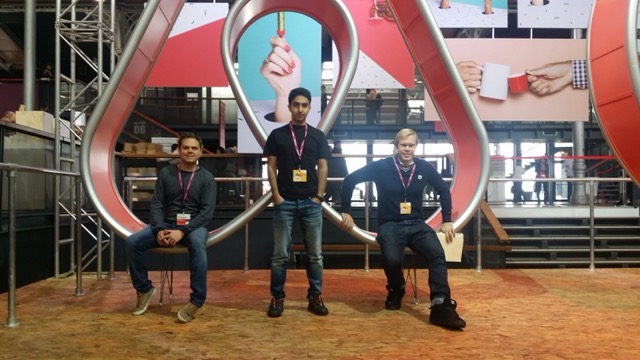
His first customer was in Portugal; an early office was in Barcelona. Hostaway's geography was already expansive while its customer list was still short. The task was to connect the different places where a property could be booked with the daily business of actually accommodating someone.
By 2018 the company had thirty people across cities including Toronto, Helsinki, Barcelona and Melbourne. Its team represented nearly twenty nationalities. A €1.25 million funding announcement that November recorded €2.4 million raised from investors and Business Finland in total. The later shorthand of a bootstrapped success can obscure those early financing steps. The business had help before the much larger cheques arrived.
Getting through the window
A company selling connections to booking platforms has to earn some important introductions of its own. Räder's account of reaching Airbnb is a story about persistence becoming recognizable. He attended events, built relationships and kept trying. A satisfied customer eventually vouched for Hostaway.
By the time he got on a call, the people on the other end already knew who he was. He recalled being told they had seen him trying to get their attention for four years. It is a pleasing reversal of the usual sales anxiety: after all that effort to be noticed, introducing himself was almost redundant.
He also learned that knowing marketing did not remove the need to find the right customers. Positioning Hostaway as Airbnb management software made the category easier to understand. A property manager with a crowded calendar could recognize a familiar problem in the description. The founders could then concentrate on delivering something that justified the introduction.
The product itself was becoming a collection of everyday connections. Hostaway introduced its Unified Inbox in 2019, bringing guest communication from different booking channels together. In 2023 it announced a $175 million investment led by PSG. The announcement came with a joke at Räder's own expense: a desert-set commercial inspired by Better Call Saul, one of his favourite shows. Serious money apparently left room for a costume change.
More money, more people to understand
In December 2024, Hostaway announced a $365 million strategic growth investment led by General Atlantic, with PSG participating. The stated plans included international expansion, product development and AI. At that point it had more than 230 employees across 44 countries, serving customers with properties in more than ninety countries.
For Räder, the attraction included experience as well as capital. He acknowledged that the company's growth had taken its founders into unfamiliar territory. An investor could supply knowledge of stages they had never managed before. That is a useful admission from someone comfortable expressing ambition: wanting to get somewhere does not confer previous experience of the place.
By October 2025, Hostaway announced a $1 billion valuation. Räder had been predicting unicorn status, though he also acknowledged that people in the industry knew him as someone who joked around. A valuation report gave the recurring prediction a rather less ambiguous punchline.
The international business now required more deliberate communication. In a later interview, he described organizing forums, workflows and time together to compensate for the conversations that do not happen spontaneously across time zones. He also said the founders should have paid themselves proper salaries sooner. At times they had been among the lowest-paid employees. Sacrifice, in this telling, needed a little editing.
Europe required a change of address
Expansion has affected where Räder lives. He moved with his family to Warsaw as Hostaway increased its attention to Europe. The city made it easier to reach customers and industry events across the continent. He argued that asking a team to focus on Europe required him to be there himself.
By September 2026, he described a year divided between seven months in Warsaw and five in Miami. The arrangement fits a business that has long crossed borders, though he continues to attach value to meeting customers in person. Remote work has expanded his map; it has hardly emptied his diary.
There are other ways to start a conversation with him. Ask about Gothenburg metal: In Flames, Dark Tranquillity, Arch Enemy and At The Gates are among the bands he names. He plays and collects guitars. Particular ESP models can apparently sustain a discussion rather longer than the average conference introduction.
When he appeared on Avery Carl's The Short Term Show, his Iron Maiden shirt prompted an immediate comment from the host. The wardrobe was doing its own introductory work. At a business gathering, where biographies often sound interchangeable, a shared opinion about a guitar has the considerable advantage of being an actual opinion.
A running total, and another question
His numerical ambitions extend beyond software. In a public post, Räder described deciding that, having raised $365 million, he could run 365 kilometres in a month. He reported doing so, with routes taking him through Warsaw, Rome, the Côte d'Azur and Islay.
Then he declined to turn the exercise into a business parable. It had taught him nothing about business-to-business sales, he wrote, and had no connection to it. The sheep on Islay had supplied an audience anyway. A founder posting about running without insisting it explains revenue may have found an underserved category.
Back at work, his attention is on AI's effect on how people discover accommodation and how managers spend their time. Hostaway's 2026 industry report reported that 61% of surveyed operators used AI in 2025. Räder sees these tools becoming embedded in ordinary workflows. The immediate opportunity is practical: less time spent handling repetitive communication and more capacity for the business around it.
He is scheduled to open Hostaway Backstage in November 2026 with a session looking toward 2027. After the financing, the moves and the miles, the assignment sounds familiar. Work out what customers will need next. Ask enough questions to recognize it. Then decide where to go.
Follow the conversation
More from Räder, on screen and in print.