Joe Kastner began making the case for solar’s adulthood long before the industry had finished celebrating its youth. On March 17, 2008, he sat before a U.S. House subcommittee in Tucson to explain what it took to make a solar project possible. Sunshine was readily available. Financial certainty required rather more negotiation.
He was then vice president of implementation and operations at MMA Renewable Ventures. His company had developed and financed the 14 MW photovoltaic project at Nellis Air Force Base. The installation offered an attractive picture of the future: panels, desert, electricity. Kastner’s account attended to the less photogenic arrangements that allowed it to exist.
That attention would become the through line of his career. Today, as co-founder and CEO of Radian Generation, he works in the business of looking after renewable energy assets through their working lives. The opening ceremony occupies an afternoon. The obligations have a considerably longer booking.
The desert lesson
At Nellis, the arrangements included the Air Force, a private project developer and a renewable energy credit agreement with Nevada Power. Kastner explained that the credit contract helped make the economics work. Nevada’s renewable portfolio standard, including its requirement for solar, had helped create the opportunity.
His testimony also described a danger buried in the contract. Uncertainty over a possible change in law could have made the project difficult to finance. An order from Nevada’s Public Utilities Commission provided assurances. Without it, he told the committee, the financing might never have happened.
There is an entire professional education inside that small conditional. A project can have suitable technology, a willing customer and a promising location, yet still depend on a provision few visitors will ever read. The panel in the desert and the clause in the agreement belong to the same undertaking.
There was a public-private puzzle here too. Public bodies could buy solar electricity but could not use federal investment tax credits in the way a private investor could. MMA’s role included putting the development and financing arrangements together. Kastner’s explanation treated that structure as part of the project itself. The technology needed an owner, a buyer and agreements each could live with. It was a lesson in the distance between having an energy resource and having an investable plan to use it.
Kastner’s responsibilities crossed those boundaries. He sourced and developed projects that fitted MMA’s investment profile and oversaw assets under construction and in operation. His testimony described the company negotiating land rights, power purchase agreements, construction contracts and utility interconnections, then obtaining financing.
He also argued for longer-term policy certainty. His recommendations concerned tax incentives, renewable portfolio standards and arrangements that would make investment less precarious. These were arguments made in 2008, in an industry with its own particular constraints. They already showed his interest in the conditions that let good engineering become a functioning enterprise.
- 01DevelopLand, agreements
and financing - 02BuildConstruction
and handover - 03OperatePerformance, records
and obligations
Three degrees, one practical question
His education covered mechanical engineering at the University of Minnesota, energy engineering at Stanford and environmental science and management at the University of California, Santa Barbara. One undergraduate degree and two master’s degrees gave him formal training across machinery, energy systems and environmental management.
His early work put those subjects in contact with buildings and investors. Before MMA, he consulted on energy efficiency and photovoltaic and solar thermal systems. At NUON Renewable Ventures USA, a subsidiary of the Dutch utility, he managed the renewable energy division, with responsibility for implementation, operation and maintenance.
Later roles included Renewable Ventures, which he co-founded, and Fotowatio Renewable Ventures. Across these businesses, his work encompassed technical development, construction and operations. His path repeatedly returned him to the point where a proposal had to become something that could be operated.
The breadth matters. A project owner sees a financial commitment. An engineer sees a system with limits and failure modes. An operator sees the next task, the next inspection, the next person who must know what happened. Kastner’s career has placed him in the conversation among all three.
Four people and the years after opening day
Radian Generation began in 2013. Kastner later recalled its starting scale with a sentence refreshingly free of corporate upholstery: “We started as four people in a San Francisco living room.”
By 2014, he was speaking as its vice president of operations about the commercial solar market. Radian served owners, lenders and investors seeking more predictable performance. It worked with partners on field maintenance, including projects that already had maintenance arrangements through contractors or warranty providers.
His preference was for preventive work and a stable long-term return. “In general we like to take the long-view,” he said. It is the sort of sentence that rarely decorates a launch party and frequently determines whether the guests have anything to celebrate several years later.
“In general we like to take the long-view”
Joe Kastner, on solar operations, 2014
At Solar Power International in 2015, where he appeared as Radian’s chief operating officer, he addressed the awkward afterlife of equipment warranties. Inverters accounted for many maintenance calls, he observed. A manufacturer going out of business could make the bill more uncomfortable. Owners needed contingencies beyond warranties and guarantees.
The question of how quickly to respond to a fault also had an economic dimension. Sending a technician costs money; leaving equipment idle can cost money too. His comments treated maintenance as a set of decisions requiring judgment. Even the humble truck visit deserved a business case.
Kastner became CEO in July 2018. In 2021, he joined kWh Analytics CEO Richard Matsui on Todd Alexander’s Currents podcast to discuss solar risk and underperformance. The subject fitted his established concerns: what owners expected from their assets, and what operating experience revealed.
The software clients wanted to buy
Looking after assets created another problem: finding software suited to the job. Kastner has recalled specialist renewable energy tools being at an early stage, while large enterprise systems could be rigid, generic and expensive. Radian built internal tools. During sales presentations, customers noticed them.
The resulting software business developed alongside the services business. Radian Digital covers stages from development through construction and operations, bringing technical, administrative and contract information together. Its premise is easy to appreciate if you have ever inherited a project whose institutional memory lives in somebody else’s inbox.
In January 2021, a new ownership partnership brought together Radian, Plus Renewable and 424 Capital. Kastner described the opportunity to strengthen the existing offer and expand the company’s products and geographic reach. The next year brought a concrete expansion.
On April 5, 2022, Radian announced its acquisition of Green IT Energy Applications. Software developers, operational technology engineers, project managers, quality assurance staff and analysts joined the business. Green IT founder Andrew Eisenberg joined Radian’s leadership as president and chief technology officer.
The acquisition added cybersecurity and operational technology expertise to a company already managing renewable assets. It also broadened the software offering across a project’s life. The practical ambition was continuity: owners should be able to carry useful information from development into operation, without repeatedly reconstructing the project’s history.
Radian’s combination of services and software allows customers to choose different levels of outside help. Some employ a third party for day-to-day asset management. Others keep those activities inside their own organization and use software and advice. The underlying work persists whichever employment arrangement surrounds it.
A company large enough to need a world tour
By October 2024, Kastner’s account of the business had acquired an itinerary. He described visiting Charlotte, where Radian is headquartered, then Guadalajara and three stops in India. He wanted to meet half the company face-to-face. Flooding in Chennai interfered with the plan.
He put the team at more than 230 people across three countries at that point. The number belongs to that moment. The travel tells another part of the story: a founder trying to put faces to a company that had grown far beyond a single room.
Colleague Ryan Carlson responded by crediting him with maintaining a culture of kindness through growth. Steve Holman, who identified himself as one of the people in the original living room, also replied. The founding scene had witnesses who could now look back across more than a decade.
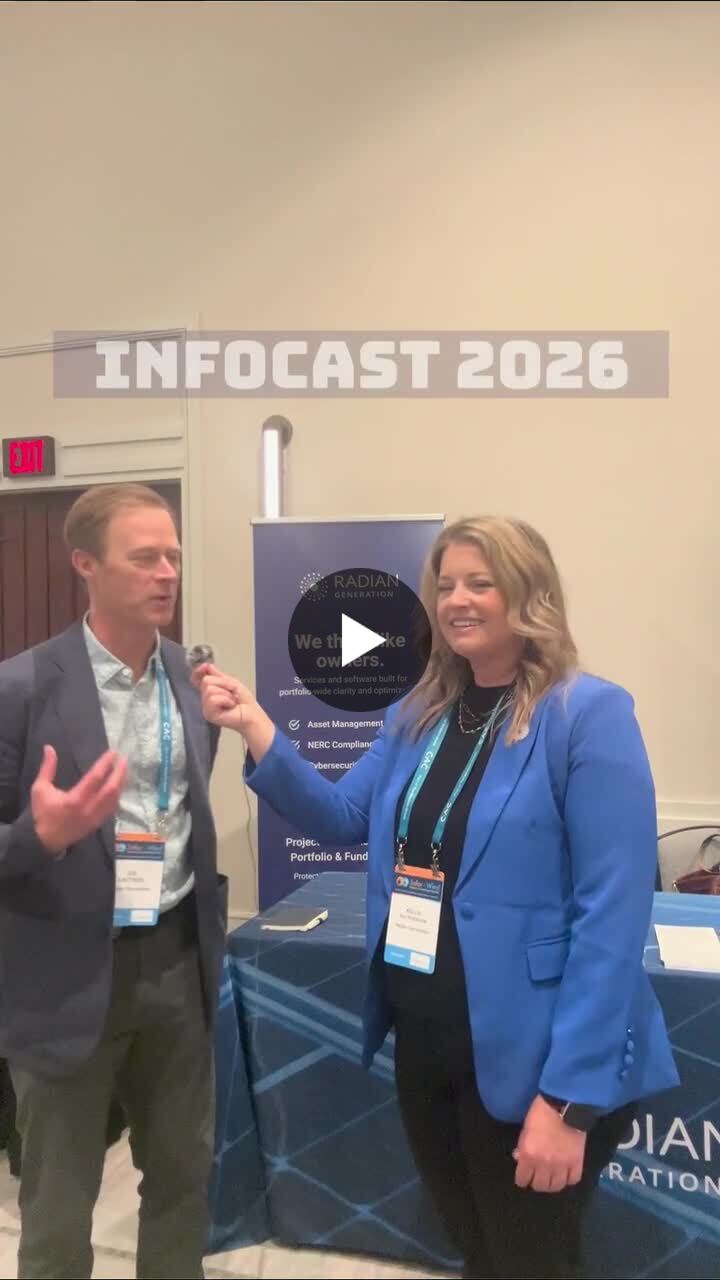
The obligations keep growing
In a June 2025 interview, Kastner returned to the discipline of planning operations early. He emphasized realistic budgets, usable shared data and careful performance modeling. He also described software as a way to preserve knowledge when staff change. His concern extended to compliance and the industry’s responsibility to be dependable on the grid.
Those concerns had measurable expression by July 2026. Radian announced that it had completed 95 NERC Category 2 registrations for clients, with another 18 projects in pre-registration. The completed group included solar, wind, standalone battery storage and hybrid solar-plus-storage projects. The count describes Radian’s client work, rather than projects Kastner personally registered.
Company milestone announced July 2026. Bars compare project counts, not generating capacity.
Macpherson, Radian’s chief operating officer for compliance and security, described the investment in people and processes behind that work. Her responsibilities illustrate how far the company’s activities now extend beyond the early image of someone keeping a solar plant’s accounts.
Kastner remains listed as CEO and co-founder on Radian’s RE+ 2026 event page. The business continues to follow the obligations created by a growing fleet of renewable assets. There are agreements to honor, records to maintain, faults to understand and new colleagues to meet.
His career makes an unusually consistent argument for attending to those details. At Nellis, a financial arrangement helped turn a stretch of desert into a working project. In a San Francisco living room, four people began a business concerned with what working projects need. The scenery has changed. The useful question endures: who is taking care of the years ahead?