Chad Sachs went to a coffee farm in Peru and encountered a small accounting problem with a rather large human consequence. A cooperative member introduced him to his aunt. She grew coffee on a nearby plot and sold her harvest through her nephew. The income was hers. In the cooperative’s records, the coffee was his. A perfectly orderly spreadsheet had managed to misplace a working woman.
Sachs described the encounter in October 2026. By then, he was chief executive and chief investment officer of NESsT, an organization financing enterprises that create jobs and livelihoods in underserved communities. Earlier in his career, he had co-founded Radian Generation, helping solar owners manage what happened after their projects were built. Across those different businesses, a recurring question emerges: what is actually happening underneath the reported result?
The education of a solar financier
His early career supplied a thorough education in capital. Sachs worked as a financial analyst at Credit Suisse First Boston, then at JPMorgan Partners, the private equity arm of JPMorgan Chase. There, his work included growth investments and leveraged buyouts in telecommunications. He helped raise more than $200 million for portfolio companies. These were businesses whose ambitions required financing structures capable of carrying them.
He also collected two degrees with useful international reach: a bachelor’s in international economics from Georgetown University and an MBA from Stanford. At MMA Renewable Ventures, he became responsible for raising tax-advantaged equity and debt for new projects. A company biography described him as the architect of its project investment structure. The vocabulary had changed from telecom to solar, but the task still involved fitting money to a business with particular requirements.
This background matters because renewable energy is a physical business with a financial life attached. A power plant must generate electricity, meet obligations, and support the expectations of the people who financed it. The equipment and the investment cannot spend their lives in separate conversations. Sachs’s subsequent work would concern itself with getting them into the same room.
After the ribbon is cut
Radian Generation began in 2013. Sachs and his fellow founders came from developing projects and saw that operating them received too little attention. Building had a natural attraction: a deadline, a completion, a thing to unveil. The years of ownership that followed required an altogether less photogenic discipline. Someone still had to check performance, administer contracts, and keep the financial arrangements working.
In 2015, Sachs explained solar asset management through three connected responsibilities: technical output, contractual commitments, and financial performance. His examples were pleasingly concrete. Harvest activity could leave sediment on panels. Warranties needed attention when manufacturers disappeared. Projects built quickly to capture incentives could carry complications into their operating years. Sunshine was welcome, but it did not fill in the paperwork.
He wanted Radian to concentrate on this continuing work, supported by a capable team and suitable information systems. The opportunity lay in a neglected part of an expanding industry. Owners needed help ensuring that an installed project produced what its investment case had promised. A successful opening day was only the beginning of that examination.
A business measured in operating years
By January 2015, Radian was contracted to service more than 150 megawatts across 55 sites in the United States and Canada. Its assignments ranged from small installations to projects exceeding 30 megawatts. The company expanded its San Francisco team and established a Charlotte office to serve eastern markets. Geography was becoming an operating question as well as a sales opportunity.
The combination of operations, technical work, contracts, and finance gave the business several ways to be useful. Scale also supported further investment in technology and processes. Sachs’s argument was that solar’s emergence as an investment category required owners to pay closer attention to long-term project results. New capacity attracted the headlines; existing capacity still needed looking after.
In September 2017, Radian reported 2.8 gigawatts of renewable assets under management, a milestone reached a little over four years after its founding. Its work had extended into solar and wind, supported by the LENS software platform. That progression matched an ambition Sachs had voiced earlier: applying the company’s operating approach beyond solar. The work of maintaining performance had found a wider market.
Renewable assets under management, a little over four years after founding.
Even the competition could be a customer
Sachs was candid about industry categories. In a 2017 conversation, he suggested that debates over separating software, maintenance, and asset management occupied conferences more than customers. Owners wanted productive assets and efficient operations. Radian’s proposition combined the tools with the people doing the work. LENS had been developed with working asset managers’ requirements in mind.
It was also available to other service providers, including asset managers and maintenance firms. Competitors could become software customers and sources of referrals. Sachs described a market in which companies collaborated in some areas while competing in others. Local maintenance expertise made that arrangement practical. A company could be very good in one geography without needing to pretend it covered every other one.
He also acknowledged that integrated services could create conflicts, and that contracts needed to align incentives. In certain warranty disputes, separating responsibilities could be valuable. The willingness to discuss exceptions gives his position some texture. He was selling an operating model, while recognizing that an owner’s circumstances might demand a different arrangement. Commercial confidence and qualifications can, occasionally, share a paragraph.
From solar assets to social enterprises
Sachs joined NESsT in 2019 and progressed through senior management roles, including chief investment officer. On April 17, 2025, the organization announced his appointment as CEO, succeeding Kirsten Dueck. He arrived in the role with experience founding two solar businesses and raising more than $1.1 billion. His earlier entrepreneurial work had given him experience on the receiving side of capital as well as the investing side.
By his appointment, Sachs had led the Lirio Fund’s investment activity through more than $11 million in loans to 19 social enterprises, supporting over 7,600 people in marginalized Latin American communities. These were fund results achieved with colleagues and enterprise leaders.
His appointment also carried institutional continuity. He publicly acknowledged both Dueck and NESsT co-founder Nicole Etchart, describing their contributions to the organization he was taking on. The move put him at the head of a mission extending across Latin America and Central and Eastern Europe. Lending would remain central, alongside the relationships and practical support that help enterprises use it.
The size and shape of useful money
Lirio addresses a financing gap familiar to smaller enterprises: microfinance may be too small, conventional lending too inflexible, and larger impact investments beyond what a business can absorb. NESsT pairs debt with business assistance, helping companies prepare for financing and work toward their operating goals. The design recognizes that access to money and the capacity to use it develop together.
By February 2026, Lirio had passed $20 million in disbursements through 37 loans. Its portfolio then included 21 companies, with some receiving further loans as they developed. The associated enterprises had reached roughly 16,000 people and contributed to preserving more than 1.5 million hectares. Each figure describes a different aspect of the fund’s activity; none is a substitute for the others.
One example involved Colombia’s Federación Campesina del Cauca. Work with the cooperative identified a need for additional working capital to pay coffee producers, leading to a revolving financing arrangement. The mechanism was specific to the operating need. For a farmer waiting to be paid, the elegance of a financing philosophy is likely to depend on its punctuality.
“Our role is to listen, to learn, and to invest in ways that reflect local realities and ambitions.”Chad Sachs · January 2026
The next question is asked in person
In his January 2026 reflections, Sachs reported that NESsT’s portfolio had grown from 88 to 132 social enterprises during 2025. He described plans to strengthen its presence across Brazil, Chile, Colombia, Ecuador, Peru, Poland, and Romania. His emphasis fell on sustained relationships and local leadership. Growth had to translate into better livelihoods and stronger enterprises to serve the organization’s purpose.
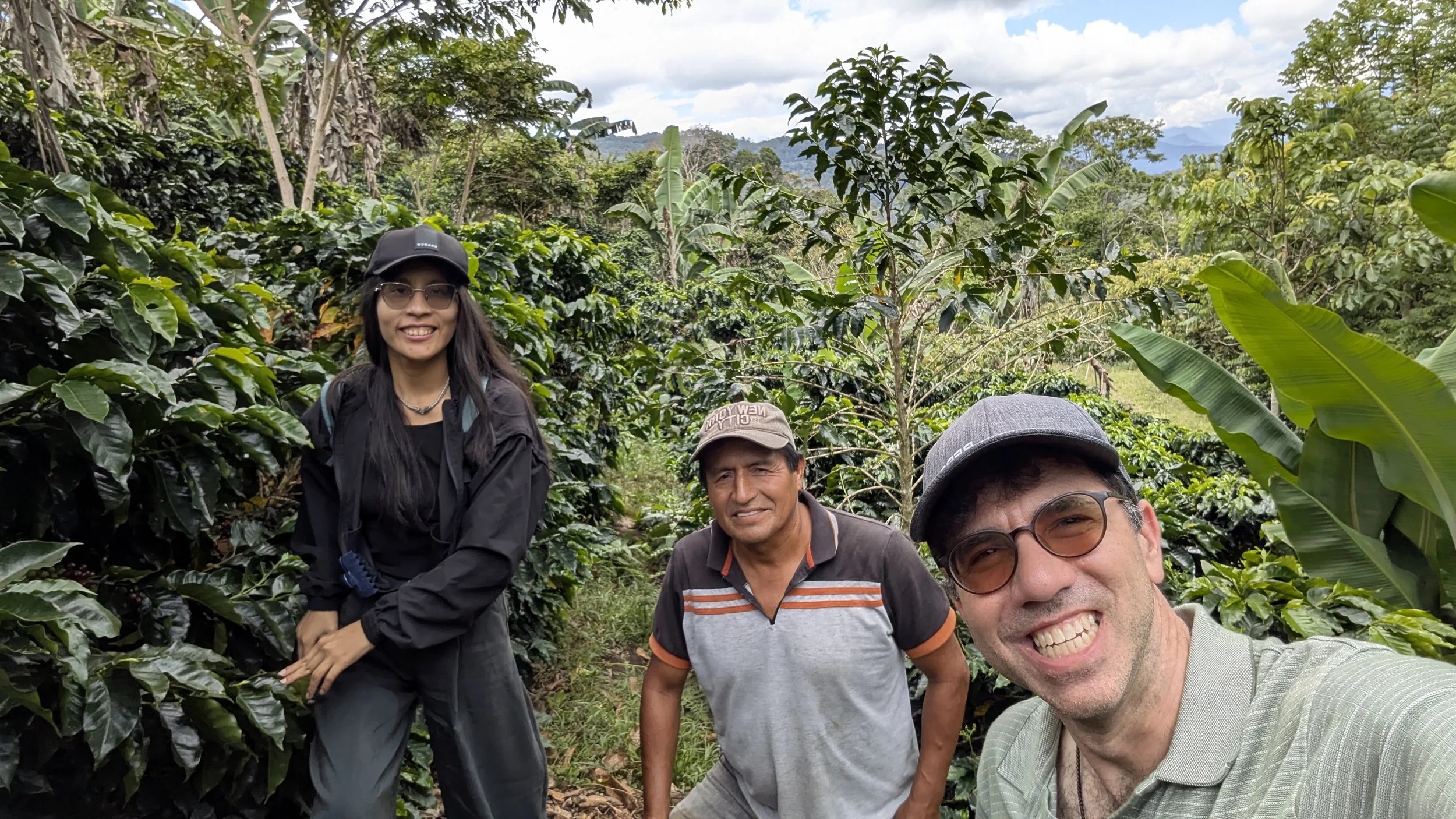
By October, that emphasis had a tangible setting in Junín. Sachs visited a Lirio-financed warehouse at COAS Sonomoro, where cooperative leaders explained what extra storage meant for their operations. He also visited an orange processing facility at Alto Kivinaki and coffee plots with Santa Ana. The itinerary connected financing decisions to facilities, producers, and the ordinary constraints of running rural businesses.
Then there was the aunt and her coffee. Her work prompted questions about how investment reporting captures women’s contributions when formal membership sits with somebody else. Sachs argued for asking more precise questions about earnings, services, and participation in decisions. The financier who once worried about a plant’s performance was now examining the assumptions inside a producer count.
There is a consistent practicality in that journey. A model deserves testing against the business it describes. A reporting category deserves testing against the people inside it. For Sachs, the next useful piece of information may arrive beside a processing line or on a small farm. A spreadsheet can accommodate a great deal. It still benefits from being taken outside.