Before there was an office to unlock, there were people to invite. In the months before IMPAQTO opened its coworking space in Quito in 2014, its founders organized gatherings for entrepreneurs. They listened to concerns, needs, fears, and hopes. The furniture could wait. First came the rather less photogenic business of finding out whether people wanted to build something together.
Daniela Peralvo has spent much of her career returning to that sequence. Bring people into a conversation. Understand what is missing. Build around the answer. Today she is IMPAQTO’s co-founder and co-CEO, sharing its leadership with Carolina Brito. Her work reaches across coworking, entrepreneurship programs, innovation, and impact investment. The invitation has grown considerably since those early meetings in Ecuador’s capital.
She calls herself a weaver of ecosystems, a description that sounds more at home beside a loom than a boardroom. Yet it is unusually useful for understanding her work. A thread on its own has limited possibilities. The interesting part begins when it meets another.
Before there was a key
Peralvo trained as an agricultural engineer at the Escuela Politécnica del Ejército. Her early professional life involved agricultural websites, marketing, and business development. At Agribusiness Ecuador, she worked with Agrytec.com and Linkagro.com and edited Agrytec.com magazine. Later, at Energía Futura, her responsibilities included selling agricultural equipment and finding new markets and customers.
That background gives her present vocabulary a practical foundation. Long before she was discussing entrepreneurial ecosystems, she was working in an industry concerned with actual growing things. In a later conversation about her career, she connected her choice of study to her father’s interest in agronomy and to the rural communities she encountered during her training.
Her move toward entrepreneurship also grew from frustration with the reception for innovation in the agricultural industry. She was interested in what was happening around the region: coworking, incubators, accelerators. In Quito, the possibility of bringing entrepreneurs together became something she could help make tangible.
IMPAQTO’s early gatherings preceded its physical home by months. When the doors opened in 2014, the organization already had experience listening to the people it hoped would walk through them. It is an origin story with an unfashionable hero: the preliminary meeting. Occasionally, one is worth attending.

The desk was a starting point
The enterprise that emerged from those conversations now has three connected lines of work: Coworking, Labs, and Capital. Physical spaces bring people together. Programs support the development of businesses and innovation. Impact investment addresses another part of the journey. For a founder, finding a desk and finding the resources to grow are related problems, even when they appear on different application forms.
and connect
and innovation
an impact purpose
In 2016, IMPAQTO became Ecuador’s first certified B Corporation. For Peralvo, certification also offered a community of peers and a way to examine how a company operates. Workers, governance, customers, community, and the environment became subjects for assessment. A declaration of good intentions acquired questions that had to be answered.
Her explanation of triple-impact entrepreneurship is similarly grounded. A business can pursue economic, social, and environmental value together. It still needs a model capable of earning revenue and continuing to operate. She asks for clarity about the problem being addressed and rigor in measuring the result. Social and environmental claims, in her account, deserve the seriousness given to financial reporting.
That is a useful complication in an industry fond of the word “impact.” The word can fit almost anywhere on a presentation slide. Evidence takes up rather more room.
A corner office with two names
In October 2022, IMPAQTO announced that Peralvo and Brito would become co-CEOs. After considering its leadership needs, the company chose to distribute the role between two women with complementary experience. Peralvo was a co-founder; Brito had been leading the coworking business.
The announcement came with unusually concrete concerns: clear responsibilities, decision rights, and a mechanism for resolving disagreements. Sharing a title makes for a brief announcement. Sharing authority requires a longer conversation.
The division remains visible in IMPAQTO’s description of its leadership in March 2026. Brito focuses on strategic growth, business consolidation, and alliances. Peralvo leads institutional vision and positioning, including the organization’s identity as a B Corp and its purpose within Latin America’s impact economy.
The arrangement fits a recurring theme in Peralvo’s work. Collaboration requires structure. Someone has to know what they can decide, what they should discuss, and when to bring the other person in. Trust becomes more useful when it comes with an understanding of who is doing what.
“I believe in collaboration over competition.”
Daniela Peralvo
Let the participants write the brief
The same instinct shaped PODER, an IMPAQTO program for women entrepreneurs. Its original plan, described in 2023, aimed to reach 600 women across 10 Ecuadorian cities with USAID funding of $2 million. Before the training came co-creation sessions. Women were asked what they needed.
The answers included empowerment, business skills, and a community of other women with whom they could share. The program brought financial education, marketing, sales, and help with structuring and formalizing a business into a ten-week format. Participants would finish with a fair where they could present and sell their products.
targeted
in the plan
per cohort
Program targets and design, rather than a count of completed outcomes.
There is a revealing choice in that design. The participants’ products needed customers, so the learning ended with an opportunity to meet them. The women also wanted peers. A curriculum could therefore include the relationships formed around it, alongside the material taught at the front of the room.
The work encountered a sharp interruption in 2025. Following the suspension of USAID-funded activities, Peralvo spoke about the uncertainty facing PODER. IMPAQTO had hired eight technical professionals for the project. Her public response included asking her network to help those professionals find new work.
It was a different use of the same network: people helping people find their next opening when a program’s funding changed. The episode also exposed a practical vulnerability in building support around external funding. The need can remain after the financing disappears.
For a founder whose work centers on connections, that moment brought the stakes down to a human scale. A network includes the people delivering the program as well as those enrolled in it.
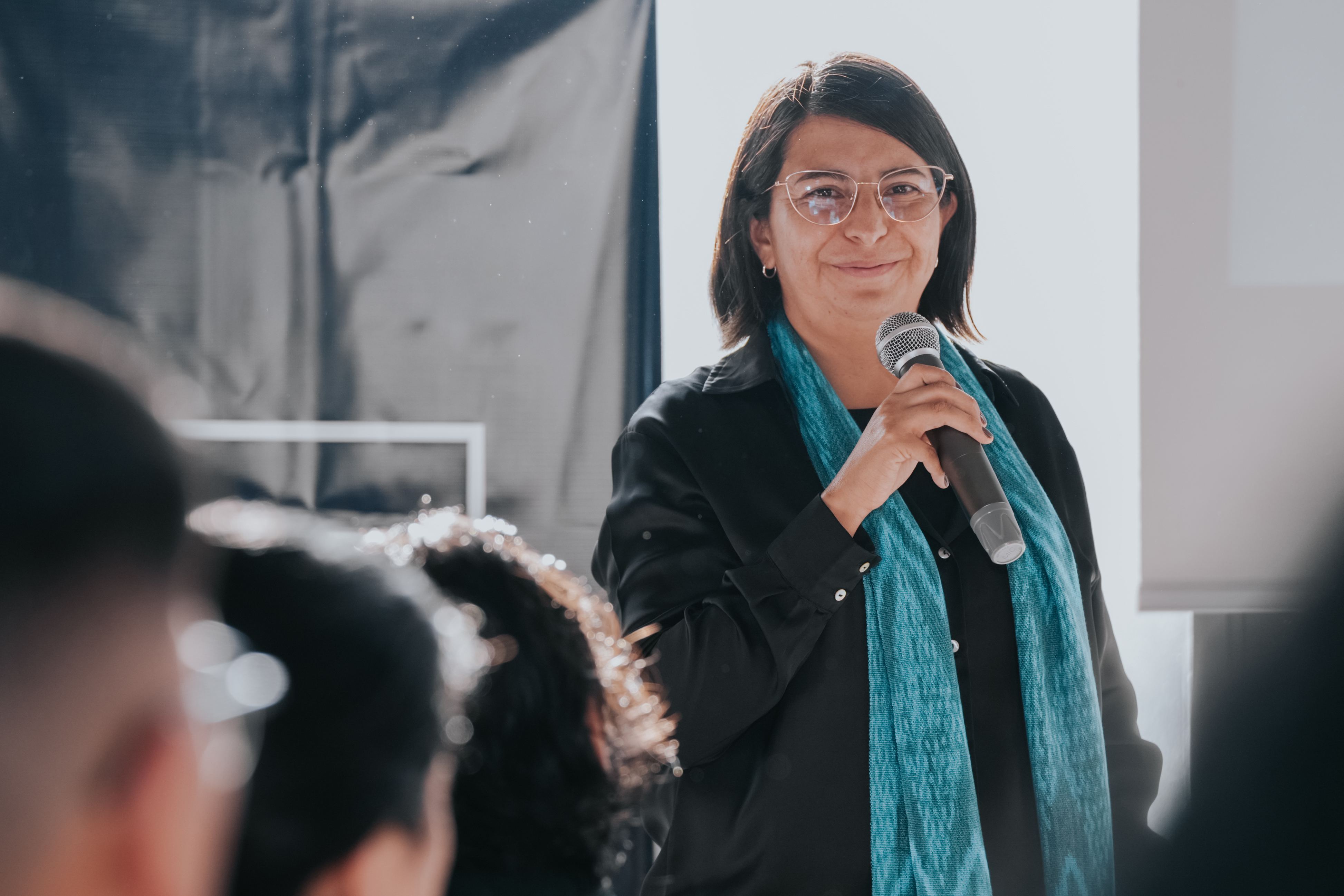
The leader joins the circle
Peralvo’s newer project, Líderes X Impacto, brings her interest in community to the practice of leadership itself. It offers a two-day immersion, a three-month community, and a digital journaling guide inspired by Theory U. These are formats with a calendar attached: time to reflect, time with others, and something to return to afterward.
Her approach includes practical exercises. A 2026 workshop description outlines a three-dimensional map in which participants use physical objects to represent their current situation. Working in pairs, they view the arrangement from several directions, then adjust it toward a future they want to create. The session ends with a concrete next step.
A sculpture is a pleasingly awkward thing to bring into a leadership discussion. It asks someone accustomed to explaining a situation to build it instead. The exercise makes room for another person’s questions and another angle of view.
In August 2026, Peralvo wrote about completing twelve weeks with the Líderes X Impacto community. Continuing conversation has become part of the offering. The person who helped create a place for entrepreneurs to meet is now making a place for leaders to examine how they lead.
A network with a return address
Her own learning has involved repeated departures from Quito and connections beyond Ecuador. She participated in the International Visitor Leadership Program’s Women in Entrepreneurship program and in the Americas Competitiveness Exchange. In 2021, she joined On Deck’s first Community Builders cohort. Since 2022, she has belonged to the BMW Foundation’s Responsible Leaders network.
She has also served on the Red de Impacto LATAM advisory council. Her education has expanded into corporate governance at IDE Business School and professional director training through UDLA’s IKIGAI Board Member Circle. The combination brings community building into contact with the formal decisions that shape organizations.
She has also co-founded Bilda, a learning technology startup using chatbots. The interest in technology sits alongside her work as a facilitator, rather than occupying a separate chapter of her career. Both involve how people learn and how support reaches them. Her projects use different settings: a shared workspace, a business program, a digital learning tool, a group of leaders meeting over several weeks. The common subject is the person trying to move forward.
Recognition has followed, including a place in Ecuador’s Merco Top 100 leaders ranking for 2024. Yet the more telling detail in her public self-description may be her list of interests: technology, nature, cultures, and food. Curiosity travels comfortably between those subjects. So do conversations.
Peralvo’s stated ambition is to help build a fairer, more prosperous, regenerative, and equitable impact ecosystem in Latin America. IMPAQTO sets its own longer horizon: by 2030, it aims to reach 10 million people through a community generating social, environmental, and economic value. That remains a goal, with the work of getting there still ahead.
Her contribution to that future keeps taking a recognizable form. There is a room, physical or otherwise. There are people with experience to offer and a problem to work on. Someone has to make the introduction, ask the first question, and leave enough space for the answer. Peralvo has made a business of being that someone.
Continue the conversation
Explore Peralvo’s work, writing, and conversations.