In 2015, Ali Zain Ul Abidin returned from a student festival in Norway and began helping other students find their way to international opportunities. He had been one of eight participants from Pakistan at the International Student Festival in Trondheim. The trip had an obvious beneficiary: him. What happened afterwards widened the circle.
It is a small episode, useful precisely because it predates the chief executive title. Today, as co-founder and CEO of the Social Innovation Academy, he works on a larger version of the same problem. How does somebody with ability get access to the training, people and practical opportunities that make ability useful?
His working geography begins in Quetta and extends through universities, business programmes and international partnerships. There are conferences in the story, certainly. There are also application instructions, school equipment and the distinctly earthbound business of teaching someone to keep a cashbook. Social innovation has a grand name. Some of its necessary accessories are stationery.
A business student takes an idea abroad
A year before Norway, Ali was studying business administration at Balochistan University of Information Technology, Engineering and Management Sciences, usually shortened to BUITEMS. In June 2014, he joined a Global Business Institute programme at Indiana University's Kelley School of Business. Sixteen other students from Pakistan joined him.
The programme brought together participants from several countries to develop business ideas they could take home. Ali's team proposed chemical-solar energy powered cells. It finished second in a business-plan competition involving 19 teams. Before he was helping other people prepare ideas for scrutiny, he had stood on the applicant's side of the exercise.
The following February took him to Trondheim, where the student festival's theme was corruption. He participated in a workshop called Change and discussed corruption in Pakistan. Business education and public questions were already sharing space in his itinerary. After returning, he offered fellow students guidance on accessing international opportunities.
- 2014Business programme at Kelley; team places second.
- 2015Student festival in Trondheim; guidance for peers on return.
- 2024Co-authored research on career crafting is published.
- 2026SIA Summit 2.0 launches SENPak.
He also studies the question
Ali went on to study International Education Management through the joint master's programme offered by Ludwigsburg University of Education in Germany and Helwan University in Cairo. His education sits close to his eventual work: organising learning, connecting institutions and thinking about what happens after a course ends.
In 2024, he publicly offered prospective INEMA applicants first-hand guidance as an alumnus. That is a pleasing echo of the student returning from Norway. The destination and qualification had changed; the invitation to ask him about the route remained.
There is a research paper in this career, too. With Naglaa Mohamed Diaa and Marvin Roller, he co-authored a study in Future Business Journal examining career crafting, perceived employability and subjective career success. The paper identifies his affiliation as Social Innovation Academy in Quetta.
The researchers surveyed 224 employees in Pakistan. They found positive relationships between career crafting and both perceived employability and subjective career success. Their proposed moderating effect of job autonomy was unsupported. The cross-sectional survey establishes associations rather than proving that one behaviour causes a career to improve.
As a companion to his practical work, the subject is revealing. Career crafting concerns deliberate actions people take to shape their working lives. Ali's programmes repeatedly return to that territory: acquiring skills, making a plan and finding people who can help put it into practice. The connection is thematic; the study itself examined employees.
The application form is part of the work
On November 3, 2023, students at the University of Turbat gathered for an awareness session about an upcoming policy hackathon. Ali joined by Zoom. His contribution included explaining the application process. It was a modest, specific task, the kind that rarely gets promoted to a conference headline.
But access has details. An opportunity can exist and still remain obscure to its intended participants. By speaking directly to students about applying, he was dealing with the distance between announcing a programme and helping someone enter it. Turbat's research and innovation office organised the session with SIA and the United States Educational Foundation in Pakistan.
The hackathon followed in Quetta from December 22 to 24. University students from across Balochistan developed policy proposals through design thinking, brainstorming and presentations. SIA's account records seed grants worth PKR 150,000 for winning recommendations. The format gave participants a problem, a method and a deadline.
That combination explains some of the academy's educational character. A participant did not have to arrive with a company or a finished product. Here, the task was to think through a public problem and explain a proposed response clearly enough for others to assess it. Entrepreneurship's tools could travel beyond a business plan.
A school lab belongs in this story
In November 2025, Ali and RedPi co-founder Khet Kumar were recognised for launching a STEAM and robotics lab at Sandeman Higher Secondary School in Quetta. The project brought science, technology, engineering, arts and mathematics into a practical learning setting. It placed another age group within reach of the academy's educational work.
A school lab and a founder summit make an unusual pair on a chief executive's record. Read together, they suggest a concern with the conditions that let people begin. One creates a place to experiment with technology. The other creates a place to encounter collaborators. Neither requires waiting for talent to arrive fully formed.
The collaboration with Kumar also puts another person into a story that could too easily become a solitary founder portrait. Laboratories, programmes and events depend on people with different expertise. Ali's public work is full of such institutional and individual connections. The recurring unit is a partnership.
Women take the floor
At SIA Summit 2.0 in Islamabad on April 28, 2026, the central question was women's place in Pakistan's social enterprise economy. The gathering brought together more than 300 participants, including entrepreneurs, investors, policymakers, academics and development partners. SIA organised it with the Prime Minister's Youth Programme.
Ali argued that women's participation in social entrepreneurship matters to Pakistan's economic progress. The programme gave that argument several practical settings: a Women's Innovation Marketplace, discussions about finance and digital access, and a Collaborative Projects Lab. An exhibition table can start a different conversation from a lectern. Both had a place.
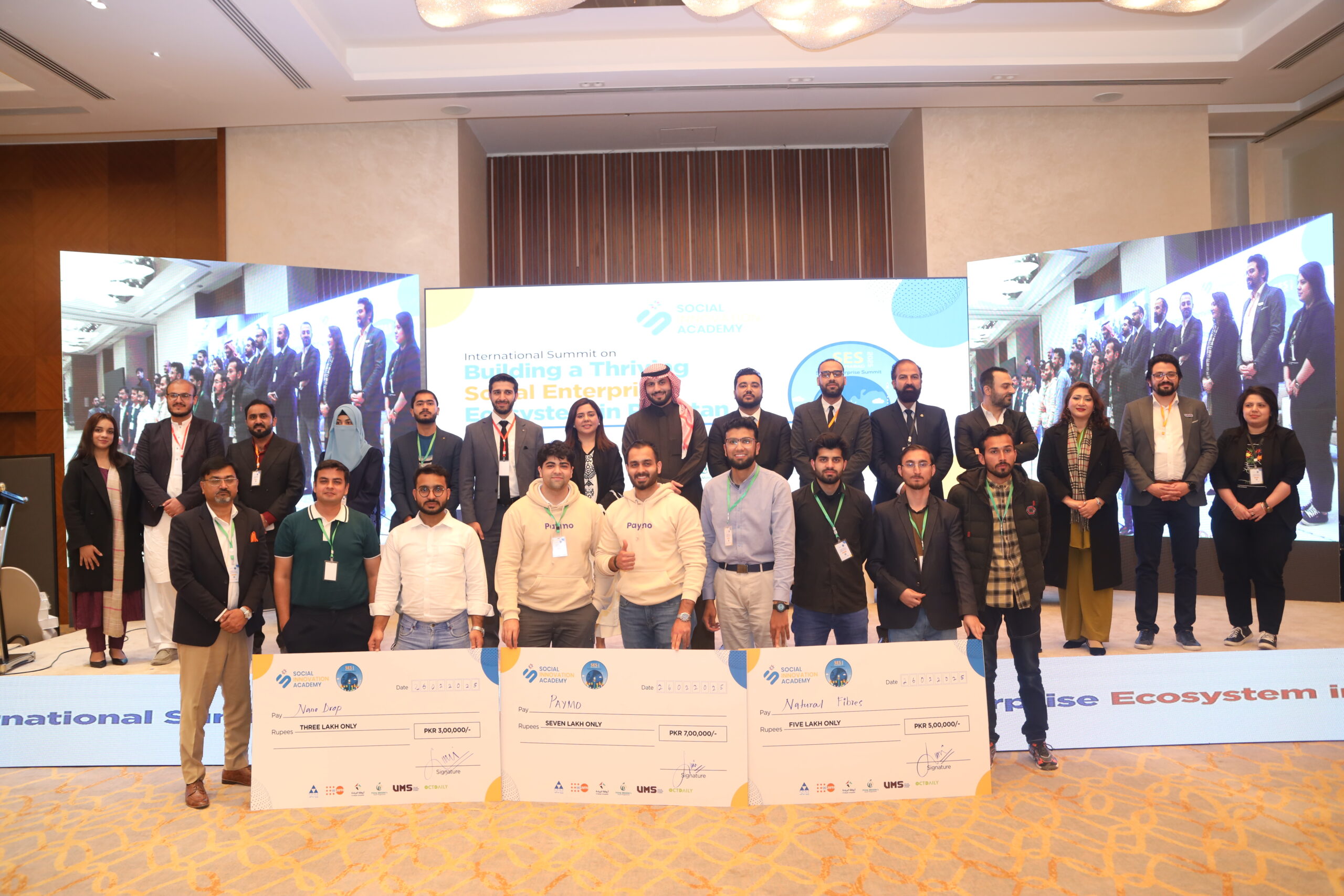
After the 2026 summit, Ali singled out Gulmina Bilal's emphasis on market access. His response welcomed the idea of connecting microentrepreneurs with regional and global value chains. That is a useful detail in his public priorities. Training has to connect with the world in which a business finds customers.
The summit also launched Social Enterprise Network Pakistan, or SENPak, as a national digital platform connecting entrepreneurs and investors. A gathering has an ending; a network offers a continuing route to contact. Its purpose gives Ali's convening work somewhere to go once the programme has finished and the room is being cleared.
“Onwards to SIA Summit 3.0.”
Ali Zain Ul Abidin, reflecting on Summit 2.0
His reflection on the event included a long roll call of organisers and collaborators. The next summit was already in view, but so were the people who had helped deliver this one. It is a public acknowledgement of the labour behind an event: coordination, preparation and the many tasks that a photograph leaves outside the frame.
The work returns to the classroom
SIA's Women Entrepreneurship Development Program provides a more distributed setting for that ambition. Its project listing records two weeks of training across Balochistan's districts for 500 women. The programme is a Government of Balochistan initiative. Its scale is provincial; its practical work happens in individual learning sessions.
Recent academy updates describe sessions covering pricing, business planning, financial records, social media marketing and attracting customers. These are decisions a business owner has to make repeatedly. A cashbook is an unromantic object, but an entrepreneur needs some way of knowing where the money went. Charisma is a poor accounting system.
The emphasis also brings the story back to Ali's early experience with business education. The subjects are familiar; the audience is wider. Instead of a student team preparing a plan for judges abroad, women across Balochistan are working through the ordinary decisions involved in running their own ventures.
young people across 4 countries
A future target shared by Ali and SIA, not a completed reach figure.The next person through the door
Ali has shared SIA's ambition to reach more than 500,000 young people across four countries by 2031. It is a substantial future target. The smaller episodes give it texture: advice to students, an explanation over Zoom, a lab assembled with a collaborator, a marketplace where entrepreneurs can show their work.
His interest in international networks continues. Recommending the Atlas Corps leadership programme, he highlighted access to a wider community for collaboration. He has also served as a judge for its leadership institute pitch competition. The former participant now has occasions to assess other people's proposals.
That change in position could be the ending. The more interesting continuity is his habit of helping someone else approach an opportunity. In 2015, it meant advising fellow students after a trip. At SIA, it means organising programmes and connections for people at several stages of learning and enterprise. The circle keeps acquiring new participants.