Olive oil is a useful place to begin a story about social innovation. It has to be made, packaged, priced and sold. A stirring mission statement will not get a bottle onto a shop shelf. When the University of Loralai sought help taking its olive products to market, Social Innovation Academy’s proposed contribution was concrete: branding, market analysis, distribution and sales strategy. The ambition was wider reach for a local product. The work was a marketing brief.
That assignment captures something distinctive about SIA, the Quetta-based organization operating across entrepreneurship education, consulting and community development. Its portfolio moves between small-business problems and national gatherings. One project teaches people to sell. Another brings policymakers and investors into a room. The connecting idea is straightforward: a socially useful venture needs the ordinary machinery of a functioning business.
SIA’s name may suggest a campus or a fixed course catalog. Its public work looks more like a set of programs assembled with universities, government bodies and development partners. Learners include students and community workers; enterprise support reaches microbusinesses and impact startups. The academy’s value is in organizing expertise and access around a particular group’s problem.
A product catalog belongs in this story
Consider Riwayat, a brand working with organic food, traditional crafts and art. SIA’s sales and brand-development initiative addressed its commercial presentation through a professional product catalog, a culturally relevant logo and digital marketing. Training covered search visibility, social media and lead generation, alongside upselling, cross-selling and storytelling. The program also included a diagnostic exercise to examine the brand’s challenges and opportunities.
The order matters. Diagnose the business, then choose the tools. A craft seller’s difficulty may be explaining a product’s value; a food business may need a route to buyers. Treating both as a vague shortage of entrepreneurial confidence would miss the job. SIA’s documented assignment illustrates a more useful starting point: identify the commercial task and teach the skills attached to it.
The Loralai olive partnership follows a similar logic, with a proposed route from production to market. Its scope includes multiple marketing channels and distribution, as well as brand development. Those are plans for reaching customers, rather than evidence of export sales. Even so, they show where SIA fits: between an institution with something to offer and the business decisions required to sell it.
An editorial map of the portfolio, not a required program sequence.
The classroom reaches beyond founders
Ali Zain Ul Abidin, identified publicly as SIA’s co-founder and chief executive, describes his work through entrepreneurship education and community-rooted innovation. That emphasis helps explain the range of people the organization works with. The participant is not always a founder carrying a pitch deck. Sometimes it is a student learning how to frame a public problem.
In December 2023, SIA and the United States Educational Foundation in Pakistan collaborated on a three-day policy hackathon in Quetta. University students from across Balochistan worked through design thinking, brainstorming and presentations. SIA reports seed grants worth PKR 150,000 for winning policy proposals. The exercise attached a practical incentive to the task of proposing solutions.
There is a useful distinction here between entrepreneurship as a career and entrepreneurial methods as an educational tool. A policy proposal does not need to become a company to benefit from identifying a problem, testing an idea and explaining it clearly. The hackathon put those habits in front of students dealing with public questions.
SIA also works in school-level science and technology education. In November 2025, the Pakistan-U.S. Alumni Network recognized Ali Zain Ul Abidin and RedPi co-founder Khet Kumar for launching a STEAM and robotics lab at Sandeman school in Quetta. SIA’s project listings include robotics bootcamps and teacher training. These activities extend its educational work to the people who may eventually become founders, employees or technically confident citizens.
The prize is money. The surrounding work is preparation.
For businesses already taking shape, SIA’s 2025 Impact Startup Challenge offered a different entry point. The call targeted social enterprises and impact-driven startups operating in Pakistan and addressing social, environmental or economic problems. It advertised grants up to PKR 1.5 million, plus mentoring, training bootcamps and introductions to investors and industry figures.
The amount gives the offer substance. It also needs to be read precisely: this was a competition’s advertised grant opportunity. It was not SIA’s valuation, company revenue or an investment round raised by the academy. For an applicant, the relevant package combined the chance of money with preparation and visibility.
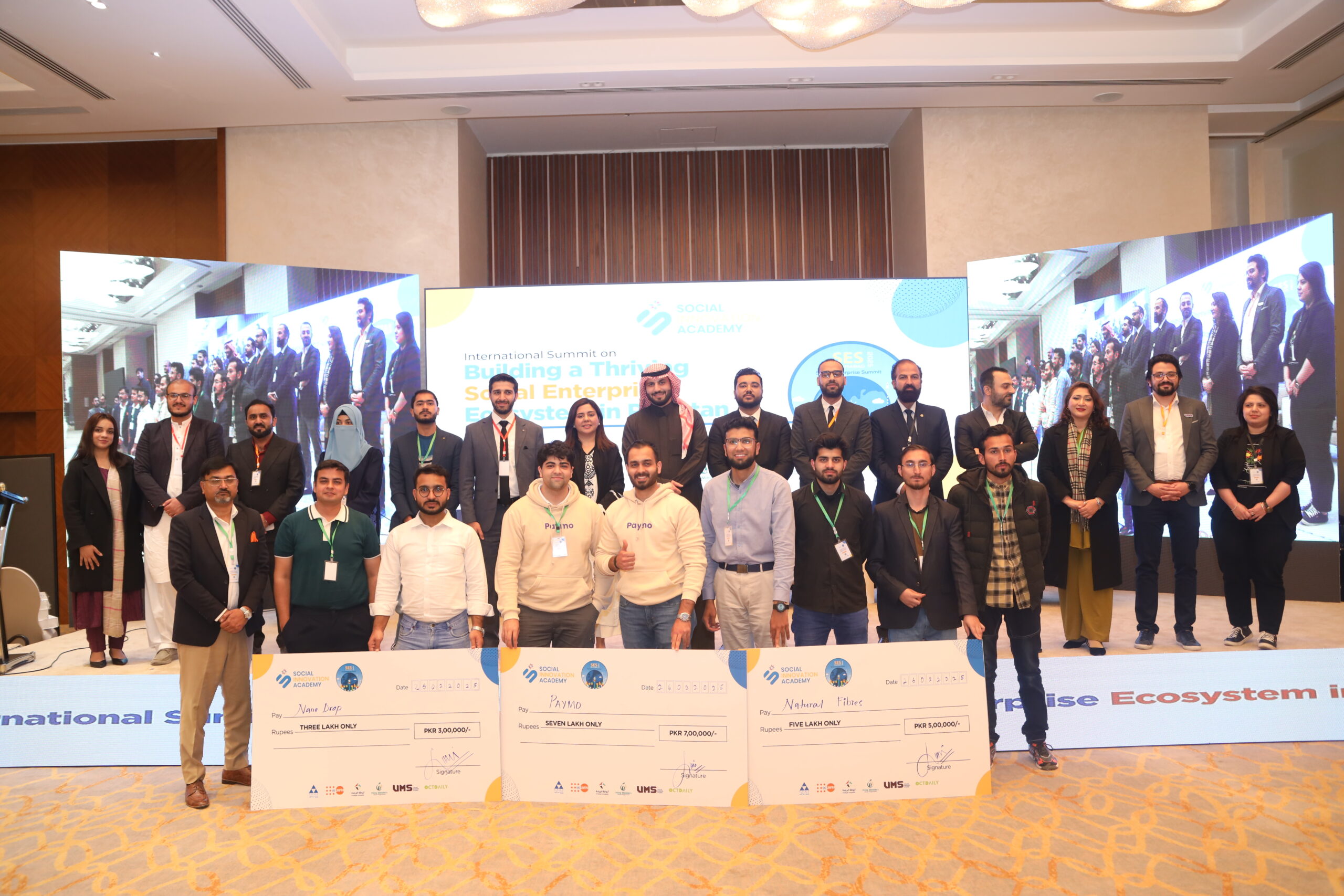
The competition sat within a larger convening effort. SIA’s Social Enterprise Summit took place in Islamabad on February 26, 2025. The academy reports more than 500 participants drawn from government, academia, grassroots organizations, business and international partners. Its named supporters included Arweqah Alreyadah, Octdaily, the Prime Minister’s Youth Programme, UNFPA and the Pakistan Poverty Alleviation Fund.
Those participants represent different kinds of help. A trainer can improve a sales pitch. An investor can assess financing. A policymaker can engage with the rules that shape a venture’s prospects. Bringing them together does not automatically create a deal, but it puts several otherwise separate conversations within reach of a founder.
“Where is the funding? Where is the talent?”
Prof. Faiz H. Shah · SES 2025 keynote
Shah’s keynote questions continued through policy, infrastructure, culture, skills, mentorship and market access. The appeal of that checklist is its impatience with single explanations. A venture can have a capable founder and still struggle with distribution. It can attract attention and still need the right financing. SIA’s range of activities makes sense against that list.
Women move to the center of the agenda
The next national summit sharpened the audience. Held on April 28, 2026, SIA Summit 2.0 focused on building a women-led social enterprise ecosystem in Pakistan. Associated Press of Pakistan reported more than 300 participants, including entrepreneurs, investors, policymakers, academics and development partners, with women-led enterprises represented from across the country.
The program gave businesses a place to show their work through a Women’s Innovation Marketplace. Discussions addressed financial inclusion, digital access, policy reform and routes to market. A Collaborative Projects Lab developed roadmaps for further work. That combination made the gathering part exhibition, part policy discussion and part planning session.
Its agenda is revealing because the barriers are specific. Digital access, supply chains and financial inclusion are different problems with different owners. The published lab structure separated them into areas for collaboration, rather than asking one training course to carry the entire burden of women’s economic participation.
SIA Summit 2.0 launched SENPak, a digital network intended to keep social enterprises, investors and collaborators connected.
SENPak, the Social Enterprise Network Pakistan, was launched at the summit as a national digital platform. Its website presents a directory and membership network, with ambitions around access to finance, knowledge sharing and policy advocacy. The useful question for a founder is practical: can the next relevant person find the business, understand what it does and make contact?
A directory can make that search easier. It still depends on useful listings and people responding to one another. The launch therefore extends SIA’s convening work into a continuing channel, with the everyday task of maintaining relationships now as important as the opening announcement.
Who buys the work, and who benefits?
SIA’s activities suggest a business built around program delivery, consulting, training and supported events. That is a reading of its documented work. The institutional partner and the person receiving support often occupy different places in the arrangement: a university may collaborate on a project whose beneficiaries are students or local producers.
This distinction helps prospective partners understand the offer. A development organization can work with SIA on a defined group’s training needs. A university can explore enterprise education or commercial support. A business can identify a particular gap in branding, sales or planning. The most productive brief would specify the audience, the obstacle and the intended deliverable.
There are alternatives for each piece of that work: business trainers, university incubators, marketing consultants and founder networks. SIA’s positioning comes from combining several of those functions with a geographic base in Balochistan and relationships reaching national institutions. Its projects make a case for coordination as a service in its own right.
The Climaventures roadshow in Quetta offers another example. SIA hosted a session with the Climate Resourcing Coordination Center’s team on financing pathways, the Climate Clinic and venture readiness. Entrepreneurs could learn how climate support programs work and what preparation they require. Hosting the conversation is a concrete role, separate from making investment decisions.
Start with the next useful task
The most transferable lesson in SIA’s portfolio is modest enough to use immediately: make the support specific. Riwayat’s work involved a catalog and sales techniques. The olive partnership specified marketing and distribution. The policy hackathon gave students a problem-solving format and a presentation deadline. Each translates a broad ambition into something people can work on.
For someone designing a similar program, the sequence is worth copying: identify the participant’s actual obstacle, select a tangible deliverable and involve the people who can help carry it forward. The necessary conditions are equally concrete. Training needs a relevant skill gap; marketing needs a credible product; introductions need interested counterparts. A workshop cannot substitute for demand.
That is why SIA’s small commercial assignments deserve attention alongside its summits. They bring the story back to the point where a social ambition meets a buyer, a budget or a classroom. The bottle of olive oil still needs a route to the shelf. Helping someone work out that route is a useful definition of the academy’s job.