Pradeep Kakkattil went to a debate in Geneva to argue that an institution should sometimes let its ideas leave home. For someone who had spent years working inside the United Nations system, it was an interesting position to take. He was also living the proposition. HIEx, the organisation he co-founded, had become independent that year.
The occasion was the Innovation Debate at Campus Biotech on 2 November 2023. Four managers had been invited to discuss whether innovation initiatives should remain inside the large organisations that created them. Kakkattil and Susanne Emonet, chief executive of Farmer Connect, took the case for independence. Cynthia Hansen of the Adecco Group’s Innovation Foundation and Geneva Airport’s Massimo Gentile argued the other side.
The audience voted for Kakkattil and Emonet. A debate victory settles an evening more readily than it settles a management question. Still, the position tells us something about Kakkattil: after a long institutional career, he was willing to question the arrangements that had made his work possible.
Before the meeting rooms, a camera
His first professional world was Indian media. Kakkattil worked in print and television journalism and as a filmmaker before moving into development work. That beginning gives his later career an unusual opening chapter. Before the partnerships and the international gatherings, there was work concerned with finding a story and making it intelligible to someone else.
It would be tempting to turn that background into a tidy explanation of everything that followed. Careers are rarely so obliging. What can be traced is a steady movement through jobs that required him to work across different groups. Between 1996 and 1999, he worked in the India office of the United Kingdom’s Department for International Development. In 1999, he joined UNAIDS in India.
He later served as deputy director of its regional support team for Asia and the Pacific from 2012 to 2015, then as a senior adviser to its executive director from 2015 to 2017. Programme partnerships, fundraising and an innovation office also became part of his professional remit. These were years spent learning how large institutions operate, how their priorities are negotiated and how cooperation gets organised.
His later role as a founder therefore came with a particular kind of experience. He had worked among the institutions an entrepreneur might hope to approach. The distance between a promising proposal and a decision was familiar territory.
An award for working from within
In 2022, the Schwab Foundation recognised Kakkattil as a Public Social Intrapreneur of the Year. The category is worth pausing over. An entrepreneur creates a venture; an intrapreneur works for change inside an existing organisation. The award placed him in the latter company, alongside Sanjay Pradhan of the Open Government Partnership.
That recognition arrived before HIEx’s independence. It catches him at an intermediate point: someone building within an institution, before leading a separate organisation. There is a useful tension in the sequence. Institutions can give a new initiative credibility and connections. As it develops, the initiative may also need room to choose its own partners and make its own decisions.
At the Geneva debate, Kakkattil’s argument centred on leadership alignment, tolerance for failure and the difficulty large organisations have in abandoning bad ideas. He favoured the freedom to work across sectors. The argument carried the weight of a founder whose organisation had recently changed its own structure.
His professional circle includes the Geneva Innovation Movement, where he is a founding member and board member. That involvement puts him among people who make organisational questions a subject of discussion in their own right. How a team is housed can seem like an administrative detail, right up to the moment it determines what the team is allowed to do.
The artist on the funding team
The Women in Innovation Fund, or WiNFUND, brought a different set of collaborators into view. Co-founded in September 2022 by Reckitt and HIEx, it joined support for women entrepreneurs with an experiment in digital art. The early partnership also included the Kofi Annan Foundation and the Ecobank Foundation.
Rwandan artist Christella Bijou designed its NFT collection. The plan was to use sales of the digital artworks as one source of support, alongside donors and partner organisations. Technology partner Tokenproof helped make the collection available. For a founder concerned with financing, it was a way to invite a different community into the project.
The artwork was only one part of the proposition. WiNFUND also sought people willing to contribute business knowledge, mentorship and connections. The model gave supporters several ways to be useful. Someone might bring money; someone else might understand a market, a business model or the next practical problem facing a founder.
“fair share of access to financing”
Kakkattil’s stated concern for women entrepreneurs, 2022
In discussing the initiative, Kakkattil made his objection to unequal financing explicit. His language was direct: women entrepreneurs should receive a fairer share. That position gives the fund a recognisable purpose without requiring a reader to be enthusiastic about digital collectibles. The financing mechanism and the people it was intended to support are separate questions.
His view of private financing also has a boundary. Kakkattil has argued for sustainable business models that offer reasonable returns without becoming exploitative, and for philanthropic money to help reduce risk for private investors. It is a qualified position. The terms matter: who takes the risk, what return is expected, and whether the enterprise can remain useful to the people it is meant to serve. Those questions put responsibility alongside the invitation to invest.
WiNFUND’s first African application round covered Egypt, Ghana, Kenya, Nigeria, Rwanda, South Africa and Uganda. WiNFUND received more than 300 applications, shortlisted 50 entrepreneurs and made investments in six. Those figures describe different stages of selection. They also show how quickly a call for entrepreneurs becomes a series of decisions about who receives help and what kind.
WiNFUND / THE FIRST AFRICAN APPLICATION ROUND
WiNFUND programme figures. Each number represents a different stage of selection.
A wider circle than the usual guest list
A photograph from Kigali in March 2023 shows Kakkattil with Reckitt colleagues Hamzah Sarwar, Cassandra Uzo-Ogbugh and Masibonge Mkhize at a WiNFUND event. He stands at the right, smiling, in a dark jacket and open-collar shirt. Behind the group is the bright lettering of the fund’s display. The picture puts faces to a partnership that could otherwise disappear into a collection of organisational names.
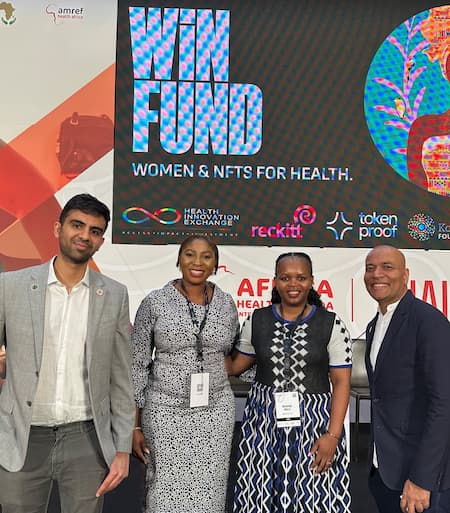
Two months later, the circle widened again. Nigerian singer Yemi Alade became WiNFUND’s global ambassador. An exclusive London performance for NFT holders was announced for June 2023. An enterprise fund had acquired an Afropop connection, which is a more entertaining development than another committee.
There was a practical idea behind the invitation. A community of supporters needs reasons to participate and occasions to meet. Art and music can create those occasions. In this instance, they also brought an artist and a performer into a network otherwise described through investors, institutions and entrepreneurs.
That September, Kakkattil was among the opening speakers at a Business Fights Poverty workshop with Reckitt and WiNFUND. Six African entrepreneurs were part of the programme, with Toyin Saraki moderating. The format gave the founders themselves a place in the conversation. It is a useful detail in a career so often described through the act of bringing people together: which people get to speak matters, too.
The next setting: climate enterprise
Kakkattil’s current work also includes Geovitas, where he is listed as co-founder and director. The company works on climate solutions for cities, industrial businesses and energy operators. Its work includes emissions measurement, compliance readiness and routes to green finance. The setting has changed, while the need to connect technical work, decision-makers and financing remains recognisable.
The leadership team includes founder chairman DSL Prasad, a former Indian Oil Corporation executive, and co-founder and chief executive Venu Puthussery. Their backgrounds bring industrial and business experience into the venture. Kakkattil’s contribution sits beside those skills rather than replacing them.
Geovitas states ambitions for 2028 that include serving more than 100 cities and industrial clients and reducing emissions by one million metric tonnes of carbon-dioxide equivalent. These are goals. Their value here is in showing the kind of work he has chosen to join: an enterprise that must connect its plans with measurable activity.
For Kakkattil, it is another setting in which a partnership needs more than shared vocabulary. Engineers, business leaders and public officials have different responsibilities. A workable project has to give each of them something concrete to do.
What survives the conference
His public reflections offer a less ceremonial view of the international meeting circuit. Writing about a week at the United Nations General Assembly in New York, Kakkattil described a mixture of rewarding discussions, contentious exchanges and plain boredom. Some rooms drained his energy; others left him convinced that people would act together.
He reserved his praise for those who continued working after the attention had moved on. His preferred kind of collaborator brought “just sheer commitment to get stuff done!” The exclamation mark belongs to him. After enough meetings, a little punctuation may be necessary.
HIEx reported another series of New York side sessions on 23-25 September 2026. The calendar keeps supplying opportunities to meet. His own comments supply a useful way to judge them: look at the commitments that survive the journey home.
The former journalist’s career now contains institutions, an independent organisation, a fund and a climate venture. Across those chapters, he keeps returning to people who have something useful to offer one another. Getting them into a room begins the work. His interest lies in giving them a reason to continue.