When Merck Serono announced the closure of its Geneva headquarters in 2012, Jérôme Wojcik had a kind of knowledge that would survive the building: he knew what it was like to need a service, look for someone to provide it, and still have work to do when the results came back. He had been the customer. Soon he would be the founder.
Quartz Bio emerged that year with Wojcik as its original chief executive. The starting proposition was specific: a small specialist business could take on data work that larger organizations needed. His former employer planned to place orders. A skill that had lived inside a corporate structure would have to earn its keep outside it.
There is an appealing lack of ceremony in that origin. The opportunity came attached to an organizational upheaval and a practical problem. An office was closing; the need for expertise carried on. For Wojcik, the next chapter began in the gap between those two facts.
A customer becomes a founder
Merck Serono announced Quartz Bio’s creation on September 3, 2012. It was part of an Entrepreneur Partnership Program intended to support businesses formed from activities and capabilities at the Geneva site. Wojcik, formerly its bioinformatics director, would lead the new venture from FONGIT’s Blue Box offices in Plan-les-Ouates.
The arrangement had a useful piece of commercial ballast. Merck Serono planned around €2 million in work orders over the following two or three years. For a young service company, an intended customer relationship meant something quite concrete: work to organize around, rather than only an idea to explain.
His experience commissioning analysis had supplied a reason to believe there was room for the business. A contractor could get the calculations right while delivering something that still needed substantial reworking for its audience. Accuracy mattered. So did the usefulness of the finished work. The buyer’s frustration became part of the founder’s brief.
The distinction is familiar to anyone who has received an elaborate answer to a slightly different question. Technical competence can be present while the customer remains busy. A specialist service has to understand the destination as well as the machinery that gets the result there.
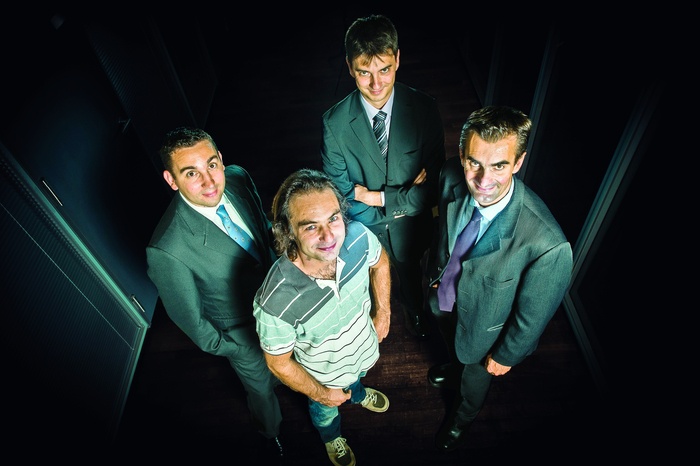
The photograph of the early team makes the smallness tangible. Four colleagues look up at the camera, close enough to fit into one frame without a panoramic lens. Company histories eventually acquire departments and regions. Here, the people still fit in a photograph with room to spare.
Wojcik’s own verdict on the change was pleasingly economical: “Sure, there is more stress, but there is more fun.” A founder gets a wider set of responsibilities. Apparently, the compensation can include the enjoyment of having them.
Forty percent before the clever part
His route into that position crossed disciplines. A mathematics master’s degree and a doctorate in biology preceded his industrial career. He led IT and bioinformatics at Hybrigenics in Paris, then moved to Serono in Geneva. By the time he founded Quartz Bio, he had worked inside both a startup and a larger organization.
That sequence gives a useful context for his interest in the less glamorous parts of data work. In a 2013 presentation, he put data management at 40 percent of the workload in a fee-for-service project, drawing on his experience. Moving, checking and organizing the material took a substantial share of the time before an analyst could make much of it.
The number gives the unglamorous work a visible size. A presentation can skip straight to the interesting finding. A project cannot skip the preparation that makes the finding worth examining. Somebody has to do the checking, and somebody has to allow time for it.
It also changes what a customer is buying. Part of the service is the discipline to establish whether the material is ready for the question being asked. The result at the end depends on decisions that may never appear in the final chart.
Data2time, the consulting business where Wojcik is managing partner, makes time explicit in its name. Its offer includes data frameworks, quality systems, analysis, databases and reporting pipelines. Those activities sit around the work as well as inside it: how a project is set up, how its information is handled, how its results are delivered.
The company’s operating details are refreshingly legible. It describes sharing analysis details and source code, tailoring work packages to a partner’s needs, and agreeing deliverables and timelines. A fixed price can follow that discussion. There is a certain courtesy in telling people what they are buying before presenting the invoice.
His service menu also includes reviewing data packages before an investment, prototyping algorithms and offering training. These are different points in a customer’s decision process. Sometimes the immediate need is to examine what is already there. Sometimes it is to try a method before committing to it. Sometimes a team needs the skills to carry the work forward itself.
That range brings the company back to the experience of being a buyer. The problem needs a shape before the service can have a price. Data2time describes examining a partner’s needs and deadlines to define the work packages. The discussion is part of making the assignment manageable for both sides.
The colleague behind the job titles
Job titles give Wojcik’s career its outline. Colleagues’ descriptions add texture. Yvan Chemama describes him as calm, creative and responsible, with a sense of humor. These are Chemama’s recollections of working with him, and they offer a more personal view than a list of appointments.
Hiroaki Tanaka’s recommendation concentrates on how Wojcik manages. He describes someone who can delegate while giving closer attention to people who need help reaching their goals. He also points to planning and the ability to meet timelines. The picture is of a manager adjusting his involvement to the person and the task.
That is an interesting balance in a specialist team. Knowing how to do the work yourself is one responsibility. Making room for someone else to do it, while remaining useful when they need you, is another. Delegation has rather more moving parts than the word suggests.
In a specialist business, the handover is part of the work.
An observation from Wojcik’s career
He has also lectured occasionally in bioinformatics at the University of Lausanne. Teaching creates another kind of handover: expertise has to become something another person can use. A student needs a route through the material, just as a new colleague needs a route into a project.
The same attention to an audience appears in his public teaching activity. In May 2023 he joined a BiotechnoSUD webinar about routes into data science, alongside Ludovic Gerdy and Afaf Saaidi. The event addressed careers and skills, giving students and other viewers a way into a field whose job titles can sound more settled than its career paths.
There is room in that conversation for his own mixed training. Mathematics, biology, IT management and company building appear in the same working life. Each move brings another set of people to understand, another vocabulary to translate, and another reason to make an explanation travel.
A company changes hands; the work travels
Quartz Bio joined Precision for Medicine in October 2017. The following year, Precision announced Wojcik as Senior Vice President for Translational Informatics and Biometrics in Europe, leading the team in Switzerland. The founder’s role now sat inside a wider organization.
The Geneva team became part of a European footprint that included Berlin, Paris and Edinburgh. Precision also announced its QuartzBio technology platform. The business that began with a specialist service and a local base had entered a structure reaching across countries.
- 2012Quartz Bio is announced in Geneva.
- 2017The company joins Precision for Medicine.
- 2025Wojcik argues for shared research infrastructure.
Wojcik subsequently took a managing director and data leadership role at STALICLA. Today his public roles include Data2time and EVBiome, whose current team page lists him as cofounder and CIO. These appointments extend a career spent moving between technical work and the organizations that make it possible.
An acquisition provides a convenient full stop for a company profile. A person’s working life tends to ignore the punctuation. There are further teams to build, responsibilities to take on and arrangements to make. Experience survives another change of address.
The founder who argues for shared foundations
There is a wider institution in this story, too. Wojcik chairs the board of directors of the SIB Swiss Institute of Bioinformatics. The board’s responsibilities include strategy, internal procedures and allocating federal funds to service and infrastructure activities. Its work concerns the foundations on which other people’s research and businesses depend.
In a July 2025 essay, he argued for supporting that infrastructure. His case connected investment in basic research with the patents, startups and partnerships that can follow. Data expertise and coordination, in his account, help turn research effort into useful results.
Read alongside his business career, the argument has a practical consistency. A specialist company needs resources beyond its own payroll. Shared capabilities must be maintained so that a team can rely on them when the next project arrives. The institution and the enterprise occupy different places in the same working arrangement.
There is a fitting circularity here. In 2012, expertise needed a new organizational home. Years later, Wojcik was making a public case for the organizations that keep expertise available to others. His career has involved both building a small business and helping oversee shared foundations.
The office in Geneva belonged to a particular chapter. The work kept finding somewhere to go.