A good idea can have a very small address. A room. A school. A neighbourhood where somebody has worked out a better way of doing things. The awkward question comes afterwards: how does it get beyond the people who already know it works? Deirdre Mortell has spent much of her career on that question. There is plenty of romance in discovering an idea. Paying for its next five years requires a different temperament.
At Rethink Ireland, the organisation she helped build from the ground up, the work is to connect social innovations with the money and practical support they need to grow. It sounds straightforward until you notice how many parties must agree: donors, government, boards, community organisations and the people those organisations serve. Each brings a different clock, a different vocabulary and a perfectly respectable reason for wanting an answer by Tuesday.
Mortell's starting observation was that Ireland already had effective community solutions and sources of philanthropic and public funding. What it lacked was a mechanism to connect them. She helped put together the business plan, identify the opportunity and raise the early money. The founder's task was to build something useful between people who needed one another, then persuade them to use it.
Dinner-table training, Cork edition
Mortell grew up outside Carrigaline in a family where politics was discussed and positions needed defending. Her father, Michael Mortell, became president of University College Cork; her American mother, Pat, is an artist. The household's American connections kept events beyond Ireland in view. Dinner came with an informal debating society attached. You learned to hold your own.
She went to UCC to study commerce and became involved in student politics. Women's rights drew her in, and she served as students' union Rights Officer and helped found the university's first LGBT society. These were concrete organising jobs: choosing an issue, getting people involved and trying to change what happened on campus. An interest in equality had acquired a place to work.
A master's in women's studies at Trinity College Dublin followed in 1991-92. Her LinkedIn education record lists a thesis asking whether there is a feminine management style. Years before she would lead a national fund, she was already interested in who gets to lead and how leadership works. Commerce and women's studies make an instructive pairing: institutions have accounts, and they also have assumptions.
Learning what money can do
Her career took her through fundraising and communications at Oxfam Ireland and Barnardos. Before leading foundations, she had to learn how to persuade people to give. These roles put the organisation of social change into daily practice: build a team, explain the work clearly, find the money and keep the work going. Conviction helps. So does somebody returning the call.
With Declan Ryan, she co-founded The One Foundation and led it for ten years. It supported organisations in Ireland and Vietnam, stewarding €85 million in social impact. The approach borrowed tools from venture capital: identify organisations with potential, understand what would help them develop, and provide support directed towards that growth. The purpose of the money was social change.
That experience placed her inside a question that would return at Rethink Ireland. What does an organisation need once its initial promise is visible? A donation may pay for an activity. Growing an organisation also involves decisions about leadership, systems and how to judge whether the work achieves its purpose. Mortell's career increasingly concerned the resources needed to make those decisions well.
The grant has company
Mortell was appointed CEO in 2014. The public launch of Social Innovation Fund Ireland, Rethink Ireland's original name, followed in January 2016, with Taoiseach Enda Kenny announcing the first awardees. The organisation brought philanthropic giving together with government support. Its five-year impact report described matching philanthropic funding through the Dormant Accounts Fund, turning that partnership into backing for social innovations.
The offer includes cash grants and business supports. That second part matters. The model looks for solutions with evidence behind them and room to grow or be replicated. Support for the organisation accompanies funding for its work. A promising project has to become an organisation capable of delivering that promise again, somewhere else or to more people.
Mortell has repeatedly used Enterprise Ireland as the comparison: social innovators should have access to the kind of growth support available to commercial entrepreneurs. This is an argument about the seriousness with which their work is treated. A community organisation with evidence that its approach works has a case for investment in its future. Good intentions should be able to arrive with a business plan.
Growth, with the people left in
By the five-year report in 2021, Rethink Ireland described a €72 million fund supporting 246 social innovations, reaching more than 400,000 people and creating over 500 jobs. Those figures gave the founding proposition a history. A mechanism conceived to connect resources and ideas was now supporting work across the country. The report also put the larger ambition plainly: build connections among innovations so they could tackle the barriers behind the problems.
Mortell's view of expansion has become more nuanced along the way. Technology can travel relatively easily; work built on relationships depends on local trust. FoodCloud, which connects surplus food with community organisations, offered an example of a technological approach spreading internationally. Face-to-face work can require someone locally who understands the community and can win its confidence.
She has acknowledged becoming more sympathetic to organisations that hesitate to expand. Growth has demands of its own. A solution may be transferable while the people who developed it have different ambitions for their working lives. That is a useful complication for a funder to admit. A national strategy still has to make sense to the person opening the door each morning.
Making room for more ideas
A Cork award, then a return to campus
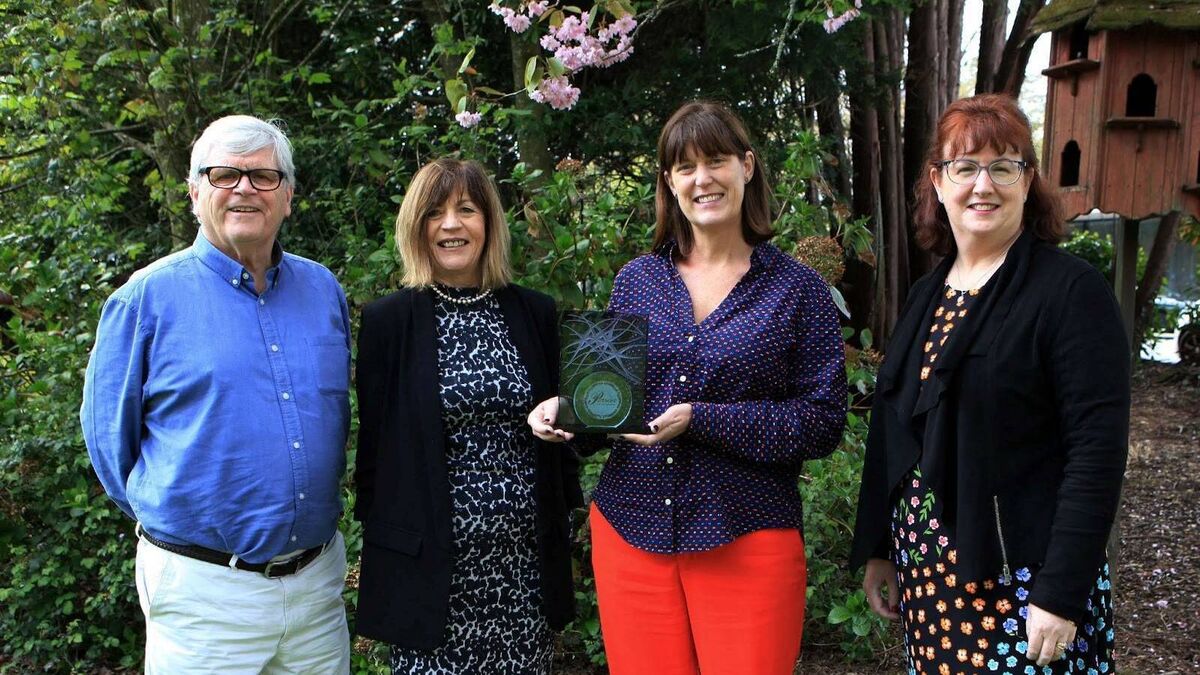
In April 2022, Mortell was named Cork Person of the Month for her contribution to social innovation and philanthropy. At the presentation, she stood with awards organiser Manus O'Callaghan, Anne Brown of Lexus Cork and Ann-Marie O'Sullivan of AM O'Sullivan PR. Recognition brought the national work back to the place where she had first learned to organise.
The figures accompanying that award supplied a snapshot of the work at that point: since 2016, Rethink Ireland had backed 333 social innovations through 36 funds. Supported organisations had created at least 677 nonprofit jobs. These are dated milestones, rather than a running total, but they show how quickly the early proposition acquired practical consequences.
In 2024, UCC named Mortell among five entrepreneurs in its new Entrepreneur in Residence programme. Students, graduates and staff developing ventures would have access to their advice. For someone whose route began with commerce and campus activism, it was a pleasing return. Social enterprise had a seat alongside other forms of entrepreneurship, with experience available to people working out what to build. The programme brought together entrepreneurs with different backgrounds, giving prospective founders access to people who had already started ventures. Mortell's presence widened the conversation about what a venture could be for. A university can teach the mechanics of starting something; a founder can also explain the decisions that remain difficult after you have learned those mechanics.
The useful art of pausing
Mortell describes herself as results-focused and empathetic, a combination that makes sense for somebody managing so many different interests. Under pressure, she gets up, walks around and takes a breath before deciding. Her point is practical: urgency can trick a leader into treating an immediate reaction as an obligation. The pause makes room for judgement.
Away from work, she reads contemporary novels by women from around the world and spends time in West Cork. She also gives Dr Seuss's Oh, the Places You'll Go! to people beginning jobs, moving countries or making other transitions. It is an unusually portable leaving present: hopeful about the journey, realistic about the difficult stretches. A leadership library can survive a little rhyme.
Her professional connections extend across founding boards, including Women for Election and Uplift, and into research through her role as CONNECT's Social Entrepreneur in Residence. The recurring activity is helping something get started. Her official biography even records learning to ride a horse, a reminder that being experienced in one field leaves plenty of room to be a beginner in another.
“I have built into myself to press the pause button.”
Deirdre Mortell
A fund to hand on, a wall to build
In 2025, Mortell received the IMAGE PwC Social Entrepreneur of the Year award in the Charitable Organisation category. The recognition fitted a career spent building organisations that back other people's work. Founding boards, fundraising teams and a national fund rarely offer the tidy authorship of a product bearing one person's name. Their achievements depend on a great many people continuing to participate.
In June 2026, she announced that she would leave Rethink Ireland at the end of the year. The original ambition had been a €5 million social innovation fund. In her announcement, she put the fund at €129 million, with 450 social innovations supported and grants awarded in every county. She credited successive boards, colleagues, donors, consultants and awardees with building it.
She plans to remain through the transition, then take a few months off to think about what comes next. There is also a stone wall she wants to build. After years of assembling the relationships that let other people grow their ideas, a project with actual stones has its appeal. The next leader will inherit the fund. Mortell has left herself some space, and something tangible to do with it.
Keep the conversation going
Follow the work, hear Mortell in conversation, or read further.