A guest list is a small exercise in power. Someone decides who belongs, who gets an introduction and whose experience counts. Dalia Said has spent years asking a useful extra question: who have we missed?
In her invitations to education and employment practitioners in Egypt, the JRNY co-founder has asked people to recommend participants beyond her immediate network. She repeated the gesture while inviting people working in sustainability to express interest in a gathering. The invitation acknowledged that valuable work could be happening outside her field of view. For someone selling connections, admitting the limits of her own address book is a revealing place to begin.
Said is co-founder and CEO of JRNY, the retreat and community-building organization previously known as ElRehla. Her work brings founders, corporate teams and industry participants out of their usual surroundings to spend time together. A conference badge introduces a job title. Her business asks what happens when people have enough time to get past it.
There is an educator behind this proposition. Before JRNY, Said worked in youth leadership and entrepreneurship media; at Harvard, she studied education. Her career has moved between settings that look quite different on a résumé. Seen through the question of how people learn, the route becomes easier to follow. The setting keeps changing. The interest in what people can discover together remains.
The classroom had a television camera
In 2008, Said was president of AIESEC Egypt. The youth leadership organization gave her an early setting for working with groups. Her later experience included Namaa for Sustainable Development and ElMashrou3. Curriculum design and event facilitation became recurring parts of her work, alongside the practical business of bringing people into contact.
She earned a master's degree in education at Harvard University, with a focus on group learning and adult development. Her research also explored how television could promote social entrepreneurship. That is a wonderfully specific educational question. A television audience has no obligation to do its homework. The learning has to earn its place inside something people choose to watch.
At Bamyan Media, Said worked in partnerships, developing relationships with participants in the entrepreneurship community. Bamyan's ElMashrou3, or The Project, put entrepreneurs into a reality television competition. Fourteen contestants faced team challenges and worked toward an investment pitch. Business learning arrived with characters, decisions and consequences, rather than a lecturer asking whether anyone had questions.
The connection to her later work is visible in the formats themselves. Television organizes an experience so that viewers will pay attention. A retreat organizes an experience so that participants will pay attention to one another. Said's professional territory sits somewhere between education, production and the introduction that turns out to matter.
A side project gets its own itinerary
ElRehla began in 2013 as a side project connecting ElMashrou3 and the MQR coworking space. It became an independent organization in 2016. The founding idea was that leaving the city and traveling together could give people more room to listen, share and learn. An enterprise grew around changing the circumstances of a conversation.
Today Said leads JRNY alongside co-founder Sara Ibrahim, its head of operations. The division of responsibilities is a reminder that a gathering needs both an idea and someone who makes the arrangements work. Nobody has ever formed a lasting professional relationship with a beautifully written agenda alone.
The company works with founders, corporate groups and industries. Its programs combine facilitated discussion, reflection, games and artistic expression. These choices give people several ways into the group. The person who speaks comfortably in a formal discussion and the person who finds an opening through a shared activity can both contribute.
Said has explicitly invited people who enjoy “introvert-friendly networking spaces.” The phrase makes room for a participant whom conventional networking can leave stranded beside the refreshments. It also signals something about the experience she is offering: participation should have more than one acceptable style.
The founder is part of the curriculum
JRNY's founder programs describe a mix of 80 percent learning through peers and 20 percent stepping away from work. The proportions are a statement of program design. A founder arrives carrying experience that another founder may need: a decision about a team, a difficult stage of growth, an approach that failed expensively enough to be remembered.
The company's clients include Flat6Labs, AUC Venture Lab, INJAZ Egypt and MINT EGBANK. Programs can help a new cohort begin together, plan its work, spend time with mentors or bring alumni back into contact. In each case, the conversation takes place within a group that has reasons to keep knowing one another afterward.
The attraction is straightforward. Advice carries a different weight when it comes from someone who has faced a similar decision and can explain the consequences. The format also asks something of the guest. Being useful to the group means contributing experience as well as collecting introductions. Everyone has brought part of the curriculum in their luggage.
When the room includes the regulator
The same organizing idea becomes more consequential when the participants occupy different sides of an industry. In November 2025, Said witnessed the signing of an agreement between JRNY and the Financial Regulatory Authority's Sandbox. Ahmed Khalifa signed for the Sandbox; Ahmed Salah Seddik, identified as JRNY's founder and managing partner, signed for JRNY.
The agreement set out cooperation on fintech programs and forums, exchanges among regulators and businesses, and dialogue relevant to future policy. Said's presence at the signing places her work in a setting rather more formal than a founder getaway. The photograph has the familiar equipment of institutional cooperation: flags, documents and a table large enough to discourage casual conversation.
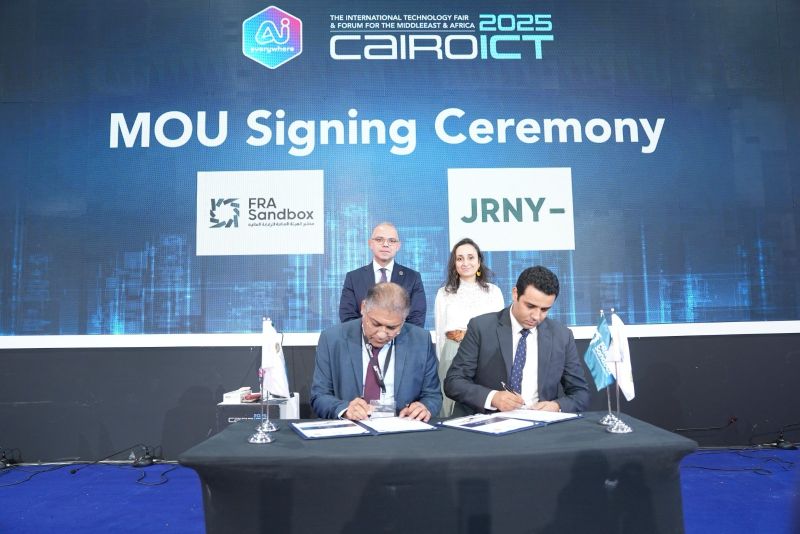
For a community builder, the interesting work begins with the different experiences around that table. A regulator, an investor and a founder can all be discussing the same industry while answering different questions. A format that lets them understand those differences has a purpose beyond exchanging contact details.
By April 2026, JRNY was announcing the second edition of its PropTech Industry Retreat, scheduled for April 23-25 on Egypt's North Coast. Its proposed participants included executives, government and regulatory representatives, technology businesses and investors. Real estate supplied another setting for Said's central interest in how groups work through shared decisions.
She described what JRNY was building as “a space for industry-wide collaboration and exchange.” The wording is modest enough to be useful. It gives the gathering a job: make room for people whose decisions affect one another to think together.
A planner that can leave with you
A retreat has a built-in limit. Only the people who attend can experience it. JRNY's answer included the DOTS Planner, created to reach people beyond its gatherings. In a public post, Said described it as a side project close to her heart and emphasized its role in helping users with focus and creativity.
A planner is a curious companion product for an organization built around groups. It belongs to one person, can be opened in silence and demands no introductions. Yet both formats arrange attention. One makes time for a conversation with other people; the other makes space to consider what to do next.
That connection is an interpretation of the work, rather than a claim about Said's private habits. It is also a useful clue to her professional range. The educator who investigated television has worked with a broadcast format, gatherings and an object someone can carry home. Each gives an idea a different route into daily life.
In August 2022, she appeared on the Riyada podcast as ElRehla's co-founder and learning director. The episode introduced her ambition to help build a more connected professional community in Egypt and across the Middle East and North Africa. The title she held then makes the educational thread unusually explicit.
The work after everyone goes home
A company built around connection needs a way to ask whether those connections led anywhere. JRNY has commissioned independent outcome assessments, including work by Collective Routes. It asks how collaborative communities form and what allows them to keep growing. Those questions make a demanding companion to the easier task of counting attendance.
What keeps a community alive and growing?
A question JRNY asks in its impact work
There are individual accounts of what followed. Sprints co-founder Ayman Bazraa says he attended an employment retreat in 2018, while the business was still an idea, and developed collaborations before founding it in 2019. iCareer co-founder Akram Marwan credits connections through ElRehla with helping his company obtain funding for a project. These are participants describing their own experiences.
The distinction matters to Said's story. An organizer can arrange an introduction and give it time to develop. The participants still have to decide what to do with it. Her work depends on other people's initiative as well as her team's design. That makes the useful aftermath more interesting than a crowded group photograph.
Her public invitations return us to the practical beginning. Ask who should be there. Ask beyond the people already in reach. Give the group a reason to listen. The career that passed through AIESEC, Harvard and entrepreneurship television has become a business concerned with those arrangements.
For Said, leaving the room has become a way of changing the conversation. The destination supplies the scenery. The people supply the possibilities. An introduction earns its keep when, some time later, someone decides to follow up.
More of the conversation
Explore JRNY and Dalia Said on LinkedIn. Listen to her 33-minute Riyada interview or watch JRNY’s introduction film.
Read the FRA Sandbox partnership announcement and her 2026 PropTech remarks. Find her earlier work at Bamyan Media.