The encounter that helped set Hikari Nonaka’s course happened in a cafeteria. At the Japan International Cooperation Agency’s center in Urasoe, Okinawa, he met a man from Kenya who had been on the island for three months. The man told him he had finally made a friend. Nonaka was startled. He remembered the welcome he had received overseas and began thinking about the people living nearby who were still waiting for one.
Distance suddenly looked like the wrong thing to measure. A person could cross an ocean and find generosity, then return home and fail to offer it across a table. Nonaka’s response became HelloWorld, where he is co-founder and co-CEO alongside Keisuke Tomida. Its premise is wonderfully inconvenient for the travel brochure: an international experience can begin without an international departure.
That premise now runs through homestays with international residents of Japan, English-language quests through towns, and online meetings between classrooms. The formats differ. Each gives people a reason to speak to someone they might otherwise pass by. For Nonaka, the destination has remained friendship.
An island childhood, an overseas welcome
Nonaka was born on Ie Island in Okinawa and grew up in Naha. In his second year of high school, he went to a desert region of the United States as an exchange student. Later, around the age of 20, he traveled through eight Asian countries. He remembers those years for the kindness he encountered and the value of meeting people across cultures.
Those experiences also exposed a gap. Some people wanted to study or travel abroad but could not spare the money or the time. International residents in Okinawa, meanwhile, wanted more opportunities to get to know local people. The two wishes belonged in the same conversation. Nonaka began organizing encounters, including cooking classes taught by people from other countries and stays in their homes.
The scale of the idea was local enough to be practical. A kitchen already existed. So did someone who knew what to cook in it. A family could share a meal and a little of its ordinary life. The interesting journey was the one from unfamiliar person to familiar face.
“The essence is the connection between people.”
Hikari Nonaka
The return to Okinawa
At the University of the Ryukyus, Nonaka studied in the Faculty of Education. His subsequent working life took him to a consulting company in Tokyo and to reconstruction support in Miyagi after the Great East Japan Earthquake. He returned to Okinawa in 2013. In 2016, he founded Ryukyu Mirai, the company from which HelloWorld would later be established through a corporate split.
He also became a representative of Startup Lab Lagoon Koza, an entrepreneurship hub in Okinawa City. There, his work included helping founders and running education and industrial-development projects with public bodies. He describes supporting more than 60 startups annually through his work at Lagoon Koza. That role places him alongside people trying to build businesses of their own.
It is a useful piece of his story because friendship alone does not organize a service. Someone must make the introductions repeatable, find partners and keep the activity running. Nonaka’s career placed him among people trying to turn local possibilities into organizations. HelloWorld brought a personal reason to that practical work.
- 2013Returns to Okinawa
- 2016Founds Ryukyu Mirai
- 2020Co-founds HelloWorld Inc.
Two founders, one shared question
Nonaka and Tomida co-founded HelloWorld in Okinawa in 2020. Tomida arrived with a different professional history: law, time as a senior visiting scholar at the University of California, Berkeley, and an interest in entrepreneurship. Nonaka brought his experience of travel and of supporting entrepreneurs at home. Their routes converged on the belief that encounters with different people should be accessible to children regardless of birthplace or family circumstances.
The company was established on October 1, 2020. The earlier HelloWorld service and the incorporated business therefore have different starting points: Nonaka was already developing the exchange idea before the two men formed the company. Keeping that distinction matters. The work grew through experiments before it acquired its present corporate form.
The founders’ ambition is to make diversity part of society’s infrastructure. That word is usually reserved for things people expect to be available. Applied to international exchange, it asks an unusually practical question: what would have to exist for meeting someone from another country to become an ordinary part of growing up?
A weekend with a different world
Machinaka Ryugaku is the homestay answer. The name is loosely translated as studying abroad right here in town. Japanese participants stay with international residents living in Japan, entering a household where food, conversation and routines offer something a classroom exercise cannot quite reproduce. The English name, HelloWorld Cultural Exchange, makes the invitation clearer to host families.
There is an operational underside to the friendly premise. Host families need enough space. Students need suitable matches. Participants may come from different schools or distant islands, so an apparently short journey can require considerable coordination. Building those arrangements is part of making a local experience available beyond the people who already find it easy to participate.
In 2024, Nonaka described hosts from about 60 countries across the Kanto and Okinawa programs. He also discussed a three-visit plan and a 12-visit plan, alongside individual stays. A world tour, in this telling, can have a recurring appointment rather than a baggage allowance.
The Machinaka Study Abroad Fund addresses another barrier by supporting free exchange experiences for children from households with limited incomes. Nonaka discussed that mechanism at a March 2024 symposium on children’s access to experiences in Okinawa and its outlying islands. Accessibility has an invoice attached; the fund gives that part of the idea an organizational home.
English with somewhere to go
HelloWorld’s other in-person format sends participants into town. In Machinaka ENGLISH QUEST, teams use English to reach checkpoints, answer questions and complete missions. The common task supplies a reason to communicate. The language has a job before anyone has time to treat it as a performance.
In June 2024, HelloWorld announced a Shinjuku Chuo Park program with JTOS, a consortium bringing together JR EAST Start UP, Tokyu, Odakyu and Seibu Holdings. Japanese and international children would take part together. The railway connection makes sense: these companies already work with the places and communities through which everyday life moves.
For Nonaka’s wider project, a quest offers another entrance. Staying overnight with a host family is one kind of commitment; meeting a team and solving a problem is another. The purpose is to give people workable occasions for contact. A checkpoint may be a modest educational technology, but it has the considerable advantage of making people ask each other where to go.
The classroom gets a window
WorldClassroom takes the exchange into schools. It combines English-learning tools with online contact between students in Japan and partner classrooms overseas. The arrangement puts a real peer at the other end of the lesson. It also allows the international part of the experience to happen within the school day.
By the end of December 2024, the company reported participation by more than 750 partner schools across 48 countries in its online international exchange program. Those are dated program figures, not a current tally of friendships or an assertion that every connection had the same result. They show the breadth of the network being assembled around the original idea.
In October 2025, HelloWorld announced that the Philippines’ Department of Education had circulated an official advisory introducing the program. In July 2026, its project for online exchange between Japanese and other Asian junior and senior high school students received EDU-Port Japan supported-project selection for a third consecutive year.
The next stated step was to bring WorldClassroom to institutions across a group of Asian countries and regions, including India, Indonesia, Taiwan and the Philippines. Nonaka’s childhood travel had depended on going somewhere. The organization he now helps lead is also making room for the student who stays in the classroom.
More than 750 partner schools had participated in HelloWorld’s online exchange program by the end of December 2024.
The introductions keep getting larger
Expansion changes the work around an idea. HelloWorld joined the sixth cohort of NEXs Tokyo in 2023, gaining connections with companies, local governments and other startups. Its Tokyo business-alliance manager, Yu Takahashi, has described the capital as a place to develop the model through a denser network of hosts and institutional partners. The company also exhibited at SusHi Tech Tokyo in 2025.
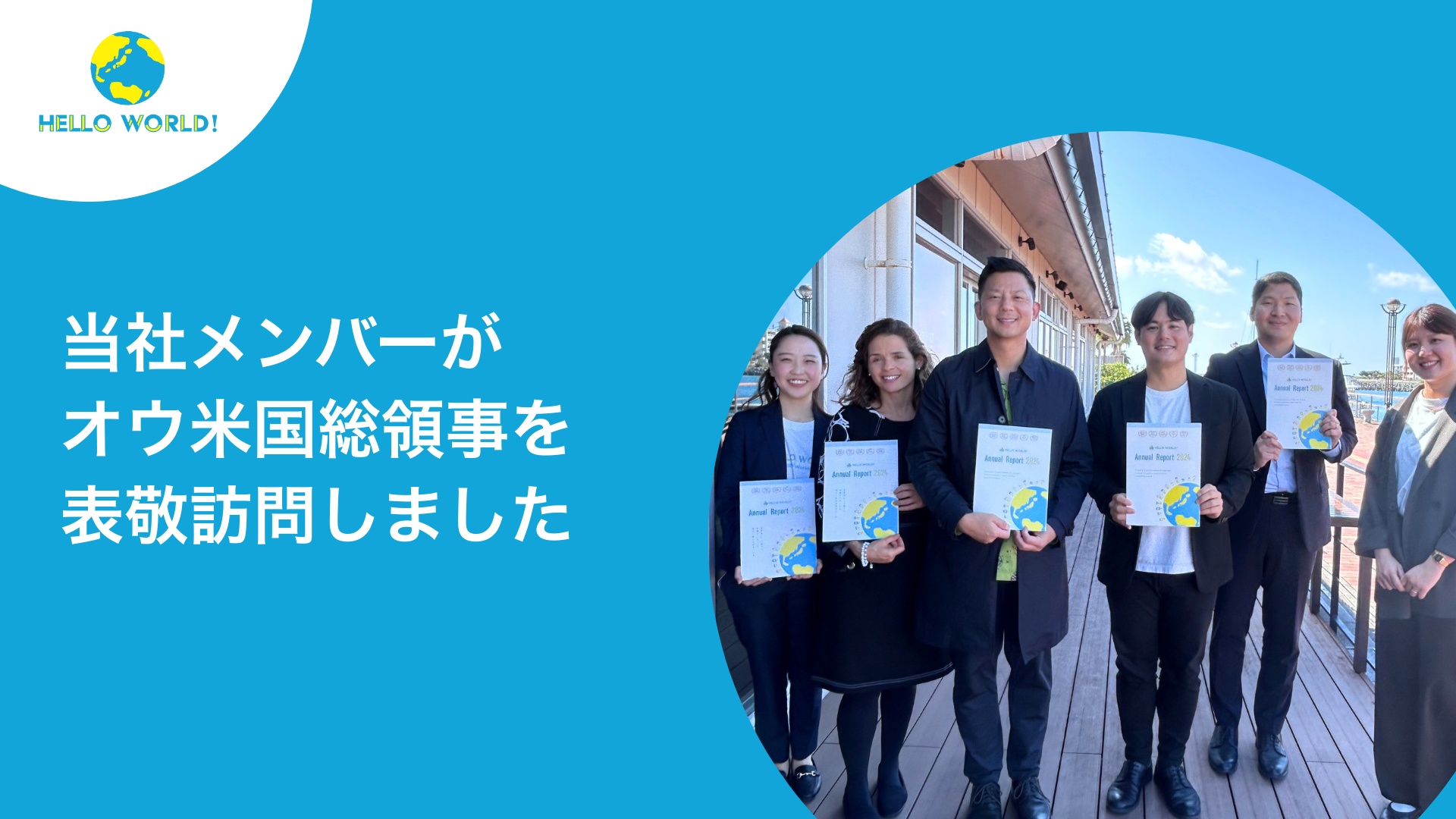
Nonaka’s own introductions have moved into diplomatic settings. In February 2026, he and three colleagues visited U.S. Consul General Andrew Ou. They discussed possible cooperation with the U.S. Embassy and the consulate in Okinawa during the United States’ 250th-anniversary year, with the aim of a longer relationship. The setting was more formal than a cafeteria; the work still concerned making contact useful.
Away from the executive title, Nonaka offers smaller points of entry: he speaks Japanese and English, enjoys meeting people from other nationalities, and likes learning to cook and eat food from elsewhere, especially spicy dishes. His interests include music, baseball and soccer too. These interests are invitations of their own. They give a conversation somewhere comfortable to begin.
The aspiration remains a society in which having a friend in every country feels normal. It is an ambition too large for one founder to tick off, and too personal to reduce to a school count. Its everyday version is easier to picture: someone newly arrived has company, a child has a question to ask, and a table has room for another person. Nonaka’s work begins with arranging the meeting.