In July 2011, Verbling’s founding team described a surprisingly tedious problem. To practise another language online, you browsed profiles, exchanged messages, swapped Skype details, negotiated a time, then hoped somebody on another continent would appear. The internet had supplied millions of potential conversation partners. Arranging a conversation still resembled planning a small wedding.
- Choose an experienced teacher for private video lessons.
- Teachers set prices and availability; Verbling supplies the classroom.
- Published fees sit on both sides of the transaction.
- Busuu bought the company in 2020, then joined Chegg in 2022.
Verbling’s first answer was a language swap. An English speaker learning Spanish could meet a Spanish speaker learning English, practise one language, then switch. Each person brought something the other wanted. The arrangement had an appealing symmetry: your mother tongue could pay for your education.
Its current website advertises lessons in more than 70 languages. Today, the exchange is more conventional. A learner chooses a teacher, books time and pays. Yet the original problem still explains the company. Verbling makes the meeting easier to arrange, gives it a purpose and keeps the materials afterward. Its business lives in the distance between wanting to speak and actually opening your mouth.
A conversation acquires a calendar
Mikael Bernstein and Jake Jolis were part of the Stanford-connected team behind Verbling, which joined Y Combinator’s summer 2011 batch. Its earliest public pitch targeted students, travellers and businesspeople. These were people with different reasons for learning, united by the inconvenience of finding someone available to practise with them.
That launch interview also contained an admirably unglamorous weakness: “Bad internet connections in Latin America sometimes make video chat slow.” Before a lesson could succeed, the connection had to work. The first documented obstacle was infrastructure, a useful corrective to stories in which educational products succeed through philosophy alone.
The move toward paid teaching changed the bargain. In a reciprocal exchange, both participants need practice. In a private lesson, one person’s job is to help the other improve. That difference explains the attraction of tutoring without requiring a claim that casual conversation failed. People can enjoy a language swap and still want somebody prepared to teach them.
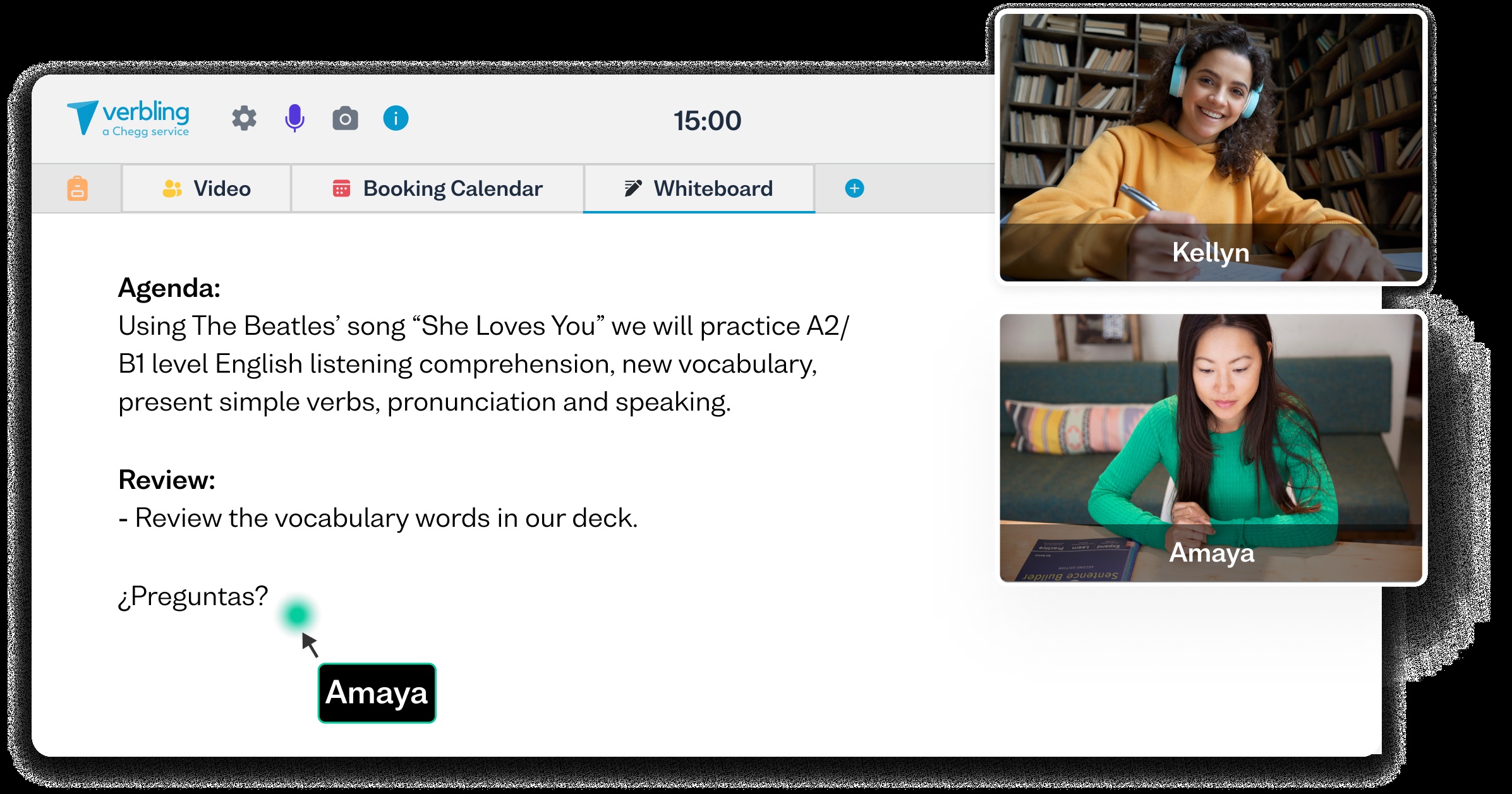
The classroom is the product
In November 2016, Verbling announced its own video system and Workspace, a central home for files, homework and lesson plans. Mikael Bernstein, writing as cofounder and product chief, explained that the new video system removed reliance on third-party video applications. The company was taking responsibility for more of the encounter.
That choice matters because tutoring produces a trail. There is the document a teacher uploads, the sentence a student gets wrong, the vocabulary worth revisiting. Verbling’s demo introduces chat, vocabulary cards, PDFs and shared textpads. The conversation can end without scattering the evidence of what happened across several applications.
For a learner, the practical move is to arrive with a task: rehearse a presentation, work through a difficult exchange or practise explaining an opinion. Agree on that task with the teacher. Then use the shared materials afterward. For a learner trying to use a language at work, that makes a specific upcoming conversation a sensible starting point for the lesson. This is an inference from the product’s design, rather than a promise that a particular number of lessons produces fluency.
What a $20 hour buys
Teachers set their hourly rates. Verbling’s onboarding guide, updated in June 2025, specifies a 15% commission: a teacher listing a $20 lesson receives $17 before any payout charges. A separate support policy describes an 8% Trust & Support fee on the amount paid by card or PayPal after credits and discounts.
$20 rate + $1.60 checkout fee. Assumes the published 8% policy applies to the full payment; excludes taxes, currency and payout charges.
The two charges pay for different sides of the same arrangement. Verbling says the learner fee supports tools, customer service and teacher vetting. The arithmetic is worth doing before buying a package: the displayed hourly rate and final cost need separate attention.
Teacher independence comes with a catch. Verbling does not assign students, and its onboarding guide says teachers cannot approach new students who have not visited their profiles. The teacher controls supply: rate, availability, preparation. Demand still depends on being discovered and chosen. Opening a calendar does not fill it.
A native accent is not a teaching qualification
Verbling requires previous teaching experience. A formal certificate is preferred, and applicants need evidence of their teaching background. Native-speaker status, however, is unnecessary: the application page accepts teachers with C2 command of the language. That distinction gives learners a better question than “Where were you born?” Ask how the teacher handles your particular difficulty.
The closest alternatives include tutor marketplaces such as italki and Preply. Verbling’s case rests on experienced teachers and an integrated learning environment. Its broader competition is whatever a learner uses instead: self-study, a local class or an informal exchange. Each demands a different combination of money, time and personal initiative.
For employers, there is another layer of coordination. Verbling’s enterprise product puts administration around the same teaching platform: inviting members, managing access, paying for a plan and generating reports. It advertises single sign-on and provisioning through a SCIM API. A manager can organize the program while employees choose teachers and book lessons. The distinction is practical. An individual needs a useful hour; an organization needs to know who can book that hour, who pays for it and how participation is tracked. Companies can request curriculum suited to their needs, although a dashboard alone cannot establish that a lesson improved someone’s performance at work.
The rival that bought a classroom
There is a pleasing turn in the ownership story. In 2011, Verbling’s founders named Busuu among the larger competitive threats. In January 2020, Busuu acquired Verbling for a sum described as double-digit millions of dollars. Busuu planned to use its technology for live tutoring alongside self-paced study. Chegg’s acquisition of Busuu closed in January 2022.
The buyer saw a fit between two learning activities. A course can introduce material whenever a learner is free. A teacher can respond to the particular person struggling with it. Verbling’s own announcement emphasized complementary expertise and access to Busuu’s audience. It was a distribution argument as much as an educational one.
For someone choosing lessons, the remaining constraints are ordinary but decisive. You need a reliable connection, a compatible teacher, available time and enough budget to continue. Purchased lessons also carry expiration rules. Try the classroom demo and check the booking terms before committing. The useful idea to copy is modest: remove the arrangements that stop a valuable interaction from happening. Then give people a reason to return.