Before Preply became a billion-dollar company, Kirill Bigai had a smaller problem: English. Growing up in Kyiv, he wanted to become an international entrepreneur. That ambition required a language he needed help learning. Finding a good tutor online suggested a business hiding inside his own frustration. The interesting part was never simply putting a lesson on a screen. It was putting the right person on the other side.
Consider the difference between recognizing a word and using it while somebody waits for your answer. One is a private victory. The other involves timing, embarrassment, correction and another attempt. Preply sells access to that second experience. Its marketplace lets learners choose a tutor, book a paid trial and build a recurring schedule of individual video lessons. The software handles the meeting; the relationship gives it a reason to happen. For the learner, an appointment also creates a small deadline that self-study can easily lack.
- Choose a tutor. Meet online. Build a speaking routine.
- Tutors set prices; Preply earns a commission.
- AI turns lesson material into feedback and practice.
First, find the demand
Preply began in 2012 with Ukrainian founders Bigai, Dmytro Voloshyn and Serge Lukianov. Its early proposition involved SAT and ACT preparation. By 2013, it had pivoted toward English tutoring. Research firm Sacra describes the move as an escape from crowded American test prep into cross-border demand, including markets such as Poland, Spain and Brazil. The first idea was too narrow for the opportunity the founders found.
That is the useful entrepreneurial lesson here: a marketplace needs a compelling reason for two strangers to transact. Language learning supplied one. A learner could find someone beyond the local neighborhood; a tutor could reach customers beyond the local economy. Preply subsequently added scheduling, calendar booking and an integrated classroom. Each addition made it easier to keep the teaching relationship inside the platform.
A trial has two price tags
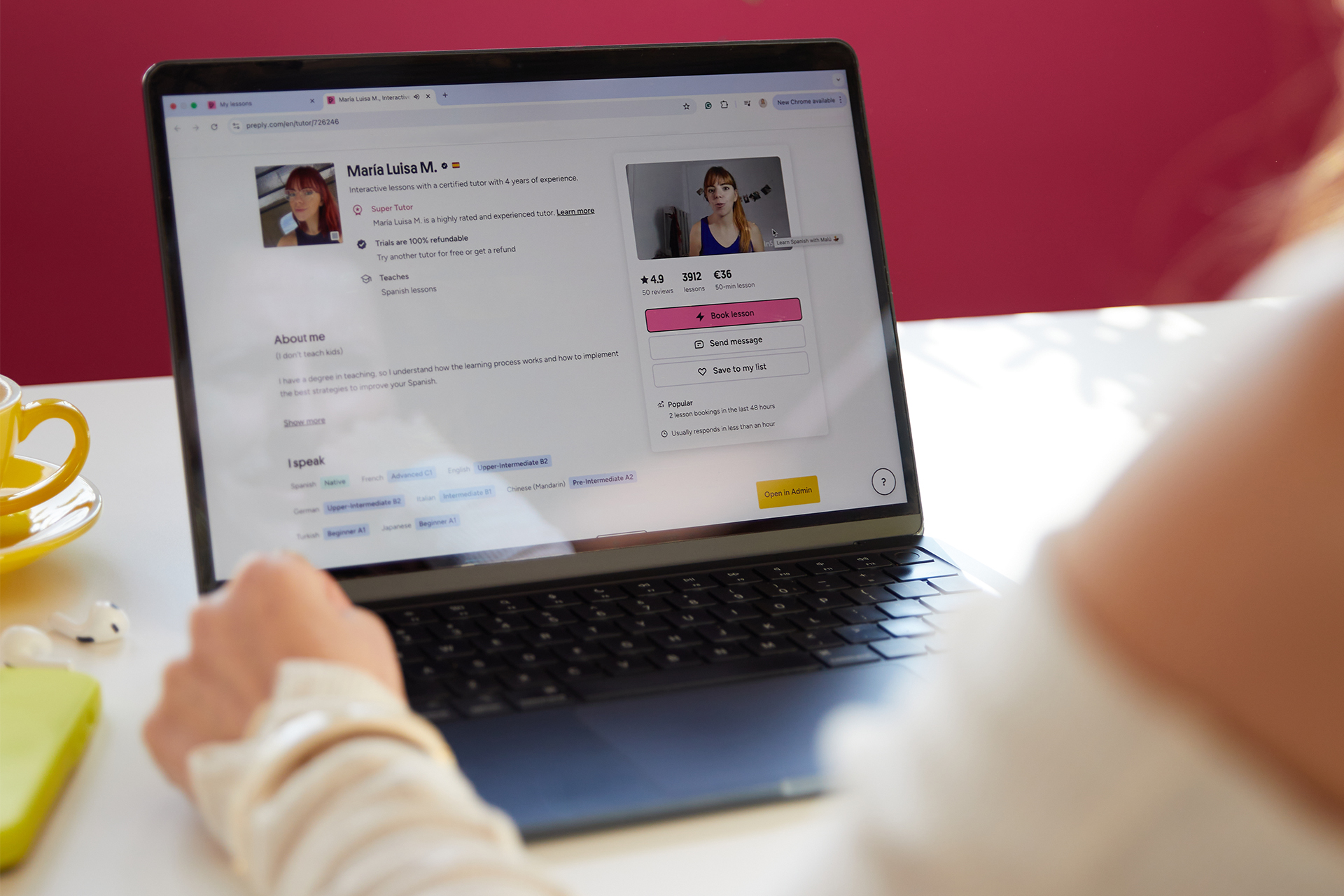
The shopping experience is familiar: profiles, introduction videos, specialties, reviews, rates and availability. The underlying purchase is unusually personal. A learner preparing for an interview may need different feedback from someone moving abroad or helping a child practice. Tutor selection lets those differences matter. Trials last 25 or 50 minutes and let both sides discuss goals, assess the starting level and consider a learning plan.
Tutors set their rates, so there is no single Preply lesson price. There is, however, a consequential platform fee. Preply keeps 100% of the fee for each trial with a new student. On subsequent lessons, its commission starts at 33% and declines with accumulated teaching hours to 18%. For a tutor charging $20, that leaves $13.40 at the initial regular-lesson rate, or $16.40 at the lowest commission, before any other expenses.
Preply says the commission funds student acquisition, classroom technology and support, including replacement trials for dissatisfied learners. For tutors, the practical question is how many first meetings become continuing students. For learners, subscriptions turn an intention into a repeating bill. Subscription billing runs every 28 days. The sensible calculation is the cost of a routine you can actually attend, with renewal terms checked before buying.
Give the teacher better tools
Preply’s AI strategy starts with the lesson that just happened. Its optional Lesson Insights produces feedback and summaries, including vocabulary and speaking metrics. Daily Exercises builds short practice around lesson material. Scenario Practice, introduced in beta, lets learners rehearse situations with AI avatars between meetings. A teacher can assign a scenario connected to the learner’s goals, bringing practice closer to the conversation that matters next.
The sequence matters: speak, inspect, practice, return. Instead of asking a learner to assemble several unrelated tools, Preply connects the work between appointments to the tutor’s work during them. Product manager Emily Stott describes the aim as “enhanced by AI, without losing the human touch.” That is a product philosophy with an economic implication: software can support more practice without requiring a teacher to attend every minute.
“enhanced by AI, without losing the human touch.”Emily Stott · Preply product manager
The meeting after the meeting
For employers, the same relationship comes with a management problem. Who is attending? Who needs help? Is the training relevant to work? Preply Business adds onboarding, employee learning plans and dashboards for engagement and progress. Its public customer examples include Miro, Delivery Hero, CloudPay, BNP Paribas and EBANX. An employee gets a tutor; the organization gets a way to administer a program across schedules and locations.
This places Preply between several familiar alternatives. italki is another destination for finding individual language teachers. Lingoda offers scheduled language classes. Duolingo and Babbel compete for self-study time. A local tutor competes on trust and proximity. Preply’s particular proposition combines tutor choice, recurring individual lessons and connected practice. The expertise it must keep improving is matching people, supporting teaching and keeping useful practice going.
The money follows the repeat visit
Building that infrastructure has required substantial capital. Preply announced a $50 million Series C in July 2022, led by Owl Ventures, followed by a $70 million equity-and-debt extension in July 2023 led by Horizon Capital. In January 2026, WestCap led a $150 million Series D at a $1.2 billion valuation. The company also said it had become EBITDA positive, a narrower claim than reporting audited net profit.
The scale is still moving. In its October 14, 2026 announcement, Preply reported more than 150,000 tutors, over 90 languages and learners in 180 countries. It appointed Lillian Reaume as Chief People Officer and former Duolingo data leader Bilal Zia as Vice President of Data Science and Analytics. Hiring someone to study learning and marketplace behavior fits a company whose next question is which relationships produce progress.

Book the conversation you need
What can a reader copy? Start with a concrete speaking task: explaining a project, answering interview questions or talking with a neighbor. Use the trial to ask how a tutor would practice that task. Reserve a realistic slot. Review the mistakes before the next session. The routine is modest, which is precisely its appeal.
This approach asks for money, a reliable connection and time shared with another person. It is a poor fit when the budget cannot sustain regular lessons, the available tutor schedules clash with yours, or you only want occasional vocabulary drills. Tutor fit also remains a variable that software cannot settle in advance. Preply’s wager depends on what happens after the introduction: whether two people find enough value in the conversation to book another one.