The monster is the first thing you notice. Green, round, cheerfully unsuited to a school board meeting. In ClassDojo, little creatures stand in for children as teachers recognize effort, kindness or teamwork. It looks like an unusually friendly classroom chart. But the more consequential thing happens when a parent opens the app. A school day that would otherwise arrive home as “fine” acquires pictures, messages and something specific to talk about over dinner.
- The job: connect teachers, children and families through classroom updates and messages.
- The bargain: keep core school communication free; charge for optional family extras.
- The lesson: win a place in someone’s daily routine before asking for a larger role.
The idea teachers didn’t ask for
When Sam Chaudhary and Liam Don arrived in California, they wanted to help children work in groups. Chaudhary had taught; Don brought the engineering. It was a plausible idea with a fatal inconvenience: teachers kept talking about other problems. In a 2015 interview, Chaudhary recalled speaking with 300 or 400 teachers during their first three weeks. Classroom management kept surfacing underneath complaints about exhaustion and marking homework.
The founders changed direction. They built a small positive-feedback tool in less than a week, Chaudhary said. Teachers could recognize useful behavior as it happened. The product gave a familiar classroom practice a convenient interface. Later, noticing that effective teachers cultivated relationships with parents as well as children, the company added accounts that brought those people into the same circle.

A classroom is also a distribution channel
Consider the shape of that circle. One teacher adopts a useful tool. Parents have a reason to join because their child’s teacher is there. Each classroom supplies its own invitation list. The relationship precedes the software, which helps explain why this particular network can spread without first persuading a district procurement department.
That is the strategic reading, rather than a claim that every school adopted it identically. ClassDojo’s About page now describes a community of more than 50 million teachers and families. That is a company-reported community figure, not a count of people using every feature each day. The useful observation is simpler: a modest classroom utility opened a route into households.
The photograph does some of the work
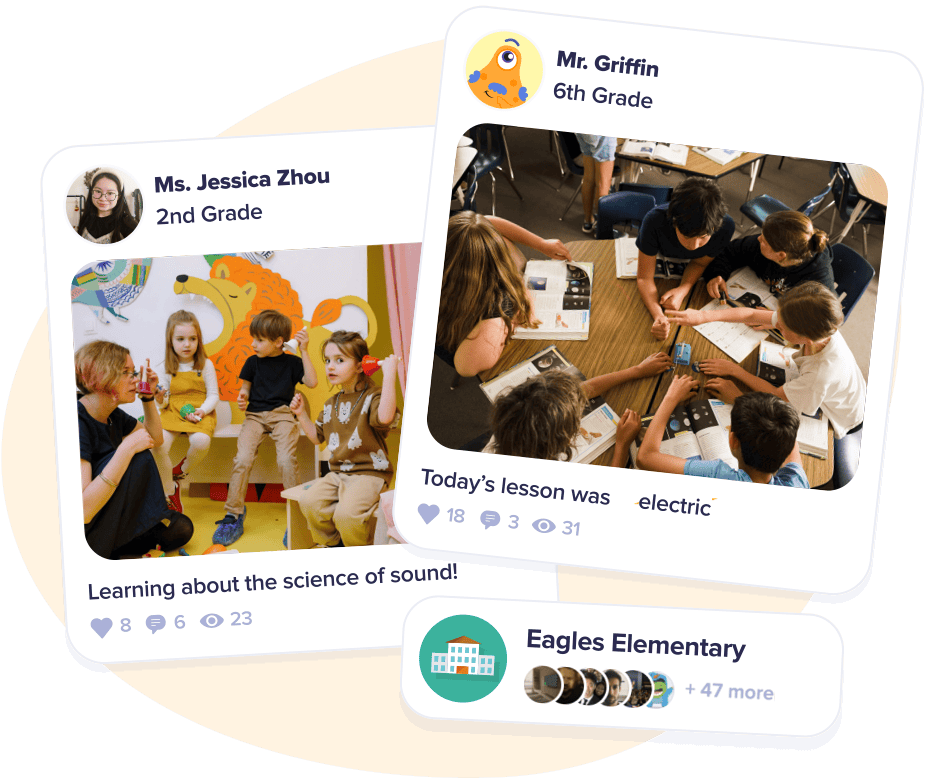
Today, Class Stories provides a private feed for classroom photographs, videos and updates. Messaging lets teachers and families communicate, with automatic translation advertised in more than 190 languages. Portfolios give children somewhere to share their work; calendars and classroom utilities handle practical chores. These are small jobs, but school-home relationships contain a great many small jobs.
A parent can see what a child made, ask a focused question and send the teacher a reply. A teacher can explain an activity once to the class’s families. Translation reduces one obstacle to that exchange. None of those features guarantees involvement. They make involvement easier to attempt, which is a more useful promise than treating an app download as an educational outcome.
Free has a financing plan
The teacher and the paying customer are often different people. ClassDojo launched its optional Plus subscription in 2019. Its current family offering includes enhanced messaging, more detailed progress reports, home feedback points and saved classroom memories, with learning extras varying by plan. Basic teacher messaging, class points and classroom updates remain free.
The company’s district page says that 5% of families choose premium features, helping fund the free service. It also now acknowledges paid district add-ons. That distinction matters: “free” describes the core service, while a growing business sells additional help around it. Families should check the plan and checkout terms they are actually offered.
For ClassDojo itself, reaching this point required patience and outside capital. Forbes reported a $125 million Tencent-led financing completed in September 2021, disclosed in 2022. Money bought room to expand; it did not remove the need to discover which extras parents valued.
“It was abysmal.”Sam Chaudhary, recalling conversion in an early paid avatar experiment
In a First Round interview, Chaudhary described selling avatar customization before the company had a substantial paid family product. Conversion disappointed. A few purchases nevertheless suggested willingness to pay. The distinction is useful for builders: a weak offer can reveal a possible customer without proving that the offer deserves a business.
What travels beyond the school gate?
ClassDojo has been testing that question with several products. Dojo Tutor offers personalized, one-to-one online lessons. Dojo Sparks uses speech recognition and phonics activities for young readers. Dojo Islands gives children a virtual space for play. The expansion follows the household relationship into activities that happen after the bell.
Meanwhile, its expertise still rests partly in making classroom practice usable. The Big Ideas growth-mindset videos began with Stanford’s PERTS lab in 2016. In July 2025, ClassDojo announced free access to Sidekick, a Claude-powered teacher assistant for tasks including lesson planning and family communication. The underlying pitch remains time saved for teachers.
There are practical limits to those ambitions. Sparks asks a child to speak aloud and interact with a touchscreen. Its help page cautions that it may be a poor fit for children who find those tasks challenging. A family choosing it needs a suitable device and a child comfortable with the interaction. Familiarity with the school app cannot settle that decision for them.
The company’s published working principles offer a clue to how it wants to build these extensions. Its careers page emphasizes protecting downtime, finishing work and putting prototypes in front of users early. Those are the company’s stated habits. They fit the original discovery: an elegant idea becomes useful only after someone with a real problem has tried it.
The monster grows up
ClassDojo now sits alongside school-home communication providers such as ParentSquare and its Remind offering, while reaching into family learning and children’s play. Its 2026 teacher pages advertise Canva integration, multi-class posts and interfaces for older students. Teacher-student messaging has eligibility restrictions, including rostering and school controls. Elementary-school charm alone cannot solve a high school’s communication requirements.
The transferable move is to start with a recurring problem someone can act on immediately, then let existing relationships carry the invitation. It depends on participants finding continued value. Where families cannot reliably access the service, or a school requires another channel, that loop weakens. ClassDojo’s next chapter will depend on making each additional product useful enough to earn its own place in the family routine.