The school laptop has a peculiar design problem. From the front of the classroom, a child researching a history project can look remarkably like a child playing a game. The lid conceals the difference. Give every student a device, and you give the teacher a roomful of tiny walls.
GoGuardian built a business behind those walls. Its tools let schools filter websites, guide classroom browsing, and flag activity that might suggest a student needs help. The interesting part is how quickly those jobs lead into one another - and how different their consequences become.
- Admin sets the district’s online boundaries.
- Teacher helps a lesson survive the browser.
- Beacon flags possible distress for adults to investigate.
First, the computer. Then, the problem.
Founded in 2014, GoGuardian arrived as schools were adopting individual student devices. Its initial browser filtering proposition addressed a problem the hardware purchase created: connecting children to the internet also meant deciding what they could reach.
GoGuardian Teacher followed in 2015; Beacon arrived in 2018. The company was moving from controlling access to coordinating attention, then toward identifying risk. A school buying one laptop per child had acquired a continuing management job. GoGuardian sold software for that job.
Its investor Sumeru describes an especially practical distribution channel: partnerships with classroom technology sellers could put GoGuardian software onto devices as schools bought them. The buyer encountered the management tool alongside the thing that needed managing. For another business to copy that move, it would need a similarly close connection between the purchase and the work it creates.
Three adults. Three different jobs.
Consider the division of labor. An IT administrator needs a filtering policy that works across the district. A teacher needs students on the right material during this particular lesson. A counselor needs enough context to decide whether an alarming search merits a conversation.
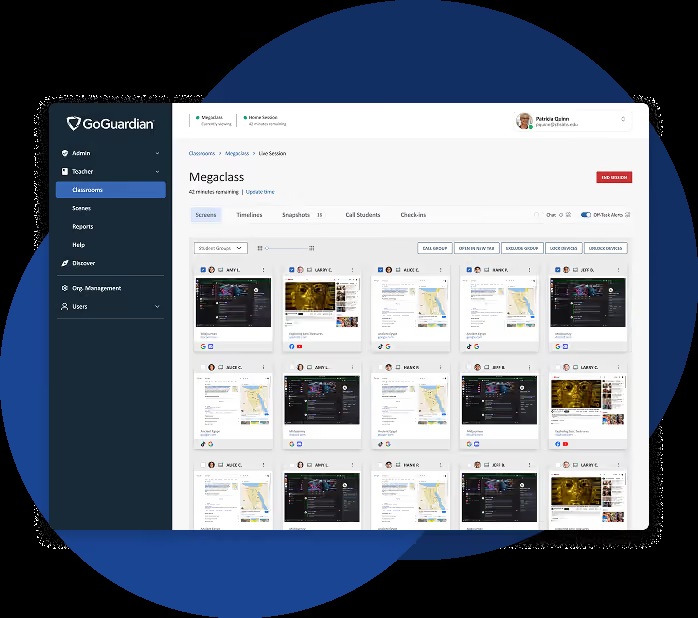
Admin handles filtering and activity reporting. Teacher supplies live screen visibility, tab controls, private chat, and website rules called Scenes. Teachers can give different groups different resources. Integrations with Google Classroom, Clever, and ClassLink help keep rosters synchronized.
Beacon analyzes supported online activity for possible suicide, self-harm, or violence risk and routes alerts through configurable workflows. Its separate 24/7 service includes human review of specified high-severity alerts and phone escalation. Coverage and response depend on the purchased service and school configuration.
Conceptual workflow. An alert starts the assessment.
The breadth is GoGuardian’s commercial distinction. Alternatives include Lightspeed Systems, Securly, and Linewize; Gaggle also competes in safety monitoring. GoGuardian connects several school responsibilities within one portfolio. That can simplify purchasing and administration, although shared packaging does not make the responsibilities interchangeable.
The budget has a browser problem, too
The company now extends beyond screens. Hall Pass manages digital permission to leave class. Discover examines application use, license spending, and privacy risks. The same general proposition keeps appearing: show school staff what is happening so they can decide what to do.
Its business model is recurring school and district subscriptions, sold directly and through resellers. Prices depend on enrollment, bundles, and contract length. A Rock Island-Milan board memo proposed a $38,400 one-year suite renewal covering July 2025 through June 2026. That is a district-specific purchasing example, not a price list.
Sumeru announced its acquisition in 2018. Tiger Global invested $200 million in August 2021 at a valuation above $1 billion. The money followed an established school software business, with subscriptions and distribution already in place.
10,000+ schools / 2M+ educators
Company-wide reach. These figures do not describe Beacon enrollment or prove safety outcomes.What changed in Centralia
In an October 2026 customer story, Centralia technology director Don Ford describes beginning with Teacher in 2018. The pandemic changed the requirement: devices were going home. He returned for Admin in 2021.
“When we had that need, I immediately went back to GoGuardian.”Don Ford · Centralia School District
His purchasing rules are refreshingly concrete. Paid software must support the curriculum and justify its cost through use. He reviews adoption, considers longer agreements for continuing needs, and starts renewal discussions before the budget deadline.
There is a useful lesson here for any buyer: examine the recurring job before accepting the recurring bill. A dashboard that nobody consults is still a subscription. An alert without an assigned responder is still unfinished work.

A crossword clue is not a confession
The hardest part is interpreting what appears on those screens. In its Red Flag Machine investigation, the Electronic Frontier Foundation documented misleading alerts, including a Beacon case involving a crossword solver’s suggestions for “Western Necktie.” One suggestion was “noose.” Context changes the meaning of a word.
That example identifies a specific failure: an innocent activity could become an alarming signal. It does not establish the current system’s overall error rate. GoGuardian says its AI uses context to reduce false positives; schools still need people who can question the result.
The company says districts own and control personal student information and choose monitoring settings. Those controls matter most when staff define access, explain monitoring to families, and treat risk signals as prompts for careful review. Software cannot supply missing counseling capacity or guarantee that a student’s difficulties will appear in monitored activity.
The next tab is policy
In August 2026, GoGuardian announced an Admin recommendation engine that suggests policy changes from activity patterns. September brought its announcement of a Kentucky statewide filtering transition supporting 155 districts and education department organizations. The product updates also acknowledge a smaller, revealing repair: URL rules that could match more than intended received more precise hostname boundaries.
GoGuardian’s opportunity keeps expanding with the work schools give computers. Its expertise lies in making activity visible and manageable at scale. Whether that visibility helps a particular child depends on the rules, resources, and judgment on the human side of the screen.