A musician can spend years learning to keep time and still have trouble filling a calendar. Steven Cox saw this at close range. A bandmate was considering restaurant work because music was not paying the bills. Cox offered to help him find students online. The problem sounded modest: put a good teacher where a prospective pupil could find him. The business that grew around it would discover how much work hides inside the word “find.”
- The job: connect learners with teachers, then manage the appointment.
- The catch: a lead is only useful if somebody converts it into a lesson.
- The money: private-lesson commissions and a group-class subscription.
- The ending: Microsoft acquired it in 2021; the service closed in 2024.
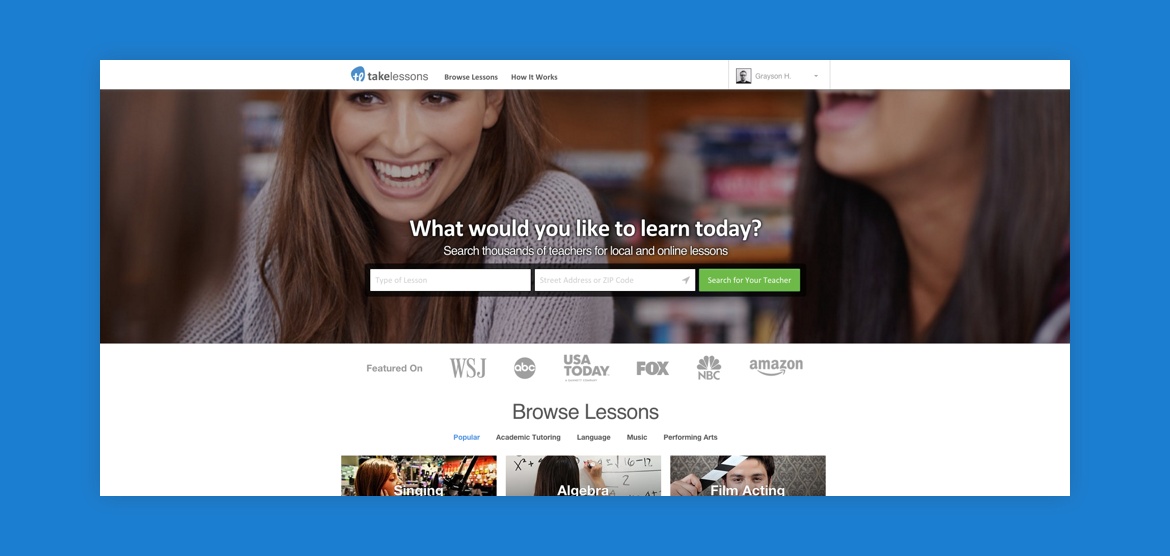
TakeLessons became a marketplace for private instruction, online and in person. Children needed piano teachers. Adults wanted Spanish, singing or a skill they had been promising themselves they would learn. Teachers needed customers and fewer administrative chores. It was a business about education, certainly. It was also a business about making Tuesday at four o’clock happen.
A maybe is a difficult thing to sell
The early venture, called Click for Lessons, tried several ways of charging for introductions. There was an unlimited-leads subscription at $30 a month, an advertising model and a price per lead. In their book The Lean Entrepreneur, Brant Cooper and Patrick Vlaskovits describe a programme that reached more than 4,000 instructors across 15 major US cities, then stalled.
The interviews behind that case study identified an awkward mismatch. Some musicians were living from one paycheque to the next. Paying $6 for an inquiry meant spending money before earning any. And the inquiry came with another task: follow up, persuade the prospective student and close the sale. Cox had supplied a business opportunity to people who wanted teaching work.
That distinction changed the model. TakeLessons would help arrange the transaction and collect payment, rather than leave the teacher holding a name and a telephone number. The interpretation is straightforward: its useful innovation was taking responsibility for more of the journey between interest and income. A teacher could be excellent at explaining rhythm without being particularly keen on explaining a cancellation policy.
A promising inquiry cannot pay the rent.
An observation about the early business model
Five kinds of lesson, one city
A marketplace has a rather humiliating weakness. It can contain thousands of people and still have nobody suitable for you. A violin teacher across the country does little for a parent seeking an in-person lesson after school. Quantity is a comforting number; availability is the number that gets a booking.
Co-founder Chuck Smith later described the company concentrating on five music lesson types in San Diego before expanding. His account offers a practical explanation: each category and city needed enough teachers to serve students, and enough students to keep teachers interested. A narrow opening gave the company a manageable place to make that balance work.
Trust was another part of the appointment. In its 2011 funding announcement, TakeLessons said fewer than eight percent of teaching applicants received its certified-instructor designation. It also described asking students for feedback after lessons and removing teachers with persistently poor ratings. Those were the company’s claims about its screening at that time, rather than a guarantee about every later listing.
For students, the appeal was comparison and convenience. For instructors, it was marketing, scheduling, billing and payment processing. By March 2014, the company reported more than a million lessons taught and over $20 million earned by teachers through its marketplace. Teacher earnings were a particularly telling measure for a company whose original customer problem was an empty calendar.
The price of the next appointment
TakeLessons never had one universal private-lesson price. In the later marketplace, instructors set their rates. Historical coverage described sessions of 30, 45 or 60 minutes costing roughly $20 to more than $200. A short beginner session and specialist instruction were different purchases. These are old advertised ranges, not an offer you can book today.
The commission was a separate calculation. SideHusl’s retrospective review documented a later schedule taking 20 percent of the first ten lessons with a particular student and 10 percent thereafter. It also recorded an earlier 40 percent commission. Fee structures changed, so treating any one percentage as the company’s rule for its entire life would be misleading.
Yellow = platform commission. Example uses the later schedule documented by SideHusl; excludes taxes and other expenses.
The arithmetic rewards a continuing relationship. It also creates a test for the platform: after the introduction, does the teacher still value the services enough to keep paying? Finding a student is difficult. Remaining useful once the student knows the teacher requires dependable work every week.
TakeLessons Live offered a different purchase: subscription access to interactive group classes, alongside recorded material. Historical coverage advertised a $19.95 monthly membership. In February 2021, the company added beginner acting classes to offerings that included music and languages. A group subscription let someone try a new subject without paying for a private appointment each time. Cox described its social premise as “real people connect with each other.”
Group teaching brought its own friction. SideHusl reported teacher complaints about unclear compensation for live and recorded classes, even while private-lesson commissions were easier to understand. Those complaints identify a transparency problem. They do not establish why the company eventually closed.
A guitar needs an accomplice
TakeLessons’ partnerships placed instruction beside the things people bought to begin learning. By June 2011, the company said it was teaching in more than 50 Best Buy stores. In March 2015 it joined the launch of Amazon Home Services, allowing customers in selected cities to book instructors from their Amazon accounts. A guitar sale has an obvious sequel: somebody must learn to play the thing.
The catalogue grew, too. A $4 million financing announcement in 2013 accompanied the launch of academic tutoring. The following year brought the education marketplace Betterfly and a $7 million funding round led by Lightbank. Chromatik, a sheet-music and chord-chart business, joined in 2017. Expansion carried the booking machinery into more subjects without pretending that an algebra lesson and a singing lesson needed the same expertise.
Its position was between direct teacher hiring and larger learning services. Lessonface overlapped in music and arts; Wyzant in tutoring; language marketplaces occupied another part of the catalogue. TakeLessons’ distinctive proposition combined breadth of subjects, live teachers, online and local options, and the business tools around recurring instruction. It asked customers to choose a person, rather than simply press play on a course.
The offer they declined, the offer they took
Steven Cox’s account of selling the company contains a useful complication. TakeLessons explored acquisition interest in 2012 and declined to proceed. There was more to build. Later came periods when a sale might have been welcome but buyers were absent. During the pandemic boom in online learning, the company tested the market again.
Microsoft acquired TakeLessons in September 2021 for an undisclosed price. Cox described access to resources, strategic fit and jobs for the employees as reasons the deal appealed. That account captures what changed his mind about a sale: the opportunity and the buyer, viewed at a different stage of the business. It is his explanation of the acquisition, not Microsoft’s explanation of what happened afterward.
Microsoft buys TakeLessons.
The platform’s final month.
New bookings ended in August 2024. The service closed on November 15. Microsoft’s closure FAQ says account information was no longer directly available to view or download from that date, and addresses outstanding payment, refund and tax-document questions. An acquisition had supplied an exit for the company. Customers still depended on a product with a finite life.
Copy the chore, then earn the fee
The useful lesson for another business is quite specific. Ask what happens after the service you sell. An introduction may leave the customer with the hardest work. TakeLessons moved closer to the outcome its instructors wanted: a paid lesson on the calendar. Starting in a concentrated market helped make those appointments possible.
My reading is that this approach works best when providers have valuable expertise, dislike administration and can form recurring customer relationships. It becomes harder when a market is too thin to produce suitable matches, when fees outweigh the work saved, or when payment rules are difficult for providers to understand. Those are conditions to examine, not a diagnosis of the shutdown.
TakeLessons is now history. The teacher’s predicament is quite current. Someone can know everything about an instrument and still need help making a living from it. A business that offers that help must keep earning its place between the teacher and the pupil, one ordinary appointment at a time.
Follow the old lesson trail
Explore the original web address, the closure FAQ and the Steven Cox acquisition interview.
LinkedIn ↗X ↗Facebook ↗Instagram ↗YouTube lessons ↗TakeLessons Live demo ↗Founder’s archive ↗Acquisition news ↗