The classroom has a peculiar relationship with technology. A lesson can remain useful for twenty years. The machine displaying it may become troublesome long before that. Somewhere between those two clocks sits Mynd.ai, the company behind Promethean’s interactive screens and teaching software. Its most revealing product decision is wonderfully unglamorous: let the teacher keep the lesson, and let the screen survive the computer.
- Mynd.ai operates through Promethean, whose classroom history began in 1996.
- Its displays and software serve schools, with growing ambitions in workplaces and public spaces.
- Replaceable computing and familiar teaching tools are central to its pitch.
- New AI features arrive while a hardware downturn puts pressure on the business.
The old lesson inside the new name
Mynd.ai sounds like a company that arrived with the chatbot rush. Its operating history tells another story. Tony Cann founded Promethean in Blackburn, England, in 1996. Interactive whiteboards came first; lesson software and flat-panel displays followed. NetDragon acquired Promethean in 2015. In December 2023, a merger involving Gravitas Education Holdings and NetDragon’s education operations outside China produced the current Mynd.ai identity.
The distinction matters. Mynd’s customer relationship begins with something schools have already bought, installed, and learned to use. The company reports its technology in more than a million learning and training spaces across more than 125 countries. That is a substantial place from which to introduce another tool. It also creates an obligation: the next tool has to fit a room already full of people, routines, and cables.
Consider Rhea County School District in Tennessee. Its seven schools served more than 4,000 students when Promethean published their story in April 2024. Some projectors and whiteboards had been in use for 15 or 20 years. Maintenance was becoming difficult. Technology director Dallas Hicks had wanted interactive panels, but the budget had other ideas.
“We’ve wanted panels for a long time.”Dallas Hicks, Rhea County technology director
A change in state funding gave the district an opening. Its team installed more than 120 ActivPanel LX displays in autumn 2023. The attraction included affordability and the ability to choose the computing device. This is a vendor-published account, rather than an independent learning-outcomes study. Still, it identifies a real purchasing problem: old equipment, constrained money, and a teacher who needs tomorrow’s lesson to work.

A screen that lets the computer grow old
Promethean introduced ActivPanel 10 and ActivSuite in January 2025. The proposition was an adaptable display-and-software combination. Connected computing can be updated or exchanged without replacing the whole panel. Schools can select an Android, Windows, or Chrome computing arrangement that suits their needs, with compatibility checked for the particular configuration.
That choice tackles a familiar procurement trap. A display is a physical investment; its operating environment has a different replacement schedule. Bundling their lifetimes can make one ageing part dictate the fate of everything else. Separating them gives the buyer another option when software requirements change.
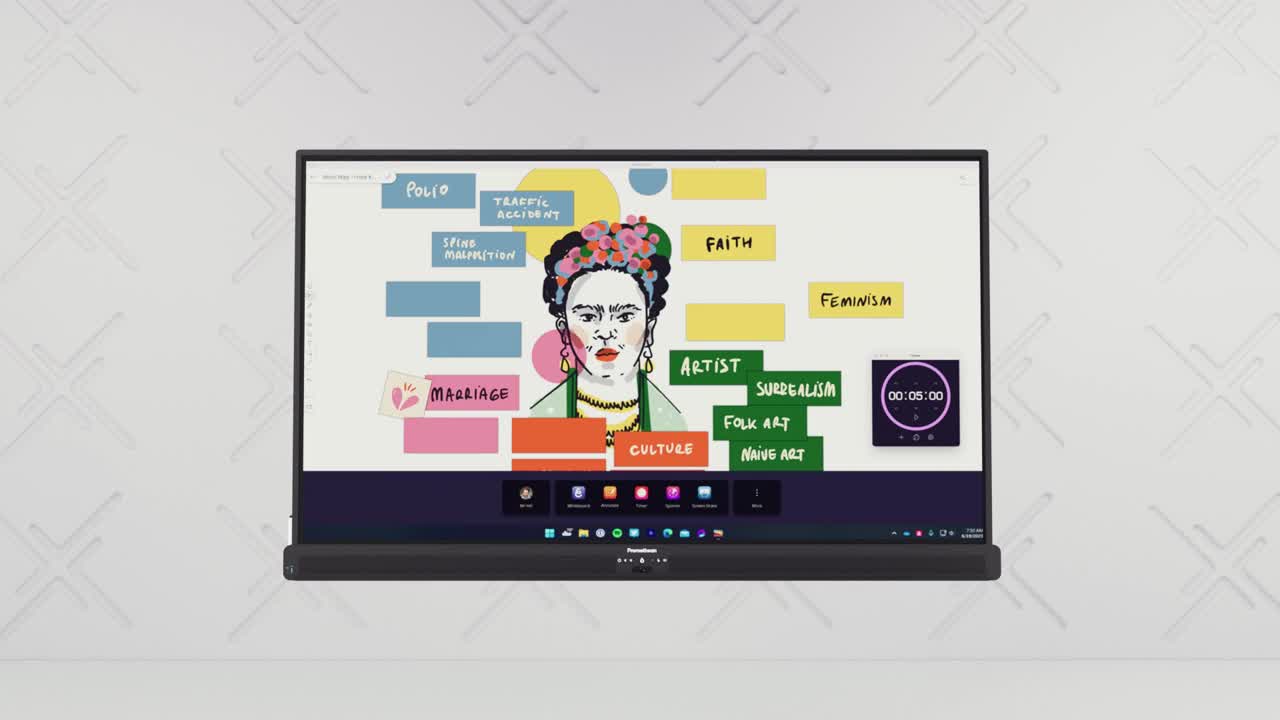
Promethean also sells configurable accessories and computing modules. Its product range extends beyond instruction: the ActivPanel D-Series addresses digital signage, while a MAXHUB partnership adds Microsoft Teams-certified meeting-room equipment to the workplace offering. The common thread is a room where people need to see, discuss, or act on shared information.
None of that makes the market empty. SMART Technologies, ViewSonic, Newline, and ClearTouch are among the alternatives named in Mynd’s annual report. A conventional screen and an existing laptop may also meet a buyer’s needs. Promethean’s claim to distinction rests on the combination of display, lesson software, support, and distribution, rather than on having invented a screen nobody else can supply.
A shared physical workspace.
Update the compatible computer or module.
Reuse and adapt familiar resources.
What the teacher takes home
The screen is conspicuous. Software is where the work continues after everyone leaves. ActivSuite groups tools such as whiteboarding, annotation, screen sharing, and timers. Explain Everything supports lesson creation, presentation, recording, and collaboration. ActivInspire provides a longer-established desktop environment with flipcharts and teaching tools.
The appeal is continuity. At Regent House in Northern Ireland, a Promethean customer account describes teachers annotating existing PowerPoint presentations and saving the results. Maths teachers used digital rulers, protractors, and compasses. The school piloted panels with its maths department before accelerating deployment. Familiar material acquired another use instead of requiring a wholesale rewrite.
Training belongs in this story, too. Learn Promethean offers courses, video tutorials, and resources. Its refreshed 2024 site brought training and resources under a common sign-in. Hardware can be delivered in a box; confidence cannot. A school’s implementation has to make room for the latter.
On September 30, 2026, Mynd announced an AI Companion for Explain Everything on compatible Apple devices with Apple Intelligence enabled. Teachers can select material on the canvas and generate additions such as quizzes, vocabulary lists, or lesson ideas. The company says processing takes place on the device and works without an internet connection. Eligible Advanced and Pro users receive the feature without an additional charge.
The useful detail is where the result appears: inside the lesson canvas, ready for the teacher to adapt. The announcement establishes an available feature and its conditions. It does not establish that generated material is correct or that pupils learn more. Those remain questions for use and evaluation.
Buying the voice, not the whole company
There is another route into this software ambition. In September 2025, Mynd announced the acquisition of Merlyn Mind’s voice and remote-control technology assets. The technology lets educators control PCs and Macs while moving around the classroom. Mynd described plans to integrate it into ActivSuite and Explain Everything.
The purchase agreement supplies a detail the announcement leaves in the background. Consideration included forgiving approximately $5.47 million in trade liabilities, dismissing related litigation, and issuing a warrant to buy up to ten million ordinary shares at $1.214 each. This was an asset transaction, with specified exclusions, rather than a purchase of the entire Merlyn business. The warrant’s exercise price is not a cash acquisition price.
Voice control addresses a small but persistent inconvenience: walking back to a computer to change what everyone is seeing. Mynd’s interpretation is that easier control makes its existing products more useful. Whether teachers adopt that control is a separate matter from owning the patents.
When the purchasing cycle turns
Mynd earns most of its revenue by selling hardware and accessories through distributors and resellers. Software subscriptions, extended warranties, and training add other revenue streams. Its 2025 filing says SaaS was not yet significant to overall operations. Calling the company a software business without that qualification would get ahead of the accounts.
The downturn was visible early in the new corporate identity. Mynd’s March 2024 results attributed lower 2023 sales chiefly to the education market returning toward pre-pandemic conditions. Buying waves end; the installed equipment remains. By 2025, reported continuing-operations revenue had fallen to $167.9 million, from $267.4 million in 2024.
Annual revenue from continuing operations
Reported annual figures, rounded. The bars use the same scale.The first half of 2026 brought lower operating expenses and narrower losses. Operating expenses fell 35%; net loss was still $20.2 million. Adjusted EBITDA also remained negative. A financing arrangement with controlling shareholder NetDragon provided up to $50 million in revolving inventory financing capacity. These are measures of a business managing pressure, rather than evidence that the pressure has disappeared.

NYSE American accepted a compliance plan in August 2026 following a notice tied to the company’s stockholders’ deficit. Mynd has until December 2, 2027 to regain compliance, with continued listing subject to milestones and review. An accepted plan buys time. It does not complete the repair.
Borrow the pilot, not the promise
A practical lesson emerges from the customer accounts: test the ordinary work. Bring an existing presentation, a saved flipchart, and the laptop a teacher actually carries. Try annotation, screen sharing, recording, and the process of returning to a saved lesson. Then ask the IT team to repeat the task under its real network and security rules.
Price the configuration rather than the rectangle: computing, installation, software entitlement, training, warranty, and support all matter. The buyer’s existing equipment and teaching habits determine whether modular flexibility is valuable. A classroom that only needs occasional video playback may have little reason to pay for an interactive workflow.
Apply the same discipline to AI. Confirm eligible devices and licences, review generated content, and test privacy settings. Mynd’s August announcement placed optional engagement tools on a Q4 release schedule; an announcement should not be treated as evidence of measured classroom benefit. The company’s opportunity is convincing because it is concrete. There is already a lesson on the screen. The next product has to help somebody teach it.