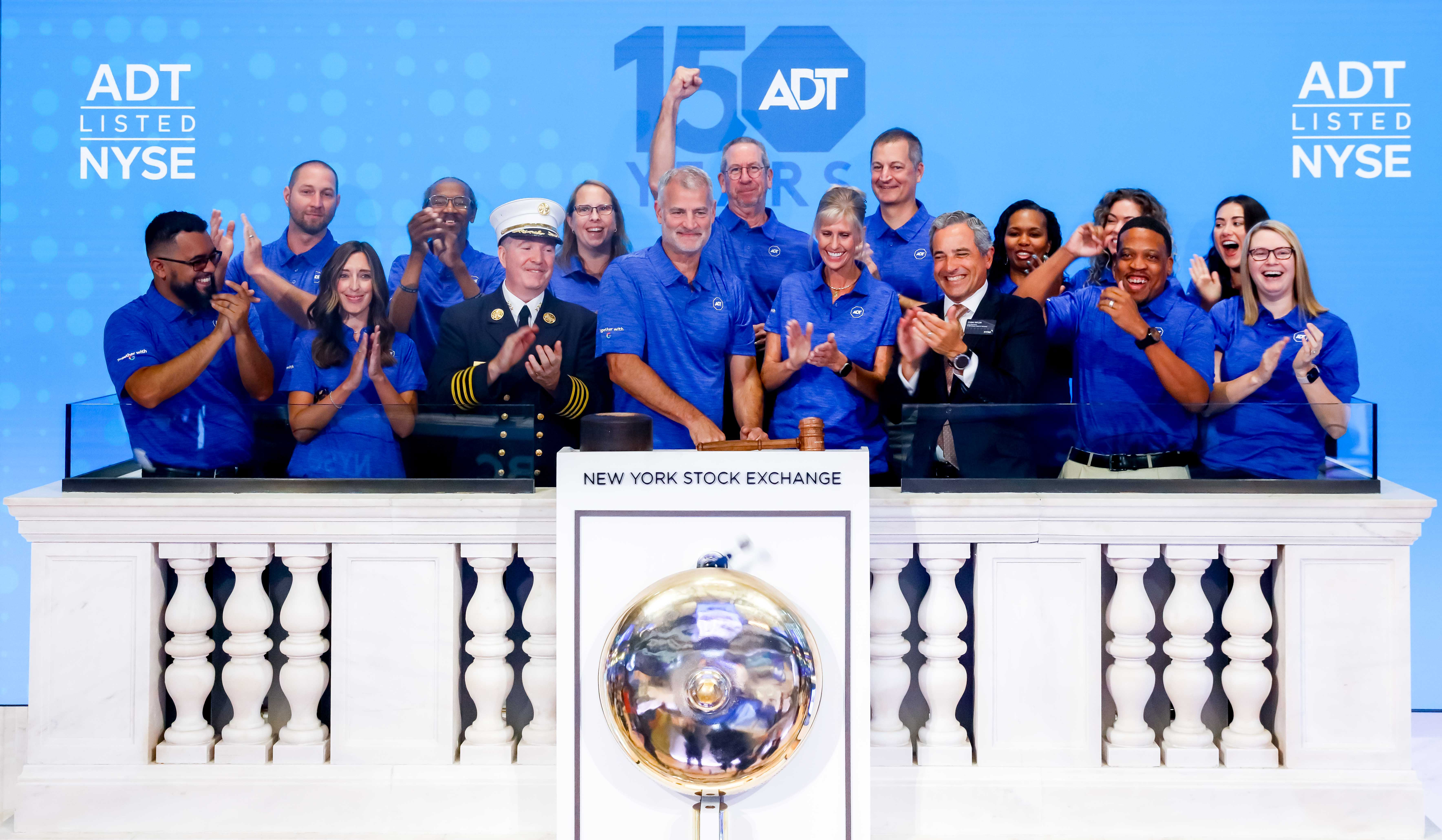
On August 13, 2024, Jim DeVries stood at the New York Stock Exchange with a group of ADT employees and rang the opening bell. The company was celebrating 150 years. For an enterprise whose ordinary work involves answering alarms, this was a pleasing reversal: for once, everyone else could listen.
DeVries had invited ten employees in recognition of their service to customers. There were executives on the podium, too, including finance chief Jeff Likosar. But the occasion made room for people who usually encounter the business through an installation, a service visit or a call. It was an anniversary photograph with an operational point.
That point runs through DeVries’s career. The chairman, president and chief executive of ADT came to the top job through human resources and operations. His work now includes software, connected devices, acquisitions and the disposition of considerable sums of money. Yet his professional starting place remains useful: someone has to make the organisation work for the person at the other end of the line.
The route through the people department
“I grew up in human resources,” DeVries said in a 2022 interview. He argued that the function offers preparation for leading people, although it rarely supplies the route to the chief executive’s office. His own career broadened into operating responsibilities at Allstate before he joined ADT.
His earlier employers included Principal Financial Group, Ameritech, Quaker Oats and Andrew Corporation. The list crosses financial services, telecommunications, food and industrial equipment. It suggests a career built around the workings of organisations rather than a lifelong attachment to one product category. A cereal company and a security company have different customers; both still need people, managers and systems that can deliver what has been promised.
His education followed several stages: a bachelor’s degree from Trinity International University, a master’s from Loyola University and an MBA from Northwestern’s Kellogg School of Management. These are the qualifications on the formal biography. The more revealing qualification for ADT was experience managing a large service operation.
At Allstate, he spent nearly a decade in executive roles, including chief administrative officer and head of operations. By the time ADT recruited him in May 2016, his responsibilities at Allstate had included leading more than 7,000 people. That is a substantial rehearsal for a business in which a customer’s experience depends on many employees doing small things correctly.
Three promotions, one expanding brief
ADT initially hired DeVries as executive vice president and chief operating officer. In September 2017 it named him president, with a brief that reached across sales, marketing, installation, field service, customer support, human resources and the authorised dealer network. The job put customer acquisition and the work of serving those customers within the same field of view.
Tim Whall, then chief executive, credited DeVries with contributing to ADT’s turnaround. The promotion was therefore more than another title on an organisation chart. It formalised a widening responsibility for the daily mechanics of the company: how a sale becomes an appointment, an appointment becomes a working system, and a working system becomes a relationship that lasts.
The next transition took effect on December 1, 2018, when DeVries succeeded Whall as CEO. He also joined the board. In 2023 he became chairman, adding responsibility for leading the board to his executive duties. The sequence matters because he had already worked inside the operation before taking responsibility for its direction.
A familiar sign meets unfamiliar technology
DeVries inherited a recognisable symbol: the blue ADT octagon. The strategic question was what that sign should stand for as cameras, phones, doorbells and locks acquired new capabilities. A household could buy connected devices individually. ADT needed to give customers a reason to bring those devices together with its installation and monitoring services.
Google supplied an important part of that answer. In 2020, the companies established a long-term partnership combining Google Nest technology with ADT’s service network. Google’s $450 million investment closed that September and represented approximately 6.6 percent of ADT’s outstanding common equity at the time. The percentage describes that transaction, rather than a claim about its ownership today.
The practical ambition was integration. A doorbell, a thermostat and an alarm may all be clever in isolation; a customer still has to operate them. Under DeVries, ADT’s proposition increasingly involved bringing the equipment and the continuing service into a coherent household experience. The partnership gave the company access to Google’s hardware and technology while making use of ADT’s existing ability to install, support and monitor systems.
Another connection drew on a world DeVries already knew. State Farm announced an investment in 2022 that included $1.2 billion for an approximately 15 percent ownership stake and a $300 million opportunity fund. Insurance and security meet at a straightforward household concern: preventing a loss is preferable to dealing with one afterward. The arrangement connected that concern to product development and distribution.
The roof was a detour
Expansion also took ADT into residential solar. By late 2022, rooftop solar was part of the company’s public account of its future alongside security and smart home services. It was an appealing grouping on paper: several services, one household, an established brand at the door.
The subsequent numbers were less accommodating. ADT’s solar segment recorded an adjusted EBITDA loss of $89 million in the first nine months of 2023, amid operating problems and difficult industry conditions. In January 2024, the company announced that it would exit residential solar. DeVries said the decision followed careful deliberation. The exit was substantially completed during the second quarter of that year.
It belongs in his story because it changed the shape of the business he leads. The sequence includes a proposed expansion, disappointing results and a retreat. The people affected by an exit experience something considerably more concrete than a revised strategy slide. Any account of the company’s transformation needs room for that cost as well as its ambitions.
ADT had also completed the sale of its commercial business to GTCR in October 2023 for $1.6 billion, subject to adjustments. Approximately $1.5 billion in net proceeds was earmarked for debt repayment. Together, the transactions concentrated the company more closely on its security and smart home operation serving residential and small business customers.
The house key gets a software update
That focus became tangible in 2024 with the new ADT+ platform and Trusted Neighbor. ADT+ brought the company’s hardware, professional monitoring and Google Nest devices into a single app experience. Trusted Neighbor tackled a task older than any smart home: letting a reliable person into the house when the owner is elsewhere.
The service allows timed and event-driven access for approved people, using compatible equipment and the required subscription. A dog walker can have an appointed window. A neighbour can be authorised to respond to a problem. The spare key, traditionally hidden somewhere a burglar might consider checking, has acquired permissions.
The technology has a team behind it. Product chief Naveen Chhangani and technology chief Gilles Drieu were instrumental in the launch. Their previous employers included companies such as Netgear, Apple and Google. Giving those specialists credit helps explain DeVries’s role: the chief executive assembles and directs an organisation whose detailed work depends on other people’s expertise.
“More and more, we’re a smart home company and less and less of a burglar alarm company.”
Jim DeVries, in a 2026 interview
A quarter with two different readings
The financial picture in July 2026 resisted a simple victory lap. ADT reported second-quarter revenue of $1.312 billion, up 2 percent. Operating cash flow rose 18 percent to $666 million. Income from continuing operations, however, fell by $13 million to $155 million. Better cash generation and lower income appeared in the same report.
DeVries emphasised the resilience of the model and continued investment. The company also reported gross revenue attrition of 13.1 percent and acknowledged the need to improve attrition trends. For a recurring-service business, keeping customers is a continuing assignment. A newly installed system begins that relationship; it does not settle its future.
Up 2% year over year
Up 18% year over year
Down $13m year over year
The period also brought ADT Blu, a self-installed offering with optional professional monitoring. By September it was available through Walmart.com. That broadens the ways customers can enter the ADT system, including people who prefer to handle setup themselves. DeVries’s operation now has to support different expectations about how security is bought and installed.
What happens before the alarm?
In February 2026, ADT announced its acquisition of Origin AI for $170 million in cash, subject to adjustments. Its technology uses radio-frequency signals and algorithms to detect and classify presence and motion without cameras, audio or wearable devices. ADT expects to begin commercialising offerings incorporating the technology in 2027.
The distinction between an acquisition and a finished customer product matters. The announced applications include adding context to alarm events and reducing false alarms. Those are goals for integration and development. A home that can supply more useful information still needs a service organisation capable of interpreting and acting on it.
Outside ADT, DeVries serves on the boards of ABM Industries and Amsted Industries, where he is lead independent director. Facilities services and industrial manufacturing extend his working connections beyond the connected home. They also keep the operating questions familiar: who does the work, how it is organised and whether the customer receives the expected result.
The anniversary bell offered a public moment for a company whose relationship with customers is usually more private and practical. DeVries’s next assignment is being worked out in software, devices and service calls. The blue sign can remain familiar. The organisation behind it has to keep earning its place in the yard.