The most important piece of equipment in LOUD Security Systems' pitch may be a telephone that a human being answers. This is almost comic in 2026, when a house can recognize a package, a camera can classify a person and an app can unlock a door from an airport lounge. Yet when a sensor chirps at 2 a.m., intelligence is measured less by the panel than by what happens next. LOUD has spent three decades building a business around that next step.
The Kennesaw, Georgia, company designs, installs, services and monitors security for houses, stores, offices, campuses and government customers. Its menu covers intrusion alarms, video surveillance, live video monitoring, access control, fire detection, leak sensors, automation, life-safety management and emergency elevator or pool phones. These are serious systems with deeply unglamorous duties: notice the open door, verify the smoke, let the right employee into the right room and summon help without creating fresh confusion.
01 / The unlikely takeoff
A pilot discovers that autopilot is boring
John Loud did not grow up plotting an alarm empire. He studied political science, worked as a Delta Air Lines flight attendant and trained to become a pilot. Then he sat in a cockpit while another pilot programmed the autopilot and glimpsed a future that felt neatly compensated and profoundly dull. The machinery was doing the interesting part. Loud changed course.
His research led through a friend to Georgia's burglar-and-fire alarm trade group. In June 1995, he started LOUD Security in the basement of his home. The founding proposition paired current technology with the customer-service habits he had learned at Delta. It also came with a marketing gift no agency could manufacture: his surname really is Loud.
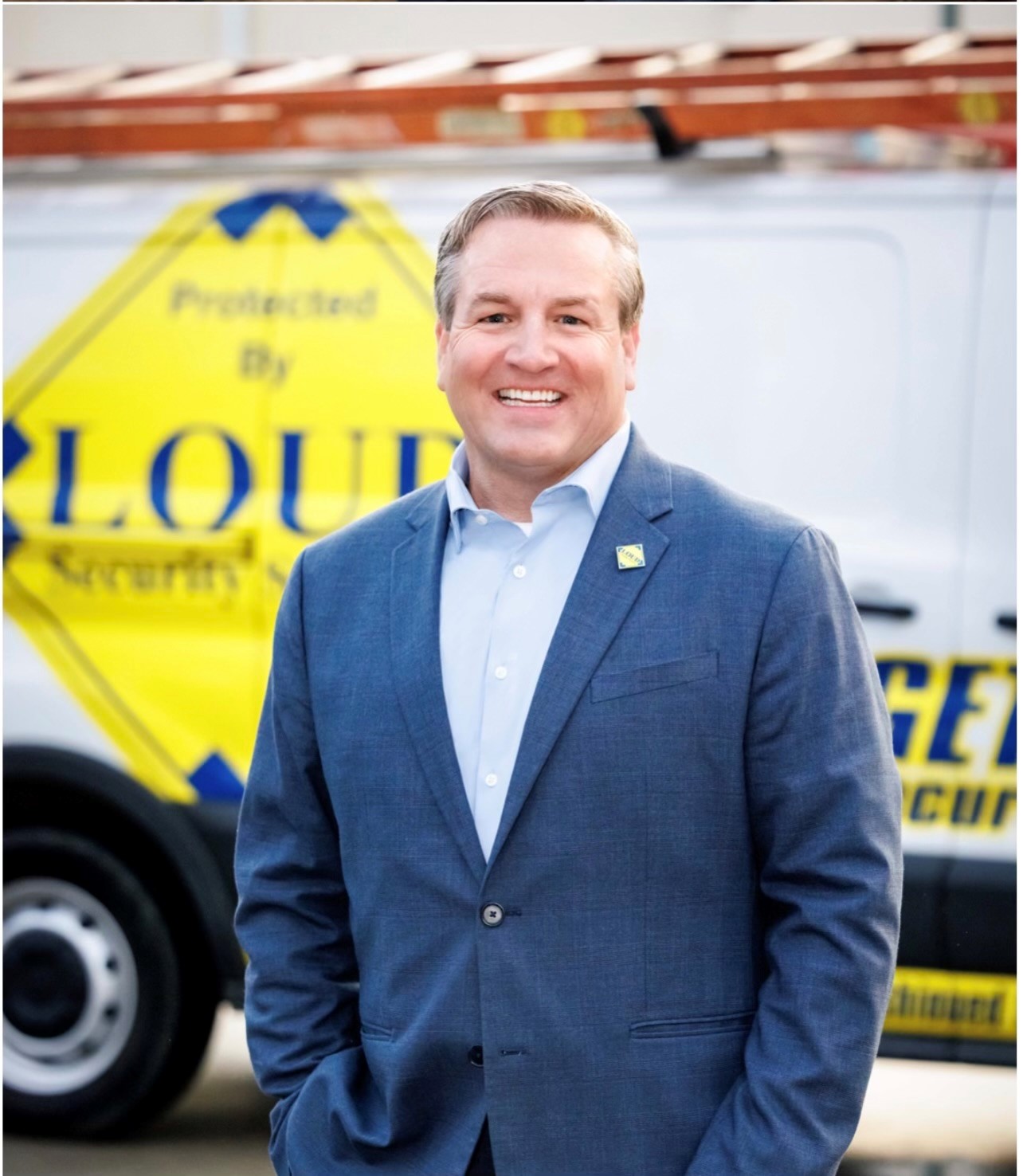
The company once paid for “Let's get Loud” spots at Atlanta Braves games, complete with a flashing banner and crowd chant. Later, Loud joked that he could hear the same chant at games he had not sponsored. The joke worked because the operating business underneath it was legible. Bright vehicles brought attention. A person answering the call kept it.
Either you shape the culture or a culture develops on its own.John Loud
02 / What it actually sells
The product is a chain of decisions
LOUD is not primarily a gadget maker. It integrates established technology from security platforms and equipment brands, then wraps that gear in site design, installation, monitoring, support and maintenance. That distinction matters. A camera is a device. A useful security service is a chain: detect something, determine whether it matters, alert the right party, intervene if possible, dispatch if necessary and preserve a record.
From motion to meaning
For a homeowner, that can mean door and window sensors, monitored smoke and carbon-monoxide detection, water alerts, cameras and phone controls. For a business, it can mean managed access, fire compliance, camera analytics across several locations or a virtual guard who can speak to a trespasser through on-site audio. For a jeweler, lender or other high-value operation, LOUD's UL-681 certification permits installations built to a more demanding audited standard. The company said earning it required a three-month application, testing and site-review process, followed by continuing education and annual inspections.
| Choice | Buyer does | Best fit |
|---|---|---|
| DIY camera | Selects, installs and usually checks alerts | Simple property, modest risk, hands-on owner |
| Monitored alarm | Uses a designed system with an external response layer | Homes and businesses wanting dispatch support |
| Integrated security | Coordinates video, access, fire and maintenance | Commercial sites, campuses and regulated risks |
The business model follows the bundle. Customers pay for equipment, design and professional installation, then may pay recurring monitoring, interactive service and maintenance charges. LOUD does not publish a universal rate card because systems are customized. Its public offers have included a free eligible device with certain interactive services, small discounts for seniors and frontline workers, and up to 20 percent off an existing monthly monitoring rate for customers who switch, with minimum rates applying. Buyers seeking a tidy one-price box will need a quote.
03 / The first thing that failed
A supplier changed hands, so LOUD changed the questions
The most instructive failure in LOUD's history was not a smoking keypad. Around 2016, the third-party central station that had monitored its accounts for eight years was acquired. That made the invisible dependency suddenly visible. The monitoring center spoke with LOUD's subscribers more often than many LOUD employees did. A careless transition could damage response quality, customer data or both.
Management did not shop on price alone. It prepared two pages of questions for potential monitoring partners. How quickly were calls answered? What was the dispatch ratio? How long did operators stay? Did a live operator answer first? What caller ID would customers see? How would account data be returned if LOUD ever needed to leave? Even operator morale made the list.
They interact more with my subscribers than any of my current employees do.John Loud, on the central monitoring partner
That episode sharpened a useful principle: outsource the function if it makes sense, but do not outsource the definition of a good customer experience. The same principle appears in LOUD's acquisitions. Nash Security brought 800 monitored accounts in 2015, with the founders' son joining LOUD. RTA Security and Premier Security pushed the total beyond 10,000 accounts in 2019. Their owners publicly emphasized finding a buyer who would care for people they considered friends and neighbors. In 2024, LOUD bought commercial specialist Vytis Security and brought founder Mike Sandes in to lead commercial services.
04 / Service as infrastructure
The moat is made of small courtesies
LOUD's customer practices sound almost embarrassingly simple. A prospect can reach the owner on his cellphone. Incoming calls are answered live. Before a home visit, the customer receives a short biography and photograph of the technician or salesperson. The technician calls while traveling to the appointment. Two or three days after service, a scheduler follows up. New installations and service calls generate surveys and phone checks.
None of these moves is proprietary. Together, they reduce three forms of anxiety common to security purchases: Who is entering my home? Will the system work after the van leaves? Can I reach someone when the screen stops making sense? In this category, courtesy is not decoration around the product. Courtesy helps the customer trust the product.
Five things another service company can steal Monday morning
- Send a photo and two-sentence bio before an employee enters a customer's property.
- Require an en-route call with an honest arrival window.
- Follow up after every installation and repair, not only after complaints.
- Score critical vendors on customer-facing behavior, data portability and staff stability.
- Keep one senior leader reachable enough to hear patterns before dashboards reveal them.
The approach has supported measurable expansion. LOUD reported more than 11,000 residential and commercial customers in 2023 and nearly 13,000 customers across metro Atlanta and 20 states by September 2025. The team remains roughly 60 people. Trade publications named it Installer of the Year in 2023, after earlier recognition for social media, marketing, workplace culture and community involvement.
The company also learned to make local relationships do more than decorate a sponsorship slide. A multi-year agreement made LOUD the exclusive security-services provider for the 1,200-plus-acre LakePoint Sports development. It has partnered with Kennesaw State athletics, participated in public-safety events and placed John Loud in leadership roles across state and national security associations. Community presence supplies referrals, hiring credibility and a public identity that a distant call center struggles to reproduce.
05 / The next scale test
Can old-fashioned service survive a bigger building?
Growth now comes with more visible commitments. In 2025, LOUD bought a headquarters of more than 51,000 square feet in Kennesaw, a conspicuously roomy base for a roughly 60-person team. Eastern Bank then supplied $7.5 million in financing, including revolving credit and treasury services, to support working capital and future acquisitions. In 2026, longtime operations leader Eric Widner became chief operating officer as the company prepared the headquarters and a second regional location in Warner Robins.
The bet is that a local operating style can stretch across a larger account base. The risk is equally plain: every acquisition adds systems, customers and expectations; every new geography makes the founder's cellphone less plausible as an organizing principle. LOUD's real challenge is to turn personal behavior into teachable process without making it feel scripted.
Works when
The service is safety-critical, recurring revenue supports follow-up, technicians visit customer property and local trust affects buying.
Breaks when
The cheapest price wins, customers want pure self-service, leaders become a bottleneck or acquisitions erase the continuity that justified them.
There are also customers for whom LOUD's model is simply too much. A renter who wants one doorbell camera may prefer a cheap DIY kit. A national enterprise may demand one contract across hundreds of sites. A technically confident homeowner may dislike recurring monitoring fees. The old-fashioned layer only earns its keep when the cost of confusion, delay or neglect is higher than the savings from doing it alone.
That condition applies to more businesses than the security industry. Plumbers, HVAC contractors, managed IT providers and home-health operators all sell expertise inside somebody else's vulnerable space. They can copy LOUD's choreography without copying its alarms. Tell the customer who is coming. Arrive predictably. Check the work after the work. Vet the vendor that speaks in your name. Make escalation possible.
The clever surname opened the door. The cameras, sensors and access readers gave the company something useful to install. But LOUD's durable idea is quieter: technology feels smarter when the people around it remove uncertainty. Thirty years after the basement, the company is still selling that feeling one answered call at a time.