A moving company has an unforgiving relationship with the physical world. A sofa must fit through a doorway. A truck must reach the right house. Whatever the ambition at headquarters, somebody has to lift the other end. Jon Nobis came into this business through its technology office, a useful place to discover how much depends on the arrangements behind the lifting.
He joined TWO MEN AND A TRUCK as chief information officer in March 2011. Over the following years, his responsibilities widened to operations, shared executive leadership and, in June 2018, the sole CEO role. In September 2024, he became CEO of ServiceMaster Brands, the parent company that had acquired the moving franchise. The route runs through accounting, computer systems and local business ownership. It gives his career a particular texture: a service executive who learned to look under the bonnet.
Nobis is a former ServiceMaster Brands CEO; the company’s leadership roster now names Michael Mullican. His earlier work remains a useful case in how a technical specialist comes to lead a business whose promises must be kept, quite literally, at the customer’s door.
The route through the technology office
Before the trucks came the accounts. Nobis began his career at Plante Moran in 2000, working in audit and tax. After receiving his CPA license in 2002, he moved into management consulting and the firm’s Lansing office. Security consulting led to broader technology assignments with construction, real estate and manufacturing clients. The recurring task was to use process analysis and technology to solve business problems.
That background helps explain the sequence of his appointments. At TWO MEN AND A TRUCK, he moved from CIO to chief operating officer in July 2013. Technology and operations are close neighbours in a service business: a change in the office can alter what a crew knows before it arrives, what a customer can book and how an owner organizes the day.
By early 2018, the company was pointing to increased tablet use, additional storage options and its national Value Flex moving service among the developments associated with his technology and operational work. These were tangible changes to the offer and the process. Innovation could arrive carrying a tablet, with little need for a ceremonial ribbon.
The long-distance expansion made that practical ambition visible. After trials in Atlanta, Cincinnati, Orlando and Lansing, the business announced an additional 12 cities in May 2017. Nobis, then COO, discussed expanding its reach beyond local moves. A familiar name on a local truck was being asked to serve customers over a much longer journey.
A hundred months, many hands
Nobis became co-CEO alongside Brig Sorber in 2017. The arrangement paired an executive with a technology and consulting background with one of the original brothers behind the moving company. They brought different histories to the same business. Sorber knew the company from its beginnings; Nobis had worked across its systems and operations.
In April 2018, the company reached 100 consecutive months of growth. Its May announcement reported that 84 of those months had set growth records, with first-quarter sales more than nine percent above the same quarter a year earlier. These are historical company figures, earned across a franchise network and successive leadership teams. The streak was already under way when Nobis arrived.
He credited shared goals, training and operational practices. It was a collective explanation for a collective result. The distinction matters in franchising, where a national brand’s performance depends on people who have invested in their own local operations. A chief executive can set a direction. Hundreds of businesses must make it work.
By June 2018, Nobis was sole CEO. The transition put a broader title on work that already crossed departmental boundaries. The questions now reached beyond which tools the company needed to how its owners and employees could use a growing system to build careers.
An owner’s seat at the table
There was a concrete mechanism for that ambition. In November 2018, TWO MEN AND A TRUCK announced the fourth annual $50,000 Mary Ellen’s Moving People Forward Scholarship, awarded to St. Louis-area sales manager Liz Friedmann to help fund a franchise. The application asked employees to account for their contribution, assess their leadership and explain how they would balance the program with their existing work.
A scholarship for ownership gives a promotion an unusual destination. The employee can become an investor in the business. For a franchise network, that connects the people who know the daily work with the people who take responsibility for a location. It also makes career development a question of access to capital and preparation, as well as encouragement.
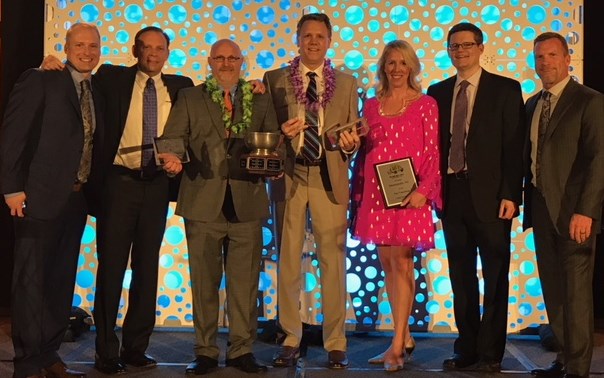
The awards photograph captures another part of that relationship. Nobis stands beside owners and operating leaders while the trophies belong to a local business. Recognition travels in both directions: the brand offers a stage, and the franchise gives the wider organization an example of the work being done.
His management thinking made room for that exchange. In a 2019 Q&A, he emphasized gathering facts without treating a person’s place in the hierarchy as a measure of the information’s value. He also wanted people to understand the reasons behind their work so they could improve it. A process becomes easier to question when its purpose is clear.
“To create leaders, you have to let people make decisions.”
Jon Nobis / 2019
Making room for a smaller market
By 2021, TWO MEN AND A TRUCK was developing its mini-market program, intended for territories smaller than those served by its conventional model. The program covered populations of roughly 100,000 to 225,000, using a smaller operating footprint. Nobis described technology and support systems as part of what made that scale possible.
The ownership arrangement was especially revealing. Existing franchisees participating in the program had to allocate 25 percent ownership to a new franchisee from within the system. Expansion could therefore create an opening for someone already working in the network. The model linked the geography of growth to the development of another owner.
Historical program terms, rather than a current franchise offer.
That is a more specific proposition than simply adding pins to a map. The local operation needed to fit the demand available, while the wider company supplied support. Growth meant adjusting the shape of the business to the place it would serve. Bigger ambitions could require a smaller starting footprint.
A larger company, a familiar question
ServiceMaster Brands acquired TWO MEN AND A TRUCK in 2021. At the time of the transaction, the moving network had locations in the United States, Canada, the United Kingdom and Ireland. Nobis joined the parent company’s executive leadership team, reporting to then-CEO Elane Stock. The moving team continued to operate from Lansing.
The acquisition widened his view from one franchise system to a portfolio of service businesses. He subsequently served as ServiceMaster Brands’ CIO. When he was appointed group CEO in September 2024, succeeding Greg Weller, he had already worked inside both the moving business and the parent organization.
His stated ambition was to work more closely with the brand teams and advance the goal of becoming the most respected brand in each industry they served. That put familiar operational concerns into several different settings. Cleaning, restoration and moving have different rhythms, but each depends on the customer’s confidence in the people sent to do the work.
During this chapter, leadership development also became a subject he taught directly. A company account of the first Mastering Management session described more than 130 leaders joining a discussion hosted by Nobis. Its focus included adapting to the team being led; future topics were to be shaped by employee surveys. The organization was asking its managers to keep learning, too.
He welcomed Regan Stokes as Merry Maids president in January 2025. At the brand’s 2026 annual conference, they welcomed franchise owners together. By April, an account of owner Brian Houtman’s business pictured Nobis with Houtman’s team and Stokes. The scene returned the portfolio job to a recognizably local scale: people running offices, supporting employees and serving households.
Teamwork, with the book open
Nobis’s reading choices offer a smaller, personal clue. Asked about management books in 2019, he named The Orange Revolution, by Adrian Gostick and Chester Elton, and Patrick Lencioni’s The Five Dysfunctions of a Team. The subject was how people work together, a fitting preoccupation for someone moving between specialists, crews, franchise owners and executives.
In another interview that year, he described spending time with his wife and six children to balance work and personal life. He also described a preference for servant leadership, coaching others and allowing them to make decisions. Taken together, those details suggest the appeal of a business in which advancement can be measured in someone else’s growing responsibility.
The trucks provide the visible part of this career. Behind them sit the accounts, software, training and ownership arrangements that Nobis spent years helping to manage. A service company’s work becomes real when someone arrives and does the job. His career follows the less visible work of making that arrival possible, and giving the next person a chance to take charge.