The most revealing part of Jillian Zatta's new job is not the title, though the title does require a moment. Founding Growth Architect, AI sounds as if someone put a hard hat on a spreadsheet. The revealing part is what she said she would miss: going deep into a customer's world, learning the peculiar shape of the problem, and designing a solution for it.
For years, that was her daily territory at Kustomer. She moved through conversational AI and four levels of solutions consulting, eventually becoming a principal. She learned the hard cases, ran the demos and lived inside the small contradictions that appear when a neat product meets an untidy organization. Then, in early 2026, Kustomer handed her a role whose edges were still being drawn.
Zatta supplied the clearest definition herself. A go-to-market strategist owns the playbook, she wrote. A growth architect owns the system the playbook runs on. The difference is between describing how to sell and building the infrastructure that makes good selling repeatable. Her stated ambition is to help colleagues and customers even when she is not in the Zoom.
“The north star is clear: not just a strategy to hand off, but a machine to own.”Jillian Zatta, announcing her new Kustomer role
It is a mechanical metaphor for a career devoted to people. That contradiction makes it useful. Companies do not lack playbooks. They lack ways to preserve the judgment behind them. The best solution consultant recognizes what a buyer means before the buyer has phrased it properly. The best customer-success leader sees a pattern while it still looks like a collection of complaints. A machine capable of carrying that intelligence would need to remember context without sanding away nuance.
A pirate, a campaign and a useful refusal to specialize
Long before AI agents, Zatta studied systems with older names. At Skidmore College, her senior history project was titled “A Nation of Pirates: Piracy, State and Empire in the British Atlantic.” She studied government and classics too. During a semester in Rome, she described the city as having one face looking forward and another looking back. It is an elegant observation, but also a tidy preview of her working habit: look at the thing and the structure around it.
After graduating in 2010, she jumped into politics. She interned in U.S. Senator Robert Menendez's office, worked with the community-affairs team and joined the campaign operation. At the time, she imagined the 2012 election season might be her natural destination. Instead, she applied for a human-capital role at Goldman Sachs because she wanted to test how portable her skills were.
In a Skidmore alumni questionnaire, Zatta explained that she did not want to limit herself to one industry or job type. Her education had trained her to find “touch points of universality” among different subjects. At Goldman Sachs University, she helped coordinate training for the Securities division, work that joined markets, policy, culture and the integration of new hires. Politics had not vanished. It had become organizational behavior.
Her college answers also reveal a less corporate current. She joked that she suffered from a short-term academic attention span because every semester produced a new favorite subject. Asked what job she would choose in a second life, she picked Broadway, provided that the next life came with stage presence and acting talent. The theatrical wish never became a career, but anyone who has watched an enterprise software demonstration knows that stagecraft has merely found a less musical venue.
The route to the machine
Where the customer meets the product
Zatta entered startup life at LISNR, whose technology sent data through sound. She moved from new business into customer-success leadership and described her work there as managing the interaction between customer and product. The phrase is almost modest. In a young company, that interaction is where product strategy is stress-tested by reality.
The work also put her near culture and entertainment. She was credited among the creative team for LISNR's 2016 Bronze Pencil in mobile innovation from The One Show. Her LinkedIn record lists Webby recognition connected to a J. Cole listening session and the Budweiser Made in America Festival. These were not ordinary help-desk tickets. They were live situations in which technology, audiences and brands had to behave together.
By 2018 she was directing customer success at Reply.ai, later adding business development. Reply built conversational automation before the current wave made AI a suffix for nearly everything. At an industry session on automation in customer care, Zatta was one of the practitioners offering a pragmatic case: brands could begin with lower-risk uses, and automation extended beyond the chatbot itself.
Kustomer acquired Reply.ai in 2020, and Zatta crossed over as a conversational-AI product specialist. She later joined solutions consulting and progressed from consultant to senior, lead and principal roles. The company itself passed through Meta ownership and emerged independent again. Amid those corporate changes, Zatta completed an MBA at Northwestern University's Kellogg School of Management, focusing on growth and scaling strategy and technology management. The subjects supplied formal names for the problem she had already been living.
The customer will not follow the script
The problem with customer-service automation is that customers behave like people. They arrive halfway through a thought. They use shorthand. They forget details, repeat irrelevant ones, and carry irritation from a previous exchange. The business, meanwhile, has refund limits, escalation rules, identity checks and promises it cannot improvise away. One side is language in the wild. The other is a procedure manual with lawyers nearby.
Zatta's public explanations dwell on distinctions that keep those two sides honest. Buyers often ask whether an AI system can train on past conversations or be coached over time. She argues that modern systems are better understood through grounding and retrieval: fetching relevant information and context to shape an answer, without retraining a model on every exchange or casually exposing sensitive customer data.
Three translations hiding inside one support conversation
That distinction is not semantic housekeeping. It changes what a buyer should test. A fluent reply is pleasant; a correct action is useful. Kustomer's 2026 product language reflects the shift from AI that responds to AI that executes, with deterministic rules handling the places where charm is no substitute for compliance. Zatta's live demonstrations put her at the junction of the promise and its proof.
A former sales leader who worked with her described one enterprise deal in which Zatta delivered the product demonstration at least seven times to different stakeholder groups. The repetition is revealing. Enterprise buying is not one audience waiting for one revelation. Finance, operations, technology and frontline leaders each need the same system translated into a different set of consequences. A good demo is less a recital than a diagnostic.
“I love understanding how things work.”Jillian Zatta
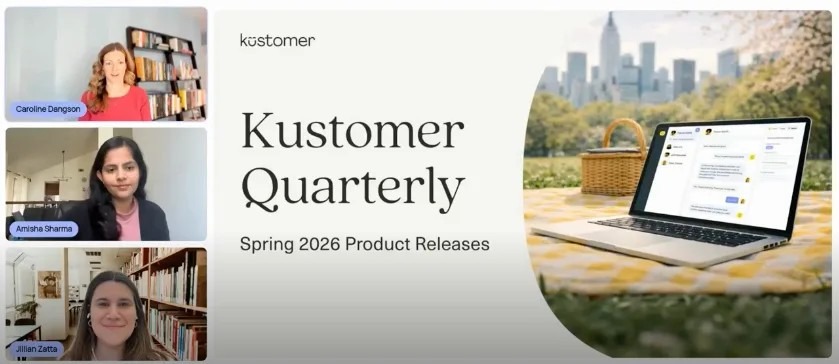
In May 2026, Kustomer listed her alongside its chief executive for a live demonstration about adding intelligence to customer experience without forcing a company to abandon the tools it already uses. The proposition matched her new remit. Growth architecture is not simply about inventing the future. It is about making change survivable for the present.
Expertise that travels without losing its accent
There is a risk in turning expertise into infrastructure. Systems prefer the repeatable; customers specialize in exceptions. A playbook can flatten the very judgment it hopes to preserve. Zatta's advantage is that she arrived at architecture through the exceptions. Customer success taught her what breaks. Solutions consulting taught her how different groups describe the same break. Her education taught her to notice the common structure without pretending the subjects were identical.
Her career is not a straight ascent so much as a sequence of translations: policy into business, customer frustration into product requirements, conversational nuance into technical rules, individual craft into organizational machinery. Even the old pirate thesis belongs. Pirates are, among other things, an edge case for a state. Customer conversations are edge cases for corporate process. Both reveal where the official map stops matching the water.
Now Zatta is responsible for a system meant to outlast the meeting. Its success will not be measured by the elegance of a title or the applause after a demo. It will show up when a colleague handles a difficult conversation better because the underlying machinery carries more context; when an AI agent knows that an answer is insufficient and an action is required; when a customer does not have to begin again simply because the person who understood the problem has left the Zoom.
Years ago, Zatta wrote that she had chosen a broad education because it let her study what she loved and still find useful work. The bargain held. Her subjects kept changing, but her method did not: look for the system, respect the human inside it, and test whether the lesson from one world can travel to another. Kustomer has now made a job out of that habit. The machine behind the playbook is still being built. Naturally, its architect began with the conversation.