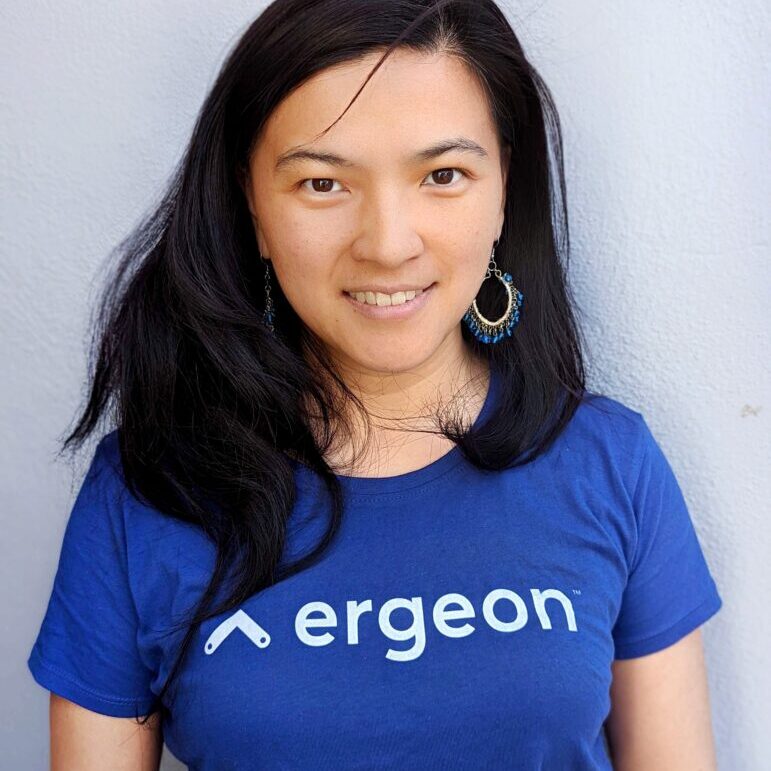
The Fence That Changed Everything
Jiayue "Jenny" He grew up next to one of the largest construction sites in the world - her family were civil engineers. The smell of concrete and the geometry of scaffolding were her childhood backdrop. Decades later, holding a Princeton doctorate and a McKinsey business card, she looked at America's $500 billion home improvement industry and saw exactly what her father would have seen: a mess that badly needed an engineer.
At the University of Toronto, she graduated ranked first in Canada among roughly 15,000 engineering graduates. That's the kind of credential that opens every door in consulting, finance, and academia. She walked through the Princeton Ph.D. door next - studying computer networking under Jennifer Rexford and Mung Chiang, two of the field's leading lights. By 2008, she had the letters after her name. By 2015, she had spent seven years at McKinsey rising to Associate Partner, leading projects that saved clients hundreds of millions of dollars and restructured operations across dozens of departments.
"Women have founded 28 percent of private companies, but only get 2 percent of the funding."- Jiayue "Jenny" He, Founder & CEO, Ergeon
Most McKinsey partners at that level move sideways into Fortune 500 executive suites. Jenny moved laterally - but into a small home-services startup called ezhome, where she became COO and later CEO. The pivot from boardroom strategy to scrubbing operational inefficiencies out of a trades business was deliberate. She wanted to understand how the actual work got done. Not in a PowerPoint. In the field.
In 2018, she founded Ergeon. The premise was specific and audacious: take the most friction-filled corner of home improvement - outdoor construction, fences, decks, artificial grass, concrete - and rebuild it from scratch with technology that construction had always refused to adopt. No more waiting for a contractor to drive to your house just to measure your yard. No more vague estimates and hidden fees. Ergeon would use satellite imagery to measure properties remotely, generate 3D visualizations automatically, and quote in minutes what used to take days.
Then came the part that most tech founders skip: she actually got a contractor's license. Not a figurehead certificate. A real license, earned because she wanted to understand the regulatory landscape, the physical constraints, and the practical realities her team faced daily. That detail says more about her operating style than any slide deck could.
The team she built is equally unusual. Ergeon runs a distributed workforce of 300+ people spanning 40+ countries - from day one. For a construction company. One-third of employees are women, against a construction industry average of roughly 1 in 30. The NPS sits at 72. Industry average is 0. These aren't marketing numbers. They're the residue of a system built by an engineer who cares about what actually ships.
The $40M Series B in June 2022 drew in DST Global, GGV Capital, Basis Set Ventures, Prysm Capital, and MetaProp. TechCrunch ran a teardown of the pitch deck as a case study in how to present an "unglamorous" industry transformation compellingly. By 2024, Ergeon reached coverage for 40% of U.S. households and Forbes named it one of America's Best Startup Employers - a designation they repeated in 2025. Angi handed over its Super Service Award. Her co-founder Odysseas Tsatalos, who helped build Upwork and sold Intacct for $850 million, isn't just a credential on a cap table - he's the technical architect of the systems that make the operation hum.
Jenny He is not building a fence company. She's building proof that technology can reach into the most analog corners of American life and make them fairer, faster, and more transparent. She's also building proof that female founders can raise serious capital for serious, non-flashy businesses. She talks about it plainly: women start 28% of companies and receive 2% of funding. That gap is not a statistic she accepts lying down.