The question was whether to sell the company. On a November 2025 earnings call, an analyst had worked his way from political uncertainty to a rather more immediate suggestion: perhaps this was a good time for Century Aluminum to find a buyer. Jesse Gary, its president and chief executive, answered without much ceremony. “The company is not for sale.”
There are expansive ways to explain a corporate strategy. There is also the six-word version. Gary went on to discuss cash generation, growth at Mount Holly and plans for a new smelter. His answer supplied a useful introduction to an executive whose working life has moved from interpreting agreements to making the expensive, physical things those agreements permit.
Gary trained as a lawyer. He now runs a business in which the availability of electricity can determine whether a plant produces metal or waits in silence. His career offers a practical answer to a familiar question about leadership: what happens when the person responsible for understanding the risks becomes responsible for taking them?
The lawyer gets the operating keys
Before aluminum, there was Berkeley, where Gary earned his bachelor’s degree, and Cornell Law School, where he earned his J.D. His public LinkedIn profile dates his Cornell years to 2002-2005. He practiced at Wachtell, Lipton, Rosen & Katz in New York before joining Century as associate general counsel in 2010.
The promotions came with widening territory. In February 2013, he became executive vice president, general counsel and secretary. Michael Bless, then Century’s chief executive, said Gary had earned the respect of colleagues and key partners in the United States and Iceland. The praise paired his skills as an attorney with his skills as a businessperson. Even then, the job description was becoming crowded.
In April 2019, Century created a chief operating officer position and gave it to Gary. Senior operating executives John Hoerner and Gunnar Gudlaugsson would report to him. He kept the general counsel title, while Morgan Walbridge became deputy general counsel and took responsibility for the legal department’s daily work. The arrangement put a lawyer over the operating businesses without pretending that he would personally do everybody else’s job.
By the time Century announced his succession to Bless in May 2021, Gary had overseen legal affairs, human resources, business development, government relations and energy. He became president, CEO and a director on July 1. His preparation had involved the parts of the enterprise that tend to meet whenever a factory has a consequential decision to make.
general counsel
& general counsel
officer
& CEO
A promising metal, an unforgiving electricity bill
Around Gary’s arrival in the top job, Century was working on ways to make more valuable products from its existing operations. In November 2021, he discussed construction of a new billet casthouse at Grundartangi, Iceland. The plan called for renewable hydropower, 150,000 metric tonnes of annual billet capacity and additional foundry alloy capacity.
The commercial logic was easy to follow even if the plant vocabulary was less obliging. Billet and foundry alloys would replace some standard-grade aluminum. Century wanted the ability to cast more than 80% of Grundartangi’s output as products carrying additional value. Gary was looking for more earnings from what the operation could make, alongside opportunities to increase how much it could make.
Then came a reminder of the limits. In June 2022, Century announced the temporary idling of Hawesville, Kentucky, amid high energy costs. Its filings also described falling aluminum prices. A smelter can have people, equipment and customers, yet still face an electricity bill that defeats the arithmetic.
That episode belongs in Gary’s story alongside the expansion plans. Running a primary aluminum producer means deciding when production makes economic sense and confronting the consequences when it does not. The contrast between Iceland’s proposed product upgrades and Kentucky’s curtailment explains more about his responsibilities than an unbroken list of promotions could.
“The company is not for sale.”
Jesse Gary / November 2025 earnings call
The dollar that bought an upstream problem
In April 2023, Century announced an agreement to acquire a 55% interest in Jamalco, the Jamaican bauxite mining and alumina business. The purchase price for the holding company was $1. That wonderfully small number came attached to a decidedly substantial operation: roughly 1.4 million tonnes of annual alumina capacity and more than 900 employees.
Gary described the purpose as securing a predictable long-term supply of alumina, the company’s essential raw material. The acquisition would connect Century’s smelting operations more directly to bauxite and alumina production. A business exposed to the price and availability of its inputs was buying greater influence over where those inputs came from.
The deal closed on May 2, 2023. A nominal purchase price does not run a refinery, of course. Integration, equipment and operating discipline still arrive with their own invoices. In his account of 2023, Gary emphasized combining the Century and Jamalco teams and sharing practices across the company. The acquisition expanded the work as well as the map.
- 01 / BauxiteMining in Jamaica
- 02 / AluminaRefining the raw material
- 03 / AluminumSupplying Century’s smelters
More of the production chain under one roof of ownership. Plenty of actual roofs still required.
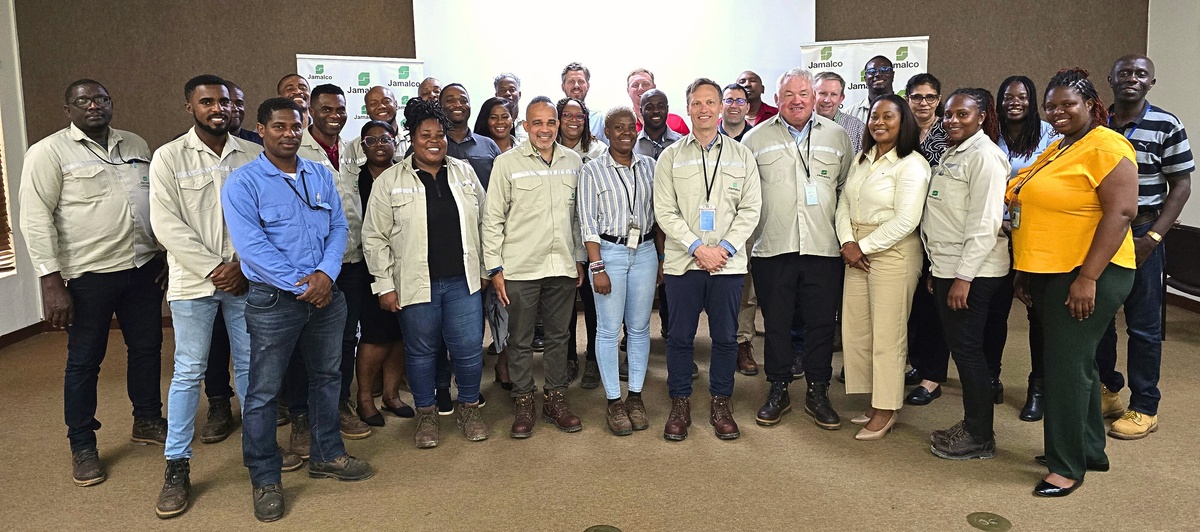
In May 2025, Gary visited Jamalco with senior colleagues and met employees who had recently been promoted. A group photograph after their luncheon offers a more human scale for the transaction. The people in it had acquired a new majority owner two years earlier. Now the owner’s chief executive was there among them, rather than appearing solely as a signature beneath an announcement.
An advocate who knows his brief
Long before he became CEO, Gary was publicly arguing for the industry’s survival. In January 2017, he appeared before the U.S. International Trade Commission on aluminum extrusions from China. He introduced himself on behalf of 1,800 Century colleagues and argued for maintaining trade protections that mattered to customers as well as their metal suppliers.
In March 2018, he defended proposed aluminum tariffs in an interview with Steve Inskeep. Gary’s argument was that subsidized production overseas had damaged American smelting capacity even as demand grew. It was an advocate’s account, offered by an executive with a direct stake in the outcome. His later support for Section 232 tariffs follows a position he had been making for years.
He also worked with a different administration. In March 2023, after a White House roundtable with industry and labor leaders, Gary thanked the Biden administration for discussions about industrial innovation and decarbonization. His statement linked federal investment, domestic manufacturing and the effort to lower emissions. In these appearances, the recurring objective was maintaining an American industry capable of investing.
By October 16, 2026, he was discussing domestic primary aluminum with retired General David Petraeus at an American Primary Aluminum Association event. National security had become another setting for the case he made as a corporate lawyer: the location of metal production has consequences beyond the company selling the metal.
Oklahoma, with the verbs still in the future
On January 26, 2026, Century and Emirates Global Aluminium announced a joint development agreement for a new primary aluminum smelter in Inola, Oklahoma. The proposed ownership split was 60% EGA and 40% Century. Annual output was expected to reach 750,000 tonnes, with construction targeted to begin by the end of 2026 and production by the decade’s end.
The announcement paired EGA’s smelting technology and construction experience with Century’s knowledge of operating in the United States. It projected 1,000 permanent direct jobs and 4,000 construction jobs. Those numbers describe the planned facility and its anticipated employment, rather than production or jobs already delivered.
Planned annual aluminum output
At the SAFE Summit that spring, Gary identified permitting as a brake on the schedule. His frustration had an operator’s specificity: a company could be ready to build and still be unable to break ground. In subsequent discussions, the Oklahoma power agreement remained a central piece of the work. Electricity had followed him from the legal portfolio to the chief executive’s agenda.
There is an instructive complication elsewhere in the portfolio. Century sold the idled Hawesville facility in February 2026 for $200 million in cash and a minority interest in an affiliate planning a computing and artificial intelligence data center there. The company intended to put a substantial portion of the proceeds toward expanding aluminum production at Mount Holly and the new smelter project.
A former smelter site could help finance future smelting while taking on an entirely different use. For Gary, preserving an industrial business involved changing its collection of assets. The ambition to make more American aluminum did not require every old plant to remain an aluminum plant.
The answer has to come out of the potline
By August 2026, there was completed work to set beside the proposals. Century reported restarting Mount Holly’s last 90 pots, returning Grundartangi’s Line 2 to near full production and bringing Jamalco’s new power-generation turbine online. The company reported second-quarter sales of $752.1 million. The machinery behind the strategy was moving.
Gary can be dry about the patience this business requires. At a June 2026 investor conference, an analyst mentioned a long aluminum bear market. “That’s been a bummer,” he observed. For an industry discussion otherwise populated by premiums, power blocks and production caps, the understatement did useful work.
His public career has followed a widening circle of accountability: first agreements, then operations, then the whole company. The next test is concrete enough. In Oklahoma, the planned metal must eventually become actual metal. The lawyer who learned the operating business now has to bring together the conditions that let it run.