A fire hydrant is a peculiar advertisement for a business. It stands outside all day, asks for no attention, and is expected to perform when attention finally arrives. Paul McAndrew leads a company that makes them. His route to that responsibility has involved a different collection of things that also have to work: factories, suppliers, engineering teams, acquisitions and the promises a manufacturer makes to a customer.
McAndrew became president and chief executive officer of Atlanta-based Mueller Water Products on February 9, 2026. He arrived with experience inside the company: first in global operations and supply chain, then as chief operating officer, then president. The sequence gives his appointment a particular character. Before taking responsibility for Mueller as a whole, he had already been responsible for much of its machinery, literal and organizational.
There is an engineering degree from Cardiff University at the beginning of the résumé. There are years of international operating roles after it. The career that follows offers a way to understand a business whose finished products can be easy to overlook. Someone must arrange for all those uncelebrated objects to exist, arrive and function. The ordinary appearance of the result conceals a considerable amount of work.
The education after engineering
From 2003 to 2017, McAndrew held operating roles at Kautex Textron in multiple countries. Those two words, “multiple countries,” compress a substantial part of an industrial career. They place the work beyond a single factory or domestic market. They also distinguish his preparation from a career spent moving through one headquarters. His operating experience crossed borders before his responsibilities reached the top of Mueller.
Later came Greenlee, where he served as vice president and general manager with responsibility for the Americas business. The remit included the full profit and loss account. That puts a price on the relationship between departments: what engineering designs, what a plant can produce, what sales can sell and what the customer is willing to buy all eventually meet in the same arithmetic.
In 2018, Emerson bought Textron’s Tools and Test business for $810 million. Greenlee was part of the transaction, alongside Klauke. The acquired business had recorded $470 million in 2017 sales and had 2,300 employees across 11 manufacturing locations. These were established operations being brought into a different industrial group, with products, distribution relationships and employees already in place.
Mueller credits McAndrew with an important role in that acquisition. Emerson completed the purchase on July 2, 2018. The transaction expanded its professional tools offering for mechanical, electrical and plumbing contractors. For McAndrew, the chapter connected leadership of an operating business with a change in its ownership and its place in a larger portfolio.
- 2003-17Operating roles across countries
Kautex Textron - 2018Greenlee joins Emerson
Tools & Test acquisition - 2022Global operations & supply chain
Mueller Water Products - 2026President & CEO
Mueller Water Products
The whole machine
At Emerson, McAndrew was vice president and general manager of Professional Tools. His responsibilities stretched across sales and marketing, product management and engineering, operations and supply chain, and human resources. It is a revealing list. A general manager with that remit cannot regard the factory as an island. The people making a product and the people making a promise about it belong to the same problem.
A beautifully designed tool still requires materials. Materials require suppliers. A product ready for shipment still needs a customer who wants it. Looking at McAndrew’s roles together suggests a practical education in these dependencies. That is a reading of the career rather than a claim about private motivation: his documented responsibilities repeatedly brought the technical and commercial sides of a business into the same field of view.
Mueller hired him in November 2022 as senior vice president of global operations and supply chain. The role put its worldwide manufacturing operations under his oversight. In August 2023, he became executive vice president and chief operating officer. In May 2024, the company added the title of president. Each appointment increased the scope of a job that had begun with making and moving products.
A customer cannot install a promise
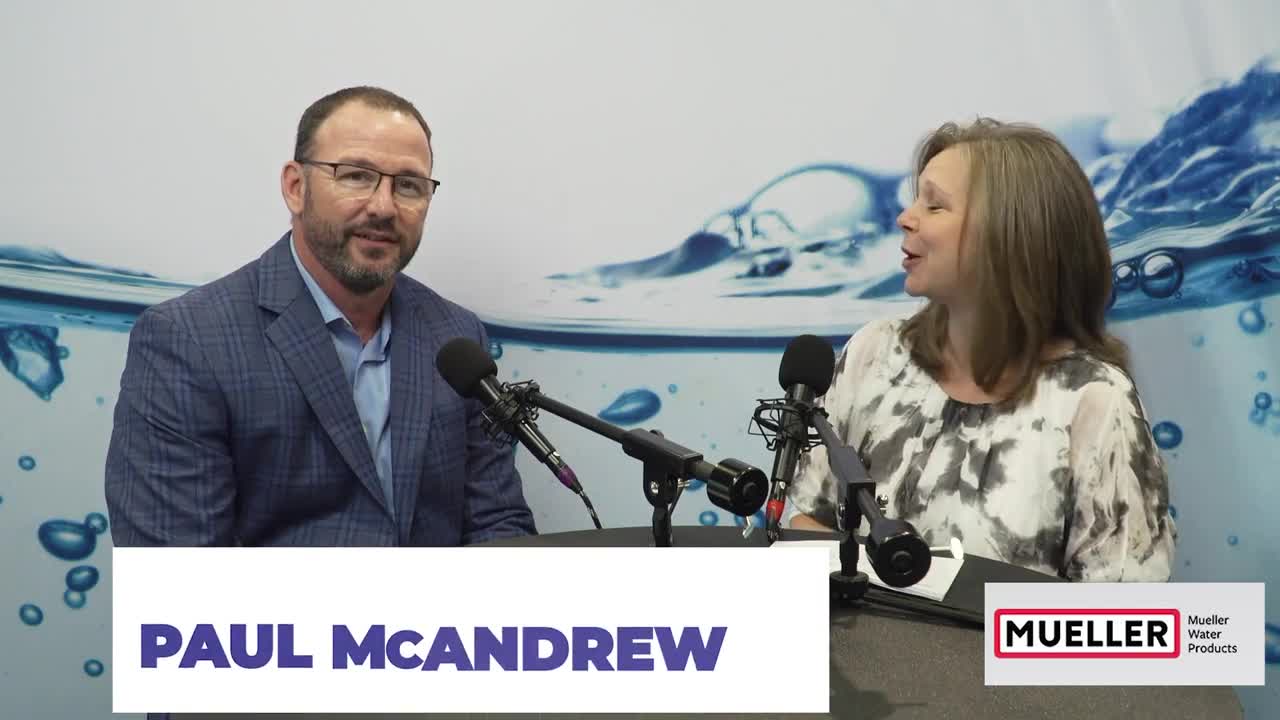
In a Water Talk appearance shared in August 2024, McAndrew discussed customer experience, supply chain challenges and investment in operations, including two new facilities. The subjects fit together naturally. A customer experiences a manufacturer through the products it receives and the service around them. A delayed component can turn a distant factory problem into a very local inconvenience.
Water infrastructure gives that relationship a physical setting. Mueller’s portfolio includes engineered valves, hydrants, pipe connection and repair products, meters and pressure management equipment. These products have destinations beyond a warehouse. They belong in networks that utilities must operate and maintain. A purchasing decision eventually becomes an installation, and an installation becomes part of someone else’s working day.
That makes customer service a useful test of an operating philosophy. It asks whether all the internal coordination produces something another organization can actually use. The factory may have its own measures of success. The customer has a schedule. Getting those two accounts of reality to agree is a less glamorous undertaking than announcing a strategy, though it tends to be remembered longer.
 ↗ WATCH THE CONVERSATION
The pipe acquires a second voice
The company McAndrew now leads also sells ways to observe a water network. Its Sentryx platform brings together services for metering, leak detection and pressure monitoring. Sensors can be installed at hydrants or valves. Information from those devices gives utility teams another view of a system whose pipes spend much of their lives conveniently out of sight.
The intended uses are specific. Track the progression of a leak. Monitor pressure and flow. Receive alerts about network events. Organize field assignments. These are decisions with people and equipment at the other end of them. A map becomes useful when it helps somebody decide where to send a crew or which part of a network deserves closer attention.
For an executive with McAndrew’s background, that combination presents a familiar coordination challenge in a different form. The hardware has to work. The information has to reach someone who can use it. The service has to fit the customer’s operation. An additional layer of technology adds another relationship to manage, alongside the older responsibilities of manufacturing and delivery.
In August 2026, Mueller identified approximately 9.6 billion gallons of client water-loss savings generated by EchoShore leak detection since 2020. The period began before McAndrew joined. It represents an accumulated company result, and it supplies a concrete measure for a field often described through abstractions. Water that would have been lost is a comprehensible reason to pay attention to a sensor.
The chair changes; the work continues
Mueller announced McAndrew’s succession in November 2025. He would succeed Martie Edmunds Zakas, who was retiring after a 19-year career at the company and would remain a senior advisor through the end of 2026. The arrangement gave the leadership change a period of overlap. McAndrew inherited an organization he knew, alongside the experience of the executive he was succeeding.
Board chair Stephen Van Arsdell credited him with helping improve the organization, operations and financial performance, and with building relationships among employees and customers. Those are the board’s judgments of his contribution. They also explain why the succession story belongs to the preceding three years as much as to the day his title changed.
His first year as CEO has brought further decisions about people and money. In October, Mueller announced Michael Morgan’s planned appointment to lead finance. McAndrew connected the appointment with planning, forecasting, execution and the Mueller Operating System. The new finance leader was scheduled to join on October 28, with the CFO transition to follow the annual report filing.
Third-quarter net sales
Fiscal quarters ended June 30. Scale starts at zero; full scale $500m. Sales increased 4.1%; higher pricing was partly offset by slightly lower volumes.
The results need reading with the same attention to parts. In the fiscal third quarter, sales rose 4.1% to $395.9 million. Higher prices across most product lines contributed; slightly lower volumes partly offset them. Operating income rose to $80.6 million from $73.7 million a year earlier. The figures describe progress, while their components explain the kind of progress being made.
On October 22, the board increased the repurchase authorization by $300 million and raised the quarterly dividend to eight cents a share. An authorization permits purchases rather than requiring them. McAndrew described a business seeking to keep investing while returning capital to shareholders. The operations executive now has responsibility for where the resulting cash goes, as well as how the products get made.
Fifty years in the room
One detail McAndrew has recalled offers a different timescale. At the Albertville plant’s 50th anniversary celebration, an employee was also marking 50 years with Mueller. A plant anniversary and a working life had arrived at the same number. For a CEO whose own Mueller tenure began in 2022, the encounter put inherited experience into unusually human proportions.
“Commercial excellence is just as critical as operational excellence.”
Paul McAndrew
It is tempting to tell an executive’s story entirely through promotions. That employee’s anniversary interrupts the habit. The new person at the top joins work that other people have been carrying for decades. McAndrew’s challenge is to make room for their knowledge while deciding which processes, investments and technologies should change. The hydrant outside still has its original assignment. The organization behind it has rather more to do.