●BREAKING: Skagit PUD + InPipe launch first community-scale HydroXS, July 2025●Hillsboro, OR unit: ~200,000 kWh/yr for 5+ years, zero outages●EBMUD becomes first California utility to run HydroXS●HydroXS ships to Rayong, Thailand - first deployment in Asia●IRA covers up to 50% of project cost●Series A: $6.5M led by FullCycle●Tagline: "Water is Power"●BREAKING: Skagit PUD + InPipe launch first community-scale HydroXS, July 2025●Hillsboro, OR unit: ~200,000 kWh/yr for 5+ years, zero outages●EBMUD becomes first California utility to run HydroXS●HydroXS ships to Rayong, Thailand - first deployment in Asia●IRA covers up to 50% of project cost●Series A: $6.5M led by FullCycle●Tagline: "Water is Power"
Portland, Oregon · Cleantech · Founded 2016
InPipe Energy
"Water is Power"
A small Portland company decided the most boring object in the energy world - a water pipe - was actually a power plant nobody had switched on.
13
People
$6.5M
Series A
24/7
Baseload power
3
States live + Asia
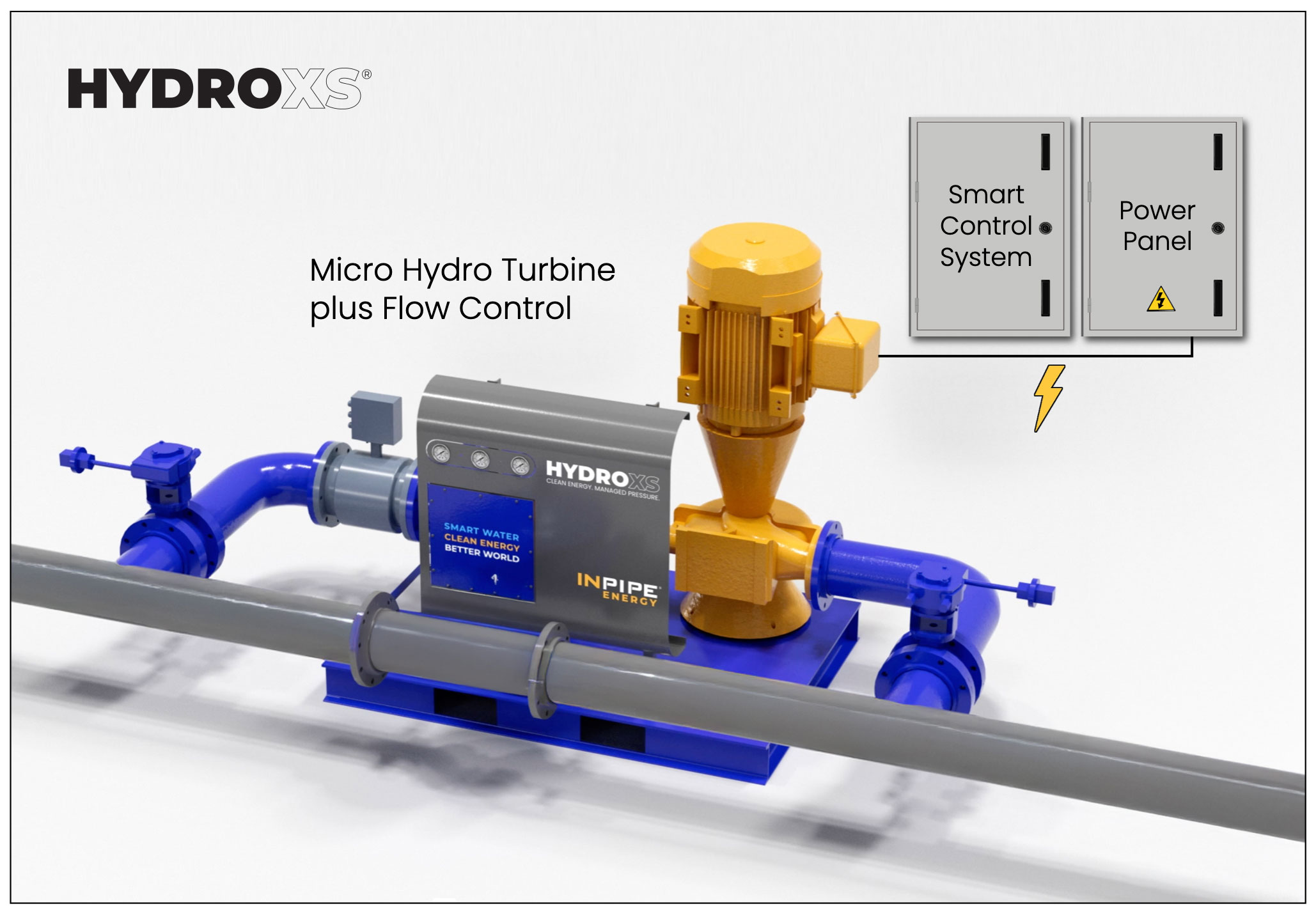
The HydroXS turbine. It looks like plumbing because, technically, it is plumbing - the kind that bills you back.
The Scene, Right Now
Somewhere under a high school, a pipe is making electricity
Next to Mount Vernon High School in Washington, water moves through a Skagit PUD pipeline the way it has for decades. The difference, as of July 2025, is that the water now leaves behind something on its way past: power. Enough to run the EV chargers in the parking lot and chip away at the school's energy bill. Students walk by it daily and never notice. That is exactly the point.
InPipe Energy builds the device responsible: the HydroXS, a micro-hydropower system that drops into existing water infrastructure and harvests pressure that utilities were paying to throw away. No dam. No reservoir. No river rerouted. Just a turbine where a pressure valve used to quietly waste energy as heat. The company is thirteen people in Portland, Oregon, and their whole argument fits on a bumper sticker they actually use: water is power.
"I envision a future where we can use existing water pipelines to generate energy to power critical infrastructure."
Here is the unglamorous truth at the center of this company. Water utilities have to control pressure, or pipes burst. So across millions of miles of pipeline, they install pressure-reducing valves - devices whose entire job is to take high-pressure water and choke it down to something safe. That excess pressure does not vanish. It becomes heat, noise, and wear. It is energy, deliberately destroyed, around the clock, in nearly every water system on earth.
Meanwhile those same utilities are among the largest electricity consumers in any city, and they are under pressure of a different kind: rising power costs, aging infrastructure, and decarbonization targets they have no obvious way to hit. Solar helps when the sun is out. Wind helps when it blows. Water, inconveniently for the skeptics, just keeps flowing.
A pressure-reducing valve is a waterfall in a box, set up to make sure nobody ever gets to use the waterfall.
THE CASE FOR IN-PIPE HYDROPOWER
The waste
Pressure valves destroy usable energy continuously, in almost every pressurized water system.
The bill
Water utilities rank among the biggest electricity users in any municipality.
The catch
Traditional hydropower needs dams and rivers - expensive, slow, environmentally fraught.
The opening
The pipes already exist. They are already maintained. Nobody was generating from them.
The Founders' Bet
A water-and-energy lifer decides the boring answer is the right one
Gregg Semler had spent since 2000 in the clean energy and water sectors, including leading the ventures Lucid Energy and Pivotal Solutions. He had seen the dam-sized version of hydropower and its dam-sized problems. In 2016 he founded InPipe Energy on a narrower, stranger premise: forget building new infrastructure entirely. Generate from the infrastructure cities already own and already pay to keep running.
It is the kind of idea that sounds obvious only after someone commits a decade to it. Semler brought in a CTO, Mickey Connor, a former GE Water engineer who has filed twelve patents and works as a registered USPTO patent agent - the rare person who can both invent the thing and write the claims that protect it. The bet was not on a flashy breakthrough. It was on plumbing, controls, and patience.
The vision is almost suspiciously modest: a future where clean energy is as abundant as clean water.
- InPipe Energy, on what it is actually building
The Milestone Reel
From idea to international in under a decade
2016
Gregg Semler founds InPipe Energy in Portland, Oregon.
2020
HydroXS goes live in the City of Hillsboro, OR - the unit that would run 5+ years without an outage.
2021
Series A funding (reported $6.5M) led by FullCycle; early backing from Imagine H2O, New Energy Nexus, LACI and CalSEED.
2022
Inflation Reduction Act passes, covering up to 50% of HydroXS project costs for water utilities.
2023-24
EBMUD becomes the first California utility to generate renewable power with HydroXS (~130,000 kWh/yr).
2025
First community-scale HydroXS launches with Skagit PUD; first export to Rayong, Thailand - the technology's debut in Asia.
The Product
HydroXS: the turbine that moonlights as a valve
The HydroXS does two jobs that water operators usually treat as separate. It manages pressure - the thing the utility actually needs - and while it is at it, the flow spins a micro-hydro turbine that produces carbon-free electricity. Smart controls keep the pressure exactly where the utility wants it, so the system never asks anyone to choose between safe water and free power. It retrofits into existing pipelines or installs in new ones, and it is manufactured in the United States, which is what makes it eligible for those IRA incentives.
The result is the rarest thing in renewables: baseload. Because the water runs day and night, so does the generation. No batteries required to smooth out a cloudy afternoon.
HydroXS
Patented in-conduit micro-hydropower plus smart pressure controls. Drops into existing or new water pipelines, harvests wasted pressure, and turns it into 24/7 carbon-free electricity - without compromising pressure management.
Utility Energy Recovery
Turnkey projects for water agencies and industrial water users, including financing help and access to IRA incentives covering up to half the project cost. Customers generate from infrastructure they already maintain.
Most renewables make you choose a time of day. Water, rudely, refuses to stop flowing.
ON BASELOAD GENERATION
The Proof
The skeptic's question is "does it actually run?" Hillsboro answered it.
A pilot that runs for a quarter proves nothing. A unit that runs for five-plus years with zero outages, quietly generating around 200,000 kWh a year to offset an adjacent sports complex - EV charging, concessions, lighting - proves something. That is the Hillsboro, Oregon installation, and it is the reference every later customer points to.
From there the map filled in. EBMUD in California, the first utility in the state to run HydroXS, generating roughly 130,000 kWh a year of emission-free power toward its carbon-neutral-by-2030 goal. Skagit PUD in Washington, scaling up to a community deployment with technology collaborator Grundfos. And then the pipeline crossed an ocean: a deployment in Rayong, Thailand, with the Aquaris Initiative - the first time in-pipe hydropower of this kind landed in Asia.
Annual clean energy, by site
// approximate kWh generated per year, per named HydroXS deployment
Skagit PUD (community)
up to 300,000 kWh
Hillsboro, OR
~200,000 kWh
EBMUD, CA
~130,000 kWh
Skagit (earlier 30 kW unit)
~104,000 kWh
A single 30-year Skagit deployment is projected to prevent roughly 9.3 million pounds of CO₂. Figures are company-reported and approximate.
"Through energy recovery projects like this one with InPipe Energy, we're protecting our ratepayers from rising electricity costs."
- George Sidhu, General Manager, Skagit PUD
Founded
2016
Portland, Oregon
Team
~13
Lean cleantech crew
Series A
$6.5M
Led by FullCycle
Flagship
HydroXS
Patented, US-made
The Mission
Decarbonize the unglamorous parts, because that's where the carbon is
InPipe's stated mission is to help the world practically and economically decarbonize by creating new clean energy from existing water infrastructure. The keyword is practically. There is no shortage of ambitious climate pitches that require new land, new permits, and a decade of construction. InPipe's is the opposite: use what is already in the ground, already permitted, already maintained, and switch on the power that was being thrown away.
It complements the renewables everyone already roots for. When solar and wind go quiet, the pipes do not. That makes in-pipe hydropower less a competitor to other clean energy and more the steady, slightly unfashionable colleague who is always at their desk.
The most radical climate idea here is refusing to build anything new.
- Why "in-pipe" matters
Why It Matters Tomorrow
Back at the high school
Return to that pipeline under Mount Vernon. Multiply it. Every pressure valve in every water system is, in this telling, a dormant generator. The total addressable opportunity is not a niche - it is the plumbing of civilization, sitting idle. If InPipe's bet holds, the boring infrastructure cities already own becomes a distributed, around-the-clock power source, and water utilities stop being only consumers of electricity and start being producers of it.
That is still an if. Thirteen people, a handful of marquee installations, and a few states plus one Thai industrial site do not yet make a revolution. But the Hillsboro unit has been running for five years, the Skagit students are charging their cars off pipe pressure, and the company keeps signing the next one. The water was always going to flow. InPipe Energy simply decided to charge admission on the way through.