A water main breaks. A crew arrives. Someone digs a hole. The sequence is familiar enough to feel inevitable. But consider a different starting point: what happened inside the pipe before the pavement got wet? For Mueller Water Products, that question connects a nineteenth-century manufacturing inheritance to a contemporary business in sensors and software. The interesting object is still the valve or the hydrant. The interesting change is what it can tell you.
- Mueller makes valves, hydrants, repair connections, meters and water-network technology.
- Its customers include municipal and private utilities, with North America its core market.
- The useful trick: gather information from infrastructure already in the ground.
Eleven sensors. A different diagnosis.
In California’s Crescenta Valley, the first visible failures were leaks and main breaks. The less visible problem was pressure. Pump operations sent swings of 70 to 80 psi through an aging network. Monitoring at pump stations left operators with an incomplete picture downstream.
The district installed 11 Mueller pressure loggers, one per pressure zone, for approximately $15,000-$20,000, using its own staff and existing sample stations. Readings fed into Sentryx. Comparing them with pump data exposed the connection. Operators staggered pumping, changed tank-level ranges and introduced gentler pump starts.
The district’s account reports $100,000-$120,000 in avoided repair costs over three months. That is an estimate from one deployment, combining equipment with operating changes. The transferable lesson is practical: measure the stress before deciding which asset deserves the blame.
The machine shop never quite left
The company’s roots reach back to Hieronymus Mueller’s 1857 business in Decatur, Illinois. In 1872, he patented a machine for tapping water and gas mains. The problem was physical and awkward: how do you make a connection to a pressurized line? Good engineering made an inconvenient operation manageable.
Today’s corporate structure came much later. Mueller Water Products became a separate publicly traded company in 2006, following its combination under Walter Industries. Its history includes the acquisition of Echologics in 2010, adding leak detection and pipe assessment, and the subsequent divestitures of U.S. Pipe and Anvil. The portfolio has been assembled and edited, rather than preserved in amber.
“Where Intelligence Meets Infrastructure”Mueller’s corporate positioning
There is something pleasingly literal about that phrase. A water network needs metal that holds pressure. It also needs a way to reveal where pressure is behaving badly. Mueller sells into both needs, with manufacturing knowledge supplying context for the measurements.
A fire hydrant gets a second job
A New Jersey American Water pilot shows the idea in miniature. Previously, a pressure recorder at a Chester Township location required a pressurized hydrant barrel and could not operate through freezing weather. The utility lost its winter view.
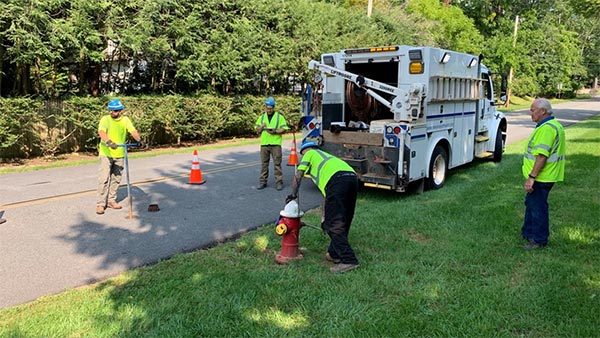
In August 2020, the team retrofitted an existing 2010 Super Centurion hydrant. The new sensor sat below the main valve, where it could capture pressure with that valve closed. Data traveled to the web-based Sentryx platform. Installation avoided excavation; the utility budgeted two hours for its first attempt and expected later installations to take an hour or less.
That changes how you think about an installed product. The hydrant is already a useful point of access to the network. Adding sensing gives it another task without requiring a new hole in the street. For a utility, avoiding excavation can matter as much as adding another feature to a dashboard.
A reading becomes useful when somebody changes a setting, schedules a repair or checks a suspicious pipe.
The business beneath the dashboard
Mueller’s product range spans engineered valves, hydrants, pipe connection and repair products, metering, leak detection, pipe assessment and pressure management. A utility can use those tools to control flow, repair a damaged connection, understand consumption or choose where to investigate next. The company is a supplier to water operators; it does not run the municipal water system for them.
Its business combines equipment sales with technology and services. Products reach customers through distributors and direct channels. Its reporting separates Water Flow Solutions from Water Management Solutions. That makes Mueller broader than a single metering vendor, while keeping the business anchored in infrastructure people actually install and maintain.
In fiscal 2025, revenue reached $1.4297 billion, up 8.7%; reported operating income was $260.6 million. Capital expenditure was $47.3 million. There were costs behind the progress: a $4.1 million inventory and asset write-down tied to the legacy Decatur brass foundry closure, plus $5.6 million of warranty charges. Selling dependable hardware carries obligations long after a shipment leaves the gate.
$824.9mWater Flow Solutions
$604.8mWater Management Solutions
The advantage has to survive the trench
The competitive field changes by product. McWane and American Cast Iron Pipe compete in iron gate valves and hydrants. Metering alternatives include Sensus, Neptune, Badger Meter and Itron. Mueller’s case rests on its installed base, distribution, technical support and the connection between physical products and network information. A familiar brand helps; delivery and field performance still decide whether it earns the next order.
The approach needs conditions a product brochure cannot supply: usable communications, compatible equipment and operators able to act on the readings. A sensor cannot repair a split main. Pressure management will help most where pressure is contributing to failures; deteriorated pipe may still need replacement. Halifax Water’s pressure-management trial, for example, began with district metered areas, pressure-reducing valves and cellular access already available.
Paul McAndrew became CEO in February 2026. By the June quarter, Mueller reported $395.9 million in sales, up 4.1%. The enduring test is smaller than those numbers: can a crew make a better decision before the next emergency call? The company’s most useful promise fits into that moment, when an underground problem becomes visible early enough to do something about it.