Robert Pagano found a testing ground for his business in a place where most executives would prefer fewer complications: a house renovation. After becoming chief executive of Watts Water Technologies, he set about rebuilding his vacation home in central New York with as many Watts products as possible. His plumber worked with the company. Its designers worked with his architect. Somewhere between the corporate portfolio and the actual building, gaps appeared.
He described the exercise in 2015, a year into the job. It gave a domestic scale to an industrial question: could the company’s many products add up to a complete system? A renovation has a useful impatience with abstractions. The equipment must fit. Someone must install it. Eventually, somebody expects the water to run.
Pagano also had a seasonal explanation for buying boiler manufacturer AERCO. Watts had supplied the ornaments; the acquisition supplied the Christmas tree. For a discussion of corporate development, it was agreeably easy to picture.
The intern returns to the pump business
Long before the renovation came an accounting internship at Goulds Pumps. Pagano studied at the State University of New York at Oswego, graduating magna cum laude in 1984. His first professional chapter took him to KPMG Peat Marwick in Syracuse. After five years in public accounting, he returned to the pump business where he had been a student intern.
The route from there included auditing, cost accounting and controller assignments. By 2002, he had been named president of ITT Industries’ Industrial Pump Group. The operation then encompassed 10 manufacturing plants, 14 service facilities and 30 sales offices worldwide, with more than 2,000 employees. This was accounting experience being carried into a business with a substantial physical footprint.
It is a revealing career sequence. A controller has to understand what the business has done. An operating president has to decide what it will do next. Pagano’s assignments gave him successive opportunities to connect those responsibilities, moving from the record of industrial activity to responsibility for the activity itself.
A finance career with factory doors
At ITT, Pagano’s responsibilities extended through senior finance positions and industrial leadership. From April 2009 to May 2014, he served as senior vice president of ITT Corporation and president of ITT Industrial Process. He arrived at Watts that May as chief executive, president and a director.
The accounting qualification remained relevant. He is a certified public accountant, and twice during his Watts tenure he also took on the interim chief financial officer’s job: from October 2014 to April 2015, and again from April to July 2018. In February 2022, he added chairperson of the board to his responsibilities.
Those overlapping jobs give his biography an unusual rhythm. The move into operations did not close the finance chapter. He returned to it when the company needed him there. It is a career with more continuity than the usual neat progression of titles suggests, with the same financial discipline available for increasingly broad assignments.
First, get everyone into the same conversation
When Pagano arrived, he began with a listening tour. He met leadership, employees, customers and investors to understand what the business needed. A strategy followed, organized around growth, operational excellence, commercial excellence, One Watts, and a talent and performance culture.
Former CEO Tim Horne described the appointment as an effort to bring renewed energy and profitable growth to the company. Pagano’s assignment involved an established manufacturer with an extensive history, rather than a business whose identity could be invented on a clean sheet of paper.
The distinction matters. In an acquired collection of businesses, each unit may have perfectly reasonable ways of working. Bringing those units together means deciding which practices can travel, which priorities everyone should share, and how a customer experiences the resulting organization. A corporate plan earns its keep when people can use it to settle those ordinary questions.
“The customer is number one.”
Robert Pagano
The brand the distributor didn’t recognize
One encounter furnished Pagano with a particularly compact example. A major distributor did not know that Powers belonged to Watts. The company possessed a range of brands; even an important customer could miss the connection between them.
Pagano’s response included making the relationship explicit in the way brands appeared, using the identification “a Watts Brand.” The episode explains why portfolio integration has a commercial purpose. Ownership on a corporate chart does little for a customer who cannot recognize what else the supplier offers.
His product decisions followed a similar interest in distinct value. Watts removed approximately $175 million in sales of products outside its chosen core. Pagano contrasted an ordinary washing-machine hose with IntelliFlow, a product that controls the water supply and incorporates leak detection. The sale being pursued changed along with the product being offered.
And the distributor? Asked about him later, Pagano supplied a short sequel: “Oh, he knows it now.” Some management stories require a diagram. This one managed with six words.
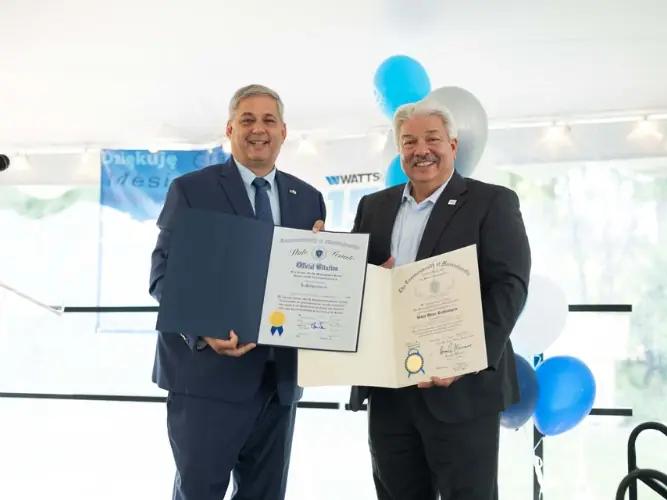
A birthday with a working agenda
In August 2024, Watts marked its 150th anniversary at its North Andover headquarters. Pagano addressed a gathering that included employees, directors, public officials, community partners and the trade media. State senator Bruce Tarr presented legislative citations recognizing the occasion.
The day also connected the company’s past to its next generation of work. Its learning center was dedicated to the Horne family, whose involvement spanned three generations. Former CEO and director emeritus Tim Horne participated alongside Pagano. For a business with a long institutional memory, that pairing gave the celebration a human connection across leadership eras.
There were products to inspect as well as speeches to hear. Visitors toured demonstrations and received an early look at Nexa, a water-management system for facilities. A birthday party can sustain a certain amount of looking backward. Bringing guests into a working demonstration gives the conversation somewhere else to go.
The lesson needs a room full of pipes
The anniversary tour made that practical emphasis visible. Demonstrations covered piping, leak protection, steam equipment and digital mixing. The newly named Horne Learning Center gave the gathering a place to examine how equipment behaves and how it can be used.
Outside, Bradley’s mobile training operation offered another way to take the products to the people specifying and installing them. Its six training vans traveled around the United States, carrying equipment and instruction to contractors, engineers and wholesalers.
There is a pleasing lack of ceremony in a room full of pipes. A product presentation becomes more useful when someone can point to the connection, inspect the assembly or ask the inconvenient installation question. In that respect, the demonstration room and Pagano’s house renovation belong to the same conversation. Both bring a company’s promises within reach of a person expected to make the equipment work.
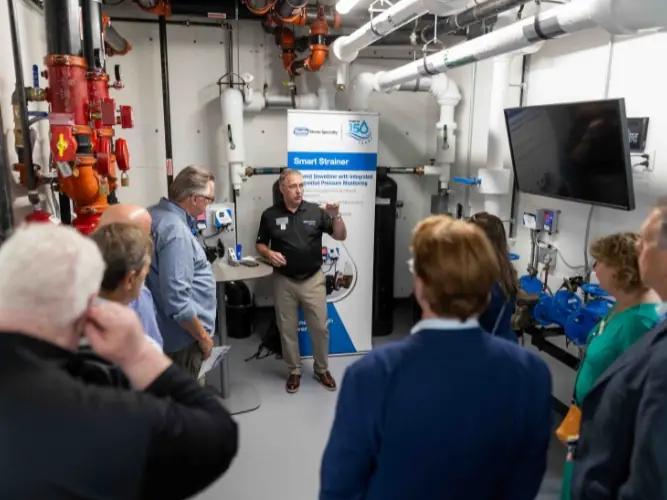
Giving the mechanical system a voice
Connected products extend that conversation beyond the installation. Watts introduced Nexa in 2024 as an intelligent water-management solution for commercial buildings. In his sustainability message, Pagano placed it within a broader agenda of water conservation, energy efficiency, and safety and regulation.
The appeal is understandable. Building operators need information about equipment already doing work out of sight. Monitoring and control capabilities can make those systems easier to understand and manage. The mechanical product acquires another responsibility: helping its owner see what is happening.
Pagano’s public agenda also includes the people around those products. Watts introduced its Watts Cares volunteer program in 2024, with participation from more than 40 sites supporting more than 50 organizations. The industrial business occupies real places, with neighbors as well as customers. Its activities extend beyond the equipment it ships.
Beyond the Watts boardroom
Pagano’s outside board work keeps him connected to two different parts of the industrial world. He joined Applied Industrial Technologies’ board in August 2017. The distributor serves industrial customers with components and related services. In October 2021, he joined the board of The Water Council, an organization focused on freshwater technology and water stewardship.
Those appointments place the manufacturer’s chief executive alongside businesses and institutions concerned with how technology reaches its users. The distribution relationship and the development of water technology both sit close to the questions he has pursued at Watts.
His public LinkedIn activity offers a smaller, less formal glimpse. Sharing recognition of Watts as a 2023 Top Place to Work by The Boston Globe, he wrote: “Very proud of the team for this recognition!!” The brief message puts the emphasis on colleagues. Alongside the formal titles and financial results, it records what he chose to applaud in public.
The numbers keep their own counsel
By August 2026, Watts was reporting another period of growth. Second-quarter net sales reached $763.2 million, compared with $643.7 million a year earlier. Reported sales rose 19%; organic sales rose 12%. The company increased its full-year sales and margin outlook.
The same results showed operating margin of 20.2%, down from 21.0%. Sales and operating income reached records while the margin percentage declined. Keeping those facts together offers a more useful picture than letting a record do all the talking.
Reported growth: 19% · Organic growth: 12%
Operating margin: 21.0% → 20.2%
Pagano pointed to data centers as an opportunity, alongside continued investment in digital capabilities and the One Watts Performance System. The old tasks remain attached to the new markets: choose where to invest, serve the customer, and make growth work through the organization.
His career has made those questions unusually tangible. There is the student internship, the controller’s desk, the industrial operation and the chief executive’s office. Then there is the house, where a plumber and an architect had to reconcile the portfolio with the plans. It remains a useful image of Pagano’s working problem: getting a collection of well-made pieces to function together, in a building where someone will actually use them.
Continue the conversation
Watts website · Pagano on LinkedIn
- The 2015 conversation: a renovation and a new strategy
- The 2024 conversation: brands, customers and connected products
- Oswego alumni magazine: the early career
- The Watts Way: the company’s history
- Watts’ 2025 annual report
- Pagano’s sustainability message
- Inside the 150th-anniversary celebration
- The anniversary innovation tour
- The Water Council leadership
- Second-quarter 2026 results
- Watch: Pagano’s anniversary address
- Watch: the 2026 Gabelli discussion
- Watch: leadership and strategy with Frans Johansson