At the Grandover Resort in Greensboro, North Carolina, the upper floors had a problem that no amount of golf, spa treatments or fine dining could improve. The water pressure disappointed guests. So did the temperature. Two new on-demand water heaters had already gone in. Still, the old mixing valves struggled. Occasionally, an engineer had to free a stuck piston by hand. Luxury, it turns out, has some rather unglamorous prerequisites.
- Watts makes the valves, heating equipment, drains and filtration products that help buildings handle water safely.
- Its customers buy through plumbing wholesalers and specialist channels; its products end up in homes, hotels, hospitals and other buildings.
- The next step is visibility: connect the equipment, catch trouble earlier and give maintenance teams something useful to act on.
The shower upstairs
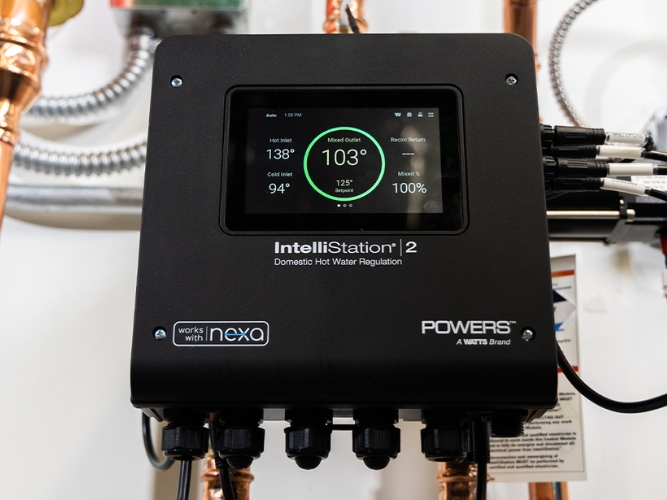
In Watts’s account of the Grandover project, Sloan Plumbing replaced the aging mixing equipment with a Powers IntelliStation 2, connected to Nexa water management software. The resort reported nearly six pounds of additional line pressure and consistent hot water upstairs. That sequence is the interesting part. Adding heating capacity had left a distribution problem unresolved. A less conspicuous component held up the experience the hotel was selling.
Watts Water Technologies occupies this overlooked territory. A pressure regulator, backflow preventer or mixing valve may command little attention when somebody tours a building. Yet each governs a condition on which everyone depends. Water has to arrive at a useful pressure, stay separate from contamination and reach people at an appropriate temperature. The company makes equipment for these jobs, along with the systems that heat, filter and drain it.
A useful thing to be afraid of
The business began in 1874, when English immigrant Joseph E. Watts opened a machine shop supplying textile mills in Lawrence, Massachusetts. Steam and pressure made mills productive. They also made failures dangerous. Watts developed regulators and relief valves that addressed those risks. The origin is refreshingly specific: a machine shop, industrial customers and a physical problem that could hurt somebody.
The company’s history places its combination temperature and pressure relief valve in the 1930s. The important idea was that pressure alone did not describe the hazard. Temperature mattered too. Watts also worked to get the technology understood and included in safety codes. There is a useful commercial lesson here: inventing protection and persuading an industry to require protection are connected pieces of work.
“It’s one less thing that we have to worry about.”
Khoury Group executive vice president, on the Grandover installation
Today, that engineering extends across several recognizable brands. AERCO and PVI supply boilers and water heaters. BLÜCHER handles stainless steel drainage; Orion handles chemical waste drainage. Powers handles mixing. The portfolio follows water through a building, giving designers more ways to address the interfaces between equipment. That breadth explains why a company associated with a humble valve also belongs in a conversation about an entire mechanical room.
The route through the supply counter
The customer relationship is more complicated than a homeowner buying a gadget. An engineer may specify the equipment, a contractor install it, a wholesaler supply it and a facilities team inherit responsibility for it. In 2025, wholesale distributors accounted for approximately 66% of Watts’s sales. Specialty channels supplied another 21%, original equipment manufacturers 10% and do-it-yourself chains 3%. The supply counter remains central to this technology business.
There are credible alternatives. Zurn Wilkins sells backflow prevention and pressure controls. Caleffi sells thermostatic and digital mixing equipment. Watts’s proposition rests on the combination of products, application knowledge, distribution and connections between systems. Buyers still have to compare the particular valve, operating range and installation. A broad catalog does not make every item the right choice.
Building that catalog also takes capital. Watts paid approximately $301.2 million, net of acquired cash, for Bradley in 2023. Bradley brought commercial washroom equipment into the portfolio, extending the company’s presence toward the fixtures people actually see. This is an established manufacturer’s expansion model: acquire adjacent expertise, then make it available through overlapping customer relationships.
Recent results show both growth and its costs. Second-quarter 2026 sales reached $763.2 million, up 19% from a year earlier. Watts attributed higher volume partly to data centers. Its reported operating margin nevertheless fell to 20.2% from 21.0%. Acquisitions, inflation and tariffs weighed on profitability. The figures are a reminder that even a business selling protection has to manage its own exposure to the price of making and moving things.
A classroom belongs in the factory
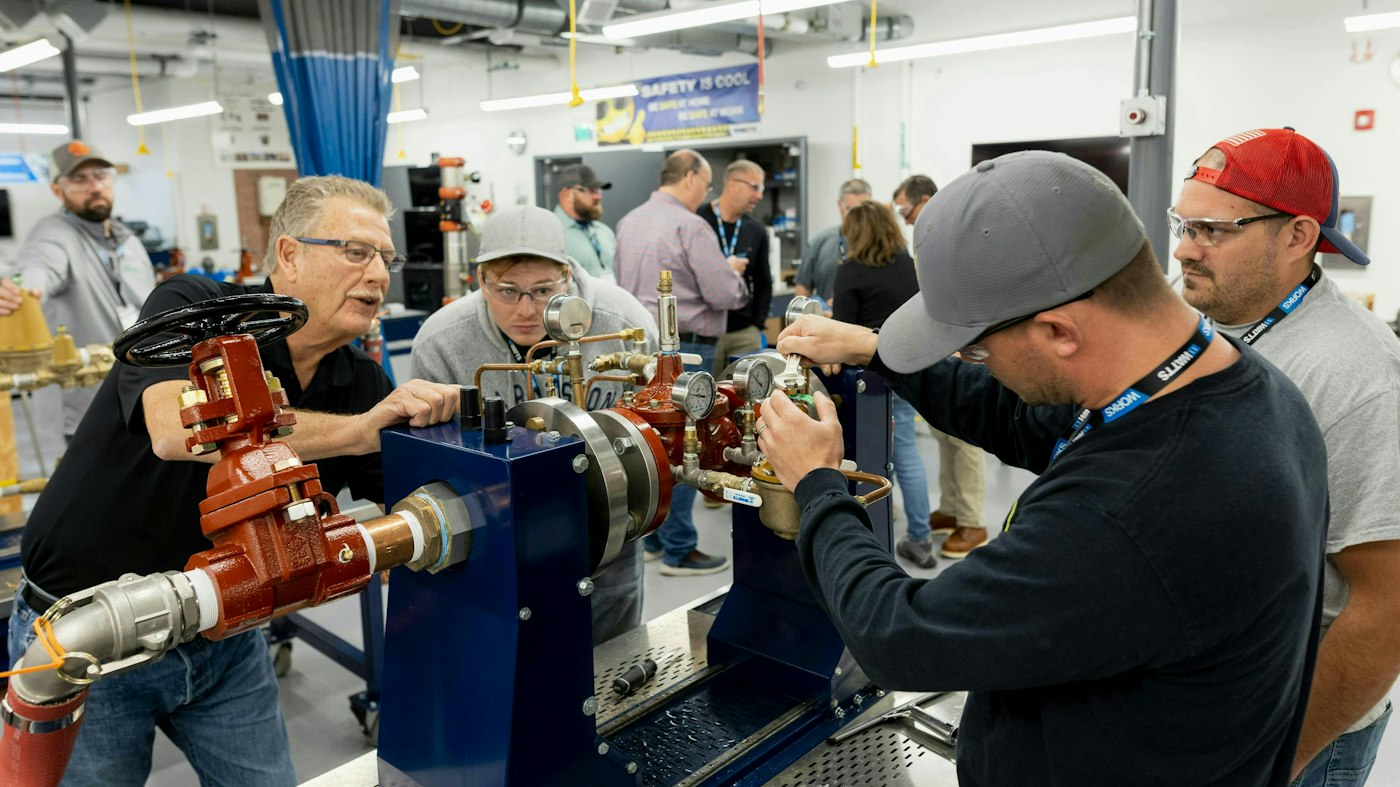
The less visible investment is teaching. In a 2024 interview, Americas sales executive Andrew Windsor said Watts had invested tens of millions of dollars in training capabilities over the preceding decade. Hands-on facilities sit alongside short online courses. The online program even lets learners earn tokens toward branded merchandise. A hat is a modest reward for understanding a valve, but the incentive is pleasantly concrete.
Training serves a practical purpose. Equipment has to be selected, installed and maintained correctly. The company’s stated culture emphasizes continuous improvement and accountability; its safety program includes hazard analysis and early reporting. Those ideas fit the product. A manufacturer promising fewer water problems needs people who notice small problems before they grow.
Give the mechanical room a voice
Nexa adds sensors, operating history and alerts to that older mechanical business. At Grandover, the engineering team and plumbing contractor could both see equipment performance. That is a useful change in who has access to the evidence. A service call can begin with information about what happened, rather than a complaint and a trip downstairs.
- MeasureFlow, pressure, temperature
- DiagnoseFind the constraint
- ActRepair, adjust, verify
Editorial interpretation of the Grandover case
For a building owner, the copyable move is to investigate the whole chain before purchasing another major appliance. Ask where pressure drops, when temperatures wander and who receives an alert. Nexa pricing varies with sensor configuration and monitoring needs. Budget for the installation and the people who will respond, as well as the equipment.
A dashboard cannot free a stuck piston. Remote control requires compatible equipment, and monitoring needs a working communications path and an assigned response. The Grandover result remains a manufacturer-reported case, rather than a promise for every property. Watts’s opportunity lies in getting those details right. The desired outcome is wonderfully uneventful: someone upstairs turns a tap, and gets on with the day.