A water valve is an unlikely place to look for a corporate strategy. It has no screen. Nobody shows it off at dinner. Installed on a home’s main supply line, Moen’s Flo Shutoff spends its working life watching water pass. When it detects certain abnormal patterns, it can close the valve. The intended achievement is wonderfully uneventful: a house that stays dry.
- Familiar brands give connected products a route into the house.
- Plumbers and insurance partners help turn a purchase into protection.
- A pending decking sale shows the cost of choosing where to focus.
Behind that valve sits Fortune Brands Innovations, the parent of Moen, Master Lock, Therma-Tru and a collection of other household names. Think of the business as a set of encounters with a building: turn on the tap, open the door, secure the shed. Its interesting wager is that these everyday objects can become more useful by noticing trouble earlier.
A leak is a distribution problem
Consider what has to happen before the valve does anything useful. Someone must buy the right size, find the main water line, arrange installation, provide power and pair the device. Moen recommends a plumbing professional because installation involves removing a section of pipe. A clever sensor cannot negotiate that appointment.
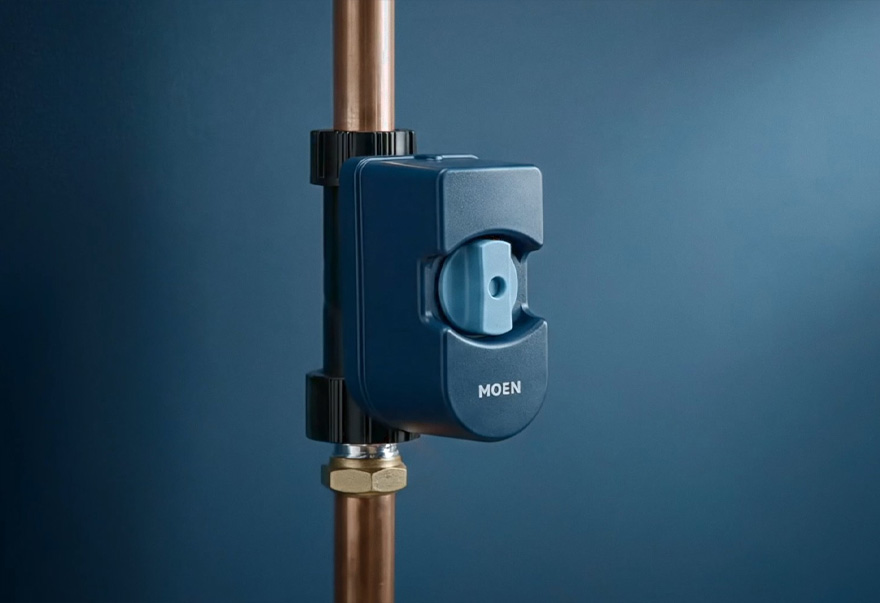
This explains an otherwise unglamorous partnership. Frontdoor, the home-warranty company, agreed to install Flo devices bought through selected insurance marketing programs. Its October 2024 announcement expanded that arrangement from California into seven more states. Some insurers were requiring leak-detection and shutoff devices in certain markets. The person worried about the claim, the person fitting the valve and the person living in the house suddenly had overlapping interests.
The useful lesson is an inference from that arrangement: distribution can include the institution that pays when your customer has a bad day. An insurer has a reason to encourage prevention that a gadget shop does not. The installer removes another obstacle. A product gets closer to delivering its promise when somebody takes responsibility for the awkward middle.
the supply
unusual use
the valve
There are practical boundaries. Flo’s standard setup requires a smartphone, 2.4 GHz Wi-Fi and an electrical supply. The valve cannot keep rain out of a roof or stop an overflowing sump pump. Its core device and app require no monthly fee, but buying hardware does not erase installation costs or plumbing constraints. Prevention works best when the buyer understands which problem is actually being prevented.
An $800 million change of locks
Fortune Brands applies the same connected-product idea to access. Yale and August bring residential smart locks; Master Lock extends into commercial connected access and digital lockout/tagout, helping organizations manage access and maintenance safety. These products belong to different purchasing conversations, even when the underlying question sounds similar: who can open this, and when?
In June 2023, Fortune Brands paid $800 million cash for Emtek and Schaub luxury hardware and the U.S. and Canadian Yale and August residential smart-lock businesses. The geography matters. It did not buy the worldwide Yale brand. The company put the price at roughly $700 million after tax benefits, a distinction worth preserving when discussing what the acquisition cost.
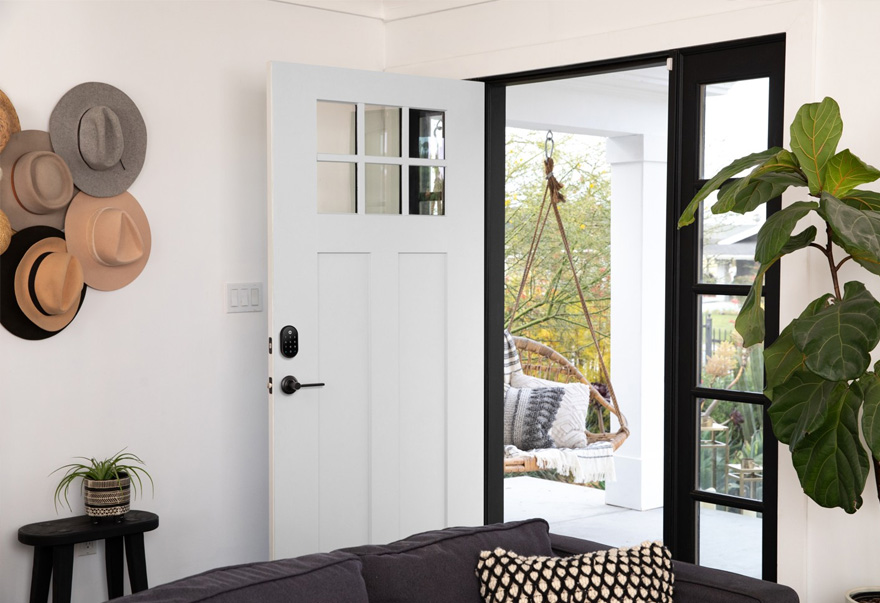
The broader portfolio keeps one foot firmly in the physical world. Moen sells faucets and showers. House of Rohl groups luxury plumbing and hardware, including Emtek and Schaub. Aqualisa supplies digital showers; SpringWell adds filtration. Therma-Tru makes entry-door systems, while Larson supplies storm doors and screens. Materials, finishes and fitting still matter. Connectivity is one reason to buy, rather than the whole proposition.
The business earns revenue by selling through wholesalers, dealers, home centers, showrooms, industrial channels and online outlets, including direct sales. Customers include homeowners, plumbers, designers, builders and property operators. Against alternatives such as Delta, Kohler and Schlage, its appeal rests on recognizable brands and established trade relationships. That network is valuable only if the goods arrive and work.
2025 net sales.
84% destined for the United States.
The part that stopped adding up
The corporate shape has changed before. Fortune Brands Home & Security became independently listed in 2011. In December 2022, it separated MasterBrand cabinets and adopted the Innovations name. Cabinets in an old company description are therefore a historical clue, not a current product line.
Decking offers a less tidy chapter. Fortune Brands bought Fiberon for approximately $470 million in 2018, entering composite outdoor materials. In 2026, a strategic review led to a $228.7 million Fiberon impairment. That accounting charge reduced recorded asset values; it should not be confused with a disclosed cash loss on a completed sale.
On October 15, 2026, Fortune Brands announced an agreement to sell Fiberon to an Inteplast Group subsidiary. Closing remained subject to regulatory approval, with completion expected within 60 days. The announcement described concentrating resources on higher-return opportunities. It did not disclose the sale price. The sequence gives the portfolio strategy a useful edge: adding a category is reversible, but the capital and attention already spent are real.
The basics have the final vote
Jesse Singh became chief executive in June 2026. The company’s second-quarter report recorded sales down 4.1%; its filing described service challenges and discrete share losses alongside market softness. In August, Singh said teams were working to “serve our customers better.” The reset makes delivery part of the innovation story.
The installer removes another obstacle. A product gets closer to delivering its promise when somebody takes responsibility for the awkward middle.
For another business, the copyable idea is modest: begin with a costly, specific problem; enlist the people who install the solution and the people who benefit from avoiding the loss. Then watch service as closely as features. For a homeowner, the test is simpler still. A smarter house earns its place by doing something useful before anyone has to think about it.
Open the next door
Explore the brands, watch the hardware in action, or follow the company’s next move.