At Hawesville, Kentucky, the troubling thing about the aluminum plant was that it had been doing well. Equipment had been upgraded. Workers were there. Four potlines were running. Then, in June 2022, Century Aluminum announced a curtailment. Electricity costs had climbed to roughly three times their historical average. The factory’s problem arrived through the power bill.
- Century makes primary aluminum for industrial supply chains.
- Power economics helped idle Hawesville; the site was sold in 2026.
- Its proposed Oklahoma expansion depends on competitive long-term electricity.
Local union president Andy Meserve said the announcement caught him by surprise, given the plant’s recent performance. More than 600 workers faced layoffs. What was initially expected to be a nine-to-twelve-month interruption became something much longer. Hawesville never returned to aluminum production under Century.
01 / The factory inside the electricity bill
In February 2026, Century sold the site to a TeraWulf affiliate for $200 million in cash and a 6.8% minority interest in a venture planning a high-performance computing campus. Aluminum had lost its place there. Computing was preparing to move in. Both businesses need enormous amounts of dependable power, but their economics differ.
That transaction is a useful entrance into Century. The company sells metal, yet its fortunes depend on arrangements surrounding the metal: electricity, raw materials, transport, casting equipment and the people who keep it running. A customer may specify an alloy. The supplier must first make the entire chain economical.
“Things had been going very well at the plant.”Andy Meserve · USW Local 9423 · June 2022
02 / Before the car, the cylinder
Century occupies an early stage in manufacturing. It makes primary aluminum, which enters other companies’ production processes before becoming a vehicle component, electrical product or household object. Its catalog includes extrusion billet, ingot and the splendidly unglamorous “sow,” a large casting intended for further processing.
A billet is a substantial cylinder of possibility. At Sebree, Kentucky, customers can choose among multiple diameters and up to 70 active alloy combinations. Most customers are within 600 miles of the smelter. Proximity matters when the thing you ship is heavy and the buyer needs it on schedule.
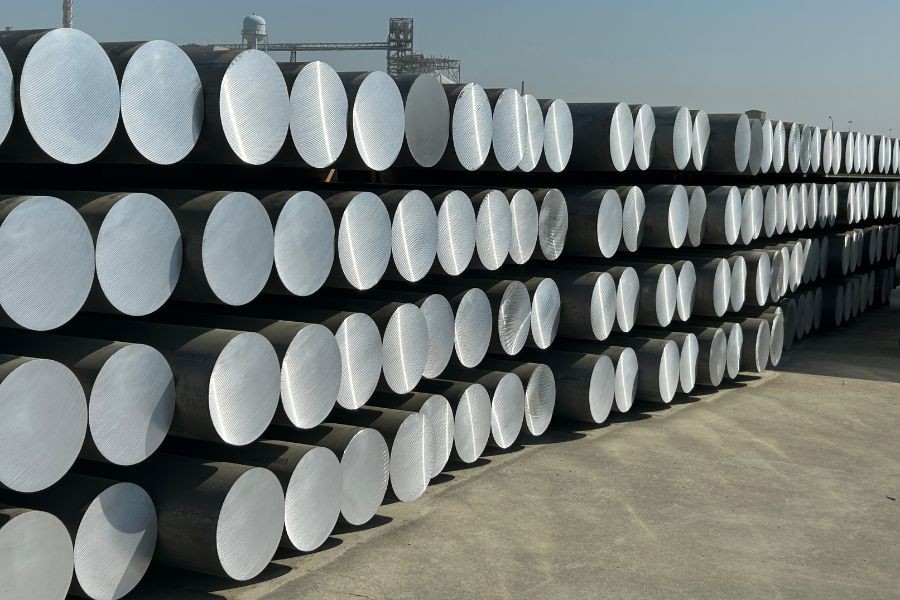
The commercial formula begins with the London Metal Exchange aluminum price, then adds regional and product premiums. Buyers pay for the metal and the particular form, specification and delivery market. This is an industrial supplier’s business, with recurring shipments and commodity exposure rather than a retail checkout.
Glencore is a major customer and shareholder. For a concrete downstream example, a 2021 agreement covered 150,000 tonnes of Natur-Al over five years for Austria’s Hammerer Aluminium Industries, supplied through Glencore. It illustrates the route from smelter through a trading partner to a manufacturer, rather than a direct relationship with every eventual consumer.
03 / A supply chain with a passport
Founded in 1995 and publicly listed in 1996, Century assembled much of its footprint through acquisitions. It bought Iceland’s Grundartangi smelter in 2004, Sebree in 2013 and the remaining Mt. Holly interest in 2014. The resulting business crosses borders because the necessary inputs and attractive operating conditions cross borders too.
Dutch carbon anodes → Icelandic smelting
The Dutch facility at Vlissingen produces carbon anodes consumed by the Icelandic smelter. Jamaica supplies another part of the chain. In May 2023, Century acquired a 55% interest in Jamalco, a bauxite mining and alumina refining venture. The announced purchase price was one dollar.
That deserves a pause. The closing-quarter filing put total cash consideration at approximately $8.3 million, including restricted cash. The nominal share price did not capture the whole transaction. A refinery also requires maintenance, reliable energy and operating investment. Century’s stated rationale was greater control and predictability over alumina, a critical input.
04 / Iceland changes the specification
Grundartangi gives Century another way to compete: renewable electricity. Its Natur-Al brand, introduced in 2020, uses Icelandic hydroelectric and geothermal power. Century’s 2023 sustainability report describes a total footprint below four tonnes of carbon-dioxide equivalent per tonne of aluminum, covering scopes 1, 2 and 3.
For a manufacturer accounting for purchased materials, that footprint becomes a procurement consideration. Alternatives include metal from Alcoa, Rio Tinto and Hydro, alongside recycled supply where specifications allow. Buyers still need to compare alloy, delivery terms and emissions boundaries. A low-carbon label alone cannot answer all three questions.
05 / Oklahoma comes with conditions
Century’s next proposed leap is Inola, Oklahoma. A January 2026 development agreement with Emirates Global Aluminium envisages 750,000 tonnes of annual capacity, with EGA owning 60% and Century 40%. The partners expect production by the end of the decade. This remains a development project, with engineering, power arrangements and definitive agreements still material conditions.
Whole-facility capacity, not output. Inola is a proposed joint venture; Century’s planned interest is 40%.
Bechtel was selected for preparatory engineering in February. In June, Oklahoma Attorney General Gentner Drummond filed a petition seeking to block the project, citing environmental and utility concerns. That filing was an attempt to stop construction, not a court judgment. Local acceptance belongs in the project’s calculations alongside power and engineering.
Financing is equally tangible. Century issued $400 million of senior secured notes in July 2025, carrying a 6.875% coupon and maturing in 2032. Those proceeds refinanced existing obligations; they should not be mistaken for a disclosed construction budget for Oklahoma. Building industrial capacity involves several separate financial decisions.
Meanwhile, existing plants demand attention. By August 2026, Century reported completing the last 90-pot restart at Mt. Holly and returning Grundartangi’s second line to near full production after equipment failures. Second-quarter sales were $752.1 million. Expansion and repair were happening together.
The transferable lesson is practical: investigate the input that can stop your business before committing to the expansion. For aluminum buyers, ask about power exposure, maintenance and backup supply alongside price. Vertical integration can reduce dependence on outsiders while leaving equipment failures and energy shocks very much inside the business.
Hawesville shows the consequence when those economics fail. Oklahoma represents a fresh attempt to arrange them favorably. Whether a site produces metal or hosts computers can turn on the same mundane document: the electricity contract.