Valentin Gapontsev had a complaint about the future: someone had filed it under “other.” In the late 1990s, laser-market analyst David Belforte visited IPG's temporary offices in Sturbridge, Massachusetts. His market reports did not give fiber lasers a category of their own. Gapontsev objected, then drew a growth curve on a chalkboard showing how the technology would challenge the established order. The visitor had come to explain the market. The physicist had brought corrections.
The encounter makes a useful introduction to Gapontsev, who founded the business that became IPG Photonics at 51. He had spent decades studying how materials handle energy. He would spend the next three decades persuading factories to put that knowledge to work. A laboratory result, in his hands, became a question about price, production and whether a customer could afford to ignore it.
There is a temptation to tell this as a story about starting late. That gives the calendar too much credit. His earlier life supplied the expertise on which the business depended. The commercial adventure began in middle age; the preparation had been going on for years.
A founder with a long apprenticeship
Born in Moscow on February 23, 1939, Gapontsev was the son of an artillery captain. His family moved to Lviv in 1946. He studied at Lviv Polytechnic and later earned his doctorate at the Moscow Institute of Physics and Technology. From 1967 into the early 1990s, he worked at the Soviet Academy of Sciences, becoming a senior scientist in laser-material physics and a laboratory head.
His research involved solid-state laser materials, spectroscopy and energy transfer between rare-earth ions. These subjects sit several floors below the usual business-school conversation. They also help explain why he could imagine a different sort of industrial laser. Understanding what happened inside the material gave him a starting point for changing the machine around it.
In 1990, he proposed a high-power fiber-laser design using laser diodes to pump energy along a doped optical fiber. The ambition was to move beyond the modest powers then associated with fiber lasers. His company's early devices produced only a few watts. The industrial possibilities required substantially more, along with the patience to build the components that would make more possible.
Gapontsev's age in 1990, when he began the business that became IPG.
The customer kept changing the map
IPG's beginnings were Russian, but its early customers helped give the business an international shape. A significant 1993 contract came from Italtel, the Italian telecommunications equipment company, for a high-power fiber amplifier. Italtel encouraged component production in Italy. The company's geography followed a practical instruction: make the technology where the customer needed it.
A different application took IPG into Germany. Daimler-Benz Aerospace needed a solution for a helicopter obstacle-warning system. Gapontsev proposed a fiber-based approach, and the customer agreed to fund it on the condition that production take place in Germany. IPG Laser GmbH was formed in Burbach in 1995. A map of the business was becoming a record of problems solved.
The American opportunity grew through telecommunications as well. In 1997, IPG won business with Reltec Communications, whose fiber-to-the-home systems were being deployed by BellSouth. U.S. operations followed in Massachusetts in 1998. There was no single heroic leap from laboratory to global company. There were contracts, subsidiaries and customers with very specific requirements. Expansion had paperwork.
When the first market fell away
Telecommunications offered growth, and then delivered a sharp lesson in dependence. IPG registered for an initial public offering in early 2001 and withdrew it as the telecom market collapsed. A company built around optical technology could be technically capable and commercially exposed at the same time. Having customers in several countries did little to help when many wanted the same thing and suddenly stopped buying.
Gapontsev accelerated the pursuit of industrial applications. Cutting, welding and marking offered other places to put light to work. The change required more than an amended sales presentation. Industrial customers needed suitable power, dependable operation and a price that made sense beside the equipment already on the factory floor. Surviving one market's collapse meant becoming useful to another.
During the downturn, IPG also invested in developing its own semiconductor pump diodes. These components supply the light that energizes the fiber and represented a major cost. Buying them left the company dependent on a supplier's economics. Making them offered control over performance, availability and cost, while adding another difficult manufacturing job to an already difficult period.
By 2004, IPG had begun production at its semiconductor-diode manufacturing facility. The decision became central to its business. A cheaper, better component could improve the finished laser; an improved laser could make an application affordable; an affordable application could bring another customer. The economics of adoption were being worked on inside the machine.
Light had to earn its place
Gapontsev's ambition was surprisingly domestic for something involving concentrated beams of light. He wanted lasers to become ordinary equipment in mass production. Industrial adoption would depend on everyday concerns: electricity, maintenance, processing speed and the cost of a finished part. A machine could dazzle at a demonstration and still fail the purchasing department's arithmetic.
“my dream is to see lasers - like computers - become a tool of choice in mass production”
Valentin Gapontsev · SPIE Laser Luminaries
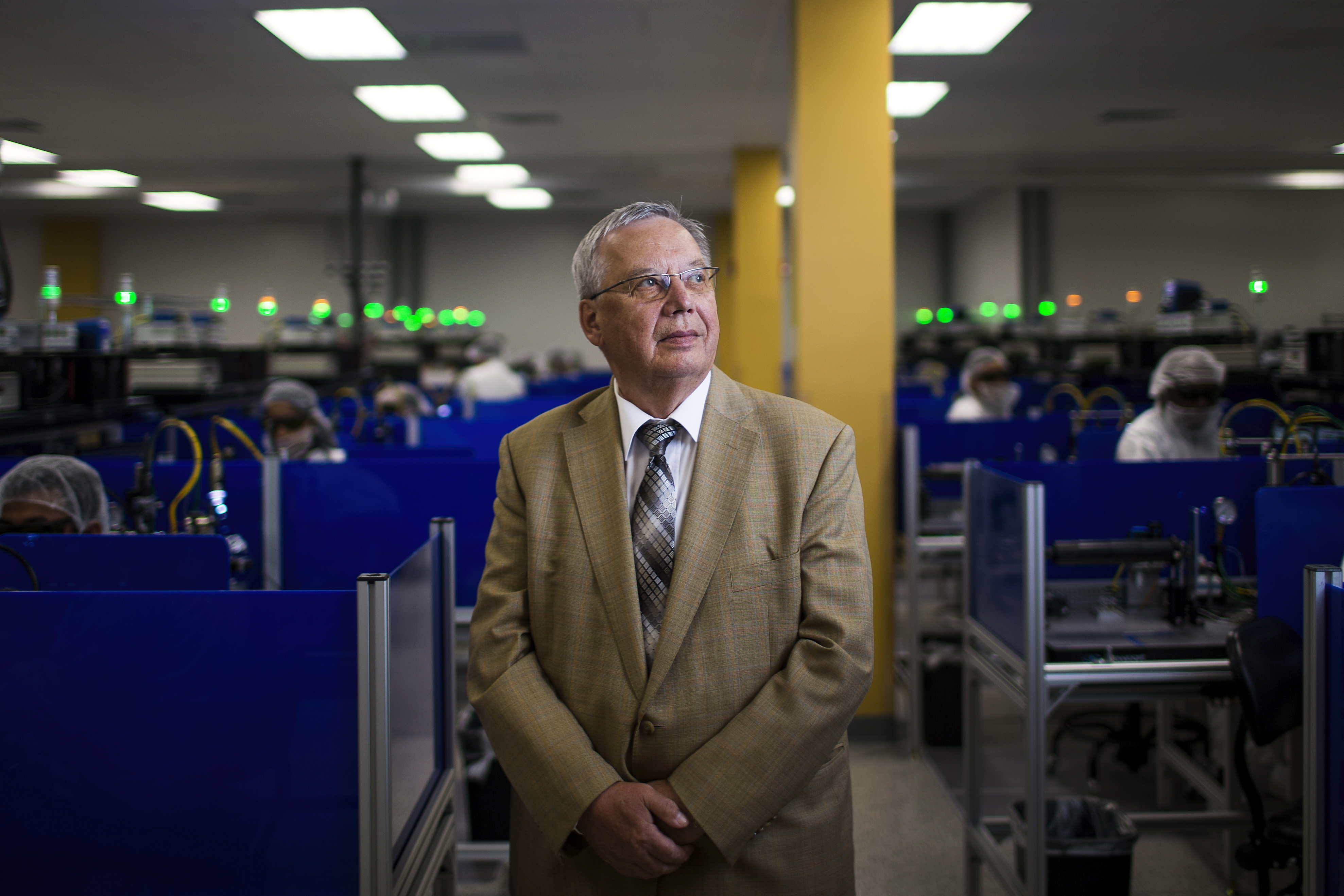
A fiber laser generates laser light in a specially doped optical fiber, energized by semiconductor diodes. IPG built a manufacturing system around those interacting pieces. Its control extended to active fibers and other optical components, allowing engineers to change designs without treating every purchased part as a fixed constraint. Technical choices and production choices became closely connected.
The power figures show the distance traveled. IPG's milestones include a 10-watt single-mode fiber laser in 1996, a 100-watt version in 2000 and a one-kilowatt single-mode version in 2004. In 2013, it introduced a 100-kilowatt multimode fiber laser. Those are different product configurations, rather than one machine steadily turned up. Together, they show how far the company's capabilities had expanded.
The business reached the public market in December 2006. For 2007, its first full year as a Nasdaq-listed company, IPG reported revenue of $188.7 million, compared with $143.2 million in 2006. Materials processing was driving growth. The company that had been exposed to telecom spending was finding demand in the physical business of making things.
A chalkboard was never merely furniture
Gapontsev could be forceful about his forecast. Belforte remembered the early chalkboard encounter and later meetings in which the founder continued to challenge his market numbers. Their relationship warmed through conversations about Russia, but family matters generally remained private. The picture is of someone who would discuss the world readily enough, provided his preferred technology received a fair hearing.
That temperament had a demanding side. Defending a new technology can become an occupation in itself, especially when established categories make it look incidental. The chalkboard episode suggests how personally Gapontsev took the work. An analyst's small category contained years of his research. He evidently felt it needed more room.
His later public remarks show the same attention to the less glamorous details. In prepared earnings remarks in 2019, he described market stress as a possible catalyst for research investment. IPG was reducing component and manufacturing costs while improving products. Competitive pressure had brought him back to familiar territory: what engineers could change, and what those changes would let customers do.
The results also depended on colleagues. Igor Samartsev, a co-founder, became chief technology officer. Eugene Scherbakov joined IPG in 1995 and led its German subsidiary before taking broader operating responsibilities. Bill Shiner helped develop industrial markets. Gapontsev's scientific conviction needed people who could turn it into products, factories and purchases. A forecast alone employs nobody.
The argument over his name
In 2018, an unfamiliar classification caused another dispute. The U.S. Treasury included Gapontsev in its unclassified report listing Russian oligarchs under CAATSA. He had become a U.S. citizen in 2008 and built a publicly traded business headquartered in Massachusetts. He and IPG challenged the listing in court in December 2018.
The dispute was resolved in September 2019. Treasury acknowledged that Gapontsev was not an oligarch in the Russian Federation for the purposes of that statutory provision and would not be listed if the report were compiled then. Its letter also said the earlier reference expressed no judgment about compliance with U.S. law. The distinction mattered to a founder whose wealth came from commercializing his company's technology.
The work outlasts the forecast
On May 4, 2021, Scherbakov succeeded Gapontsev as CEO. Gapontsev became executive chairman, remaining involved in research, development and strategy. It was a shift toward the technical work that had occupied him before there was a company to run. He died on October 22, 2021, aged 82, leaving a business employing more than 6,000 people worldwide.
His record included more than 100 patents and more than 200 scientific papers. Recognition crossed the boundaries of his two careers: an engineering excellence award in 1999, a New England entrepreneurship award in 2006, the Arthur L. Schawlow Award in 2009 and election as an Optica Fellow in 2012. The academic and the manufacturer remained visible together.
A newer expression of that connection arrived in 2024 with the Gapontsev Prize for Innovations in Fiber Lasers. Funded by the VPG Foundation, it supports early-career researchers with a $20,000 stipend and travel expenses. Michael Müller received the inaugural prize; Daniel Lesko followed in 2025. In September 2026, Optica named Marvin Edelmann the next recipient.
The prize gives another researcher room to try something. He began his company after a long scientific apprenticeship and kept returning to the practical obstacles between an idea and its use. Somewhere between the chalkboard and the factory, his forecast became equipment. Other people now get to decide what to make with it.
Follow the light
More on Gapontsev, the company and the work that continues.
- IPG Photonics · corporate website
- Optica · biography and scientific honors
- David Belforte · remembering the chalkboard encounters
- The 2019 Treasury settlement
- IPG Photonics · LinkedIn remembrance
- The Gapontsev Prize · researchers and recipients
- Optica · September 2026 prize announcement
- Explore the IPG Photonics company profile