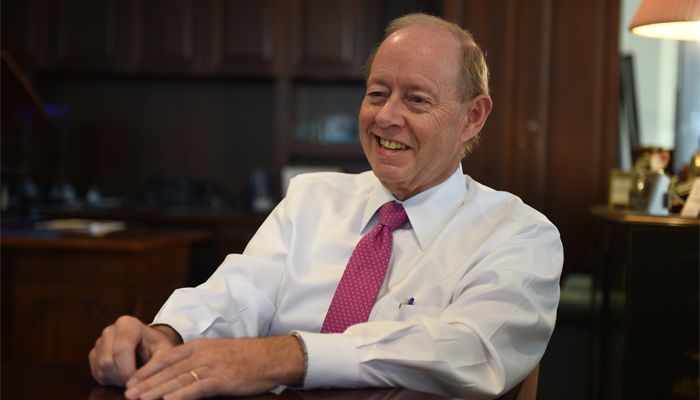
Rich Holbrook’s office contained several ways to establish that it was time to get on with things. There were grandfather clocks, including one with a moon-phase dial, and two Dr Pepper clocks. One of those was made from a soda can. In a bank executive’s office, that is a welcome interruption to the usual vocabulary of polished wood.
Holbrook liked the mechanics. He also liked the implication. Time moved forward. The past could be studied; the future still required a decision. In 2016, with his retirement approaching, he put the question plainly.
“How can I change the future?”RICH HOLBROOK · 2016
By then, he had spent twenty years at Eastern Bank. His work there had helped turn a narrower regional institution into one reaching across eastern Massachusetts and into New Hampshire. The harder part of that story is what happened to the bank’s sense of obligation as its territory expanded.
A career with room between the titles
Richard E. Holbrook arrived at Eastern in 1996 as chief financial officer and executive vice president. He became president and chief operating officer in 2001, then chairman and chief executive in 2007. The progression placed him in charge of the numbers, then the operations, then the institution itself.
He had an undergraduate degree from Yale and an MBA from Harvard Business School. His banking experience included commercial lending, trust work, planning, and financial management. That combination matters in an institution whose customers may be saving for a household purchase, borrowing for a business, or arranging the management of family assets.
Those jobs offer different views of the same bank. A lender sees the proposed use of money. A trust officer encounters the responsibilities attached to it. A financial manager must consider the institution’s own capacity to keep its promises. Holbrook’s career passed through all three kinds of work before he reached Eastern’s top job.
The buyer had something to learn
In June 2010, Eastern announced an agreement to acquire Wainwright Bank & Trust for approximately $163 million in cash. Eastern had about $6.6 billion in consolidated assets at the end of March. Wainwright had about $1 billion. The proposed combination would have more than ninety retail offices, including twenty-two in metropolitan Boston.
The announcement also gave unusual prominence to Wainwright’s social commitments. Holbrook welcomed a partner associated with affordable housing, environmental concerns, and protecting people’s rights. Wainwright’s leadership, in turn, emphasized that Eastern intended to carry its community development lending and social justice commitments forward.
An acquisition announcement normally explains what the buyer expects to obtain. This one also described practices the buyer wanted to preserve. There is a useful distinction there. When an organization purchases another organization, it has to decide which expertise deserves a larger audience and which habits deserve another chance.
For Holbrook, the public promise attached to the deal made that question concrete. The additional offices would make Eastern more visible in Boston. Continuing Wainwright’s commitments would help determine what people encountered when they looked inside.
A wider map, with customers on it
The New Hampshire move arrived through Centrix Bank & Trust. In March 2014, Eastern announced an approximately $134 million all-cash agreement to buy the Bedford-based bank. Centrix shareholders were to receive $41 a share. Its president and CEO, Joseph B. Reilly, would remain as Eastern’s regional president for New Hampshire.
Holbrook described the state as a natural extension of Eastern’s existing markets. He also stressed the opportunity to offer Centrix customers products and services they could not yet obtain there, while retaining the service they already valued.
Reilly’s explanation was complementary: Centrix needed a partner with greater capacity to meet changing customer needs, and one that understood its community commitments. The intended continuity of local leadership gave that argument a practical detail. Customers would gain access to a larger institution while an executive familiar with the market stayed involved.
There was a business reason for expanding those capabilities. By 2014, Eastern’s commercial loans and leases had grown 92 percent since 2009, reaching $3 billion. The planned Centrix acquisition would add roughly $500 million in commercial loans. For a regional bank, growth in lending is where a broader map begins to acquire an economic purpose.
Sixty-nine organizations and a quarterback
A different picture of Holbrook’s working life emerged at Eastern’s Boston headquarters in April 2013. He and former NFL quarterback Doug Flutie honored sixty-nine local nonprofits. Each received a grant of at least $10,000. Representatives also caught footballs thrown by Flutie, who signed the balls.
About a hundred people attended. There were employees, nonprofit representatives, and the slightly improbable business of receiving a pass at a bank event. Afterward, Holbrook and Flutie playfully contested possession of a football. The photograph is a useful corrective to the idea that a chief executive’s entire public existence takes place behind a lectern.
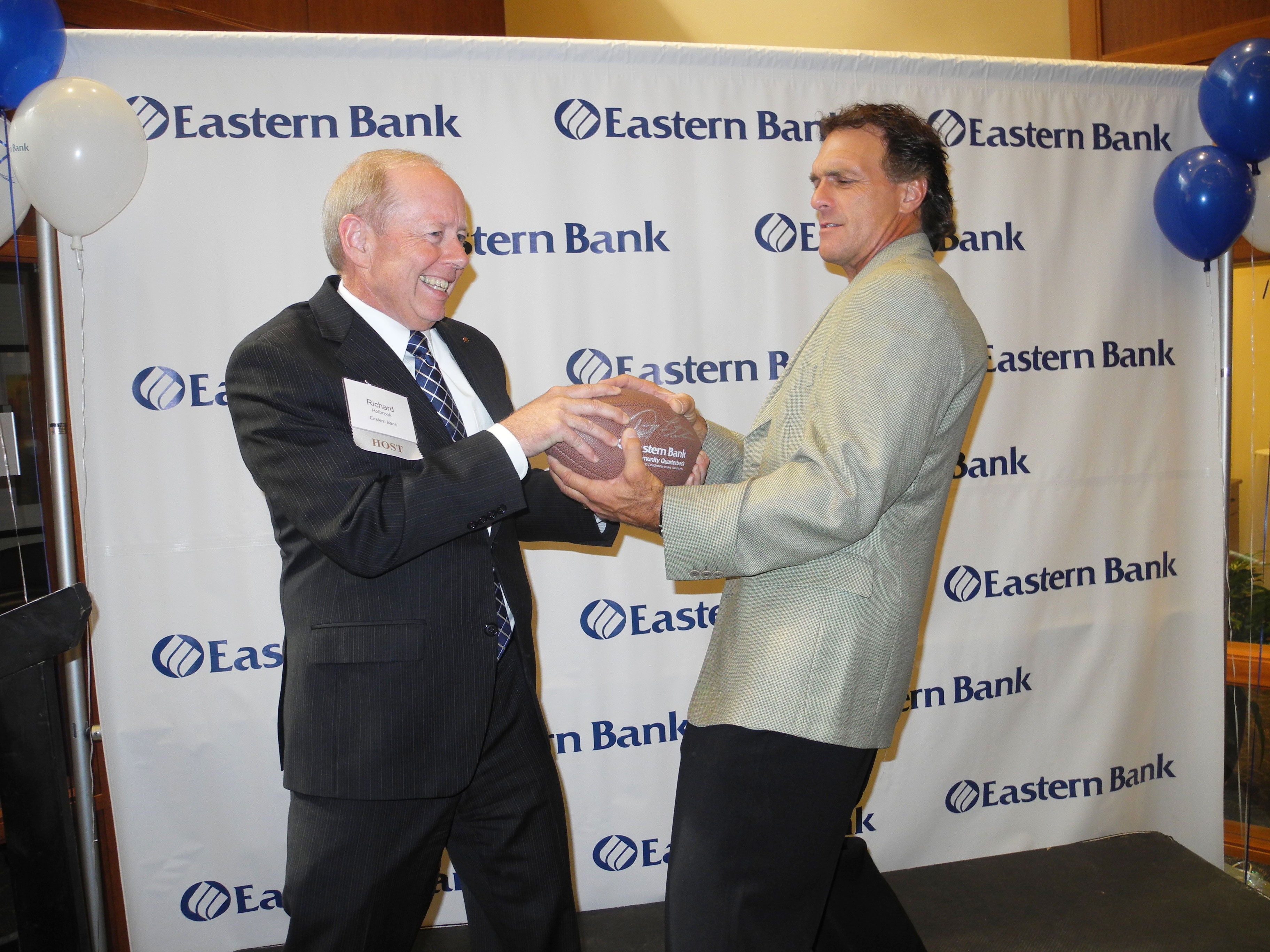
The previous year, Eastern and its foundation had donated more than $4 million to 1,300 local nonprofits. Those totals explain the occasion better than the footballs do, although the footballs made the thank-you considerably easier to remember.
The giving had an institutional history. Since 1999, Eastern had committed a share of its earnings to charity. At the time of the Wainwright agreement, it reported average annual donations exceeding 10 percent of net income and more than $50 million over the preceding decade. That policy made community funding part of the bank’s ongoing allocation of money.
The experiment inside the institution
Another development during Holbrook’s tenure concerned the way customers would use the bank. In April 2014, Eastern hired Dan O’Malley to launch Eastern Labs. O’Malley had previously run PerkStreet Financial, an online banking venture, and brought several members of that team with him.
He reported to Eastern president Bob Rivers. The arrangement placed a group of technology builders within an established bank, with a remit to develop new services and influence how the organization worked. It also supplied resources that an independent startup would have had to assemble for itself.
A customer service center could help test ideas directly with customers. Banking colleagues could contribute credit and product expertise. The group still had to choose where to concentrate: O’Malley described an early list of about twenty-five possible projects and the capacity to pursue only two at once.
That is a recognizable managerial problem, even without the word innovation attached. A new team needs permission to try things, access to people who understand the work, and someone prepared to decline the twenty-third attractive suggestion. The institutional setting gave the experiment both advantages and obligations.
Required application items for Eastern’s Express Business Loan, as described in 2018.
This later result followed the Labs’ 2014 launch; Holbrook had retired as CEO in 2016.By 2018, Eastern’s Express Business Loan was being discussed in terms a borrower could understand: fewer required application items, falling from fifty-five to eight, and real-time decisions. That later account belongs to the continuing team’s work. It helps explain why creating room for the team in 2014 mattered.
The local banker in a national room
Holbrook’s responsibilities also carried him beyond Eastern. He represented the First Federal Reserve District on the Federal Advisory Council, a body with one banker from each of the twelve Federal Reserve districts. It meets quarterly with the Federal Reserve Board of Governors to discuss business and financial conditions.
He also served on the Boston Fed’s board, chaired the Massachusetts Bankers Association, and chaired the American Bankers Association’s Mutual Institutions Council. These positions placed his regional banking experience in conversations about the system around it.
At a 2015 gathering, Comptroller of the Currency Thomas Curry acknowledged Holbrook’s presence and his mutual-institutions role. Curry described the freedom mutual institutions had to consider customers’ interests without stock market expectations. It was a policy argument closely connected to the ownership structure under which Holbrook was then running Eastern.
That context belongs to its period. Eastern later converted to a publicly traded holding company in October 2020. Reading the earlier career means keeping that change in view: the mutual bank Holbrook led and the company on whose board he continued to serve occupy different chapters of the institution’s history.
Leaving the next appointment to someone else
Eastern announced Holbrook’s retirement in February 2016, with an effective date of December 31. Rivers would succeed him on January 1, 2017. Quincy Miller would join the bank and was expected to become president at the same transition. The announcement gave the organization most of a year to prepare.
Across Holbrook’s two decades there, Eastern had grown more than fivefold in assets and more than tripled its locations. The expansion reached beyond the North Shore to southern New Hampshire and Cape Cod. Holbrook’s stated concern at the handoff was continuity for customers, employees, and communities alongside continued growth.
He remained a director and now serves as chair emeritus. Eastern’s 2026 proxy anticipates his retirement from the board on December 31, 2026, under company policy. The executive chapter has been over for nearly a decade; the institutional relationship has lasted longer.
The clocks offer a modest ending. Their owner could attend to the machinery, admire the workings, and know exactly which direction the hands would go. Choosing the next step still fell to people. At Eastern, Holbrook eventually made that choice by arranging for other people to take it.