A submarine is an awkward place to ask a satellite for the time. Water gets in the way. In a trial announced in October 2025, Infleqtion and MSubs put an optical atomic clock aboard the Royal Navy’s Excalibur autonomous testbed. The clock, called Tiqker, operated through multiple dives. For a business associated with quantum computing, this was a wonderfully tangible assignment: keep good time underwater.
- One foundation: controlled atoms, lasers, vacuum systems and software.
- Different products: clocks and sensors alongside quantum computers.
- The open question: how much useful computing can the engineering deliver?
A clock goes diving
Precise timing helps navigation, communications and sensing systems agree about what happened when. When satellite signals disappear, an onboard reference must hold its own. Ordinary clock drift becomes a systems problem. Tiqker supplies a stable local reference; it does not, by itself, tell a submarine where it is.
The experiment established that the instrument could function on a demanding platform. Further benchmarking against high-grade time standards was still to follow. That distinction matters. A successful dive answers an engineering question. A fully characterized navigation system requires more work.
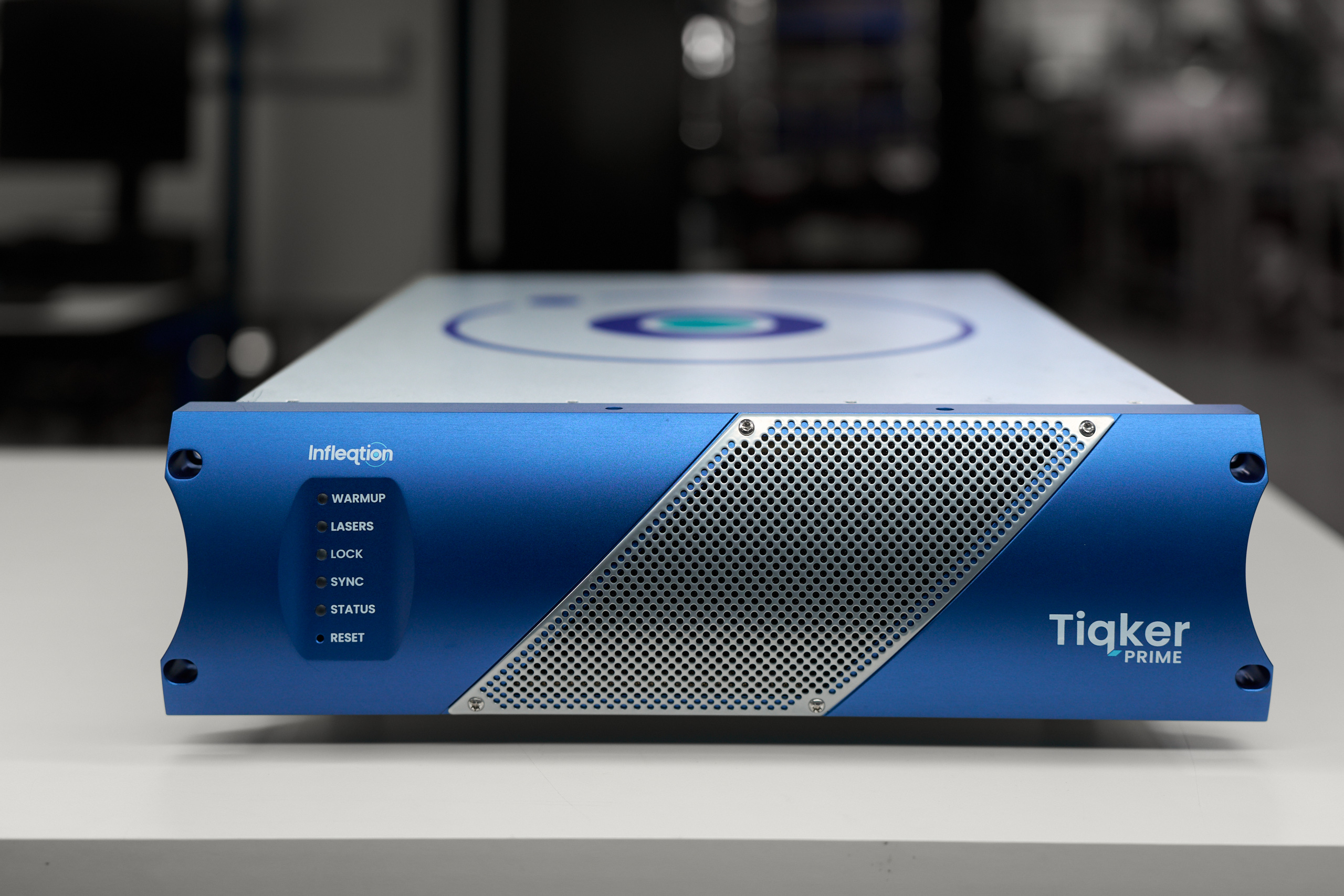
There is something revealing about the product’s appearance. Tiqker Prime occupies three units in a standard equipment rack. It looks at home beside networking gear. The sales proposition concerns synchronization, interfaces and reliability. The quantum physics has to earn its space in the cabinet.
Nature supplies the parts
Infleqtion began in 2007 as ColdQuanta, a University of Colorado Boulder spinout rooted in Dana Anderson’s research. Its early business supplied tools for producing and controlling ultracold matter. Long before the public-market ticker INFQ, there were researchers who needed a more manageable way to work with atoms.
Neutral atoms offer an appealing starting material for computers: atoms of the same isotope are naturally identical. Lasers can trap them, arrange them and control their quantum states. The qubits are supplied by nature. The equipment needed to make those qubits cooperate is an engineering project of considerable ambition.
Vacuum · control · software
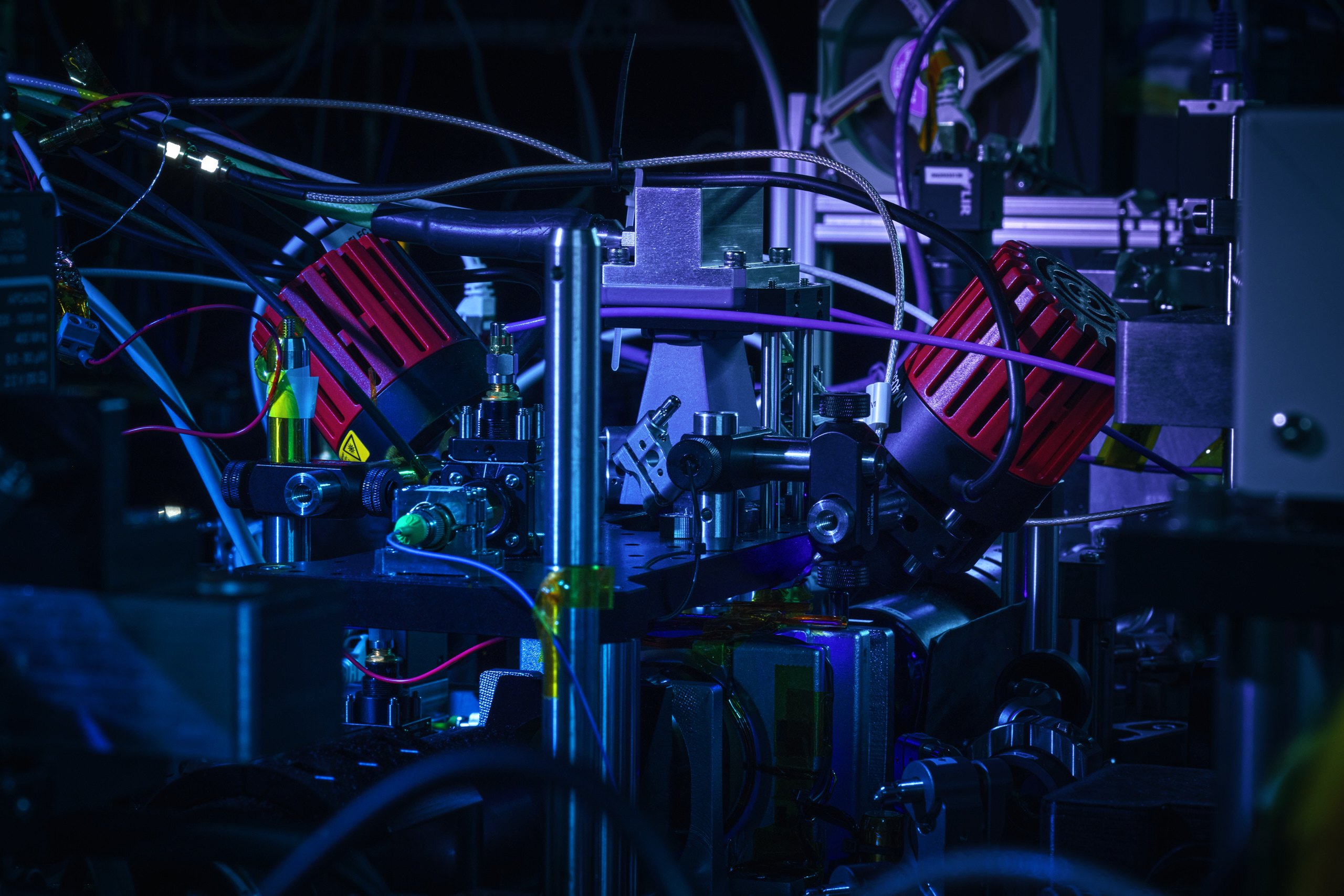
That equipment also has other jobs. Atomic behavior can provide a frequency reference for a clock, reveal radio-frequency signals or help measure motion and gravity. Infleqtion builds across those markets. Its expertise spans vacuum systems, photonics, electronics and software, with research components still part of the catalog.
Matthew Kinsella’s route into the business helps explain that choice. In a public interview, the investor turned CEO recalled being skeptical of the quantum companies he initially encountered. Meeting Anderson changed the investment question. Neutral atoms could address several markets, creating a commercial business while the computing opportunity developed. It was an argument for making several related products from the same technical foundation.
Other neutral-atom companies, including QuEra, Pasqal and Atom Computing, pursue computing too. Infleqtion’s distinctive commercial proposition is the breadth of products built around atomic control. For a buyer, the relevant comparison changes with the purchase: another quantum processor for research, perhaps, or an established timing instrument for a communications system.
The computer needs a translator
In 2022, ColdQuanta acquired Super.tech, a quantum software startup. Later that year it introduced the Infleqtion brand. The acquisition addressed a practical limitation: a promising algorithm must survive translation into the operations a particular machine can actually perform.
Superstaq handles that translation and optimization. Developers can work through familiar Cirq or Qiskit interfaces while the software accounts for hardware constraints. It supports multiple quantum backends. The underlying idea is economical: reduce the operations a calculation needs before asking engineers to build a bigger machine.
“Getting 30 logical qubits to work together is hard, and our team has done it.”
Matt Kinsella, CEO · September 2026
In September 2026, Infleqtion reported an experiment entangling 30 logical qubits using 80 physical qubits on its Sqale computer. Logical qubits encode information across physical qubits to manage errors. The demonstration connected hardware and software in a specific circuit; it did not establish a general-purpose, fault-tolerant computer.
A demonstrated encoding and entangled circuit. Reliability and useful circuit depth still matter.
Atom loss remains a nuisance. The technical account describes recovering some missing measurement outcomes through software, yielding more useful samples at the cost of higher error rates. It is a recognizable engineering tradeoff. Throughput and accuracy must be balanced, and future systems need stronger error suppression.
Who pays while the science matures?
The customers give the business its shape. At Britain’s National Quantum Computing Centre, an operational Sqale system reached 100 physical qubits in December 2025, a milestone announced the following March. Researchers can use such infrastructure to benchmark methods, explore applications and learn what operating a quantum computer entails.
For a prospective user, the sensible starting point is a workload and a measurable target: timing holdover, circuit resources or a benchmark against an existing method. Infleqtion offers applications-development services to help frame those experiments.
Eaton offers a different example. Its $7 million, 24-month Air Force Research Laboratory project brings Infleqtion and Penn State into work on grid security. The task is to investigate combinations of failures and threats. Infleqtion’s subcontract connects quantum hardware and algorithms to a defined research problem; the full award belongs to Eaton’s program.
Infleqtion sells instruments, components, systems, software and applications expertise, and undertakes funded development. It reported $32.5 million in 2025 revenue. Financing operates on another scale: a $100 million Series C announced in June 2025, followed by more than $550 million in gross proceeds from its February 2026 public-market transaction. Capital raised is money available to build, rather than evidence of customer demand.
Make it small enough to leave the lab
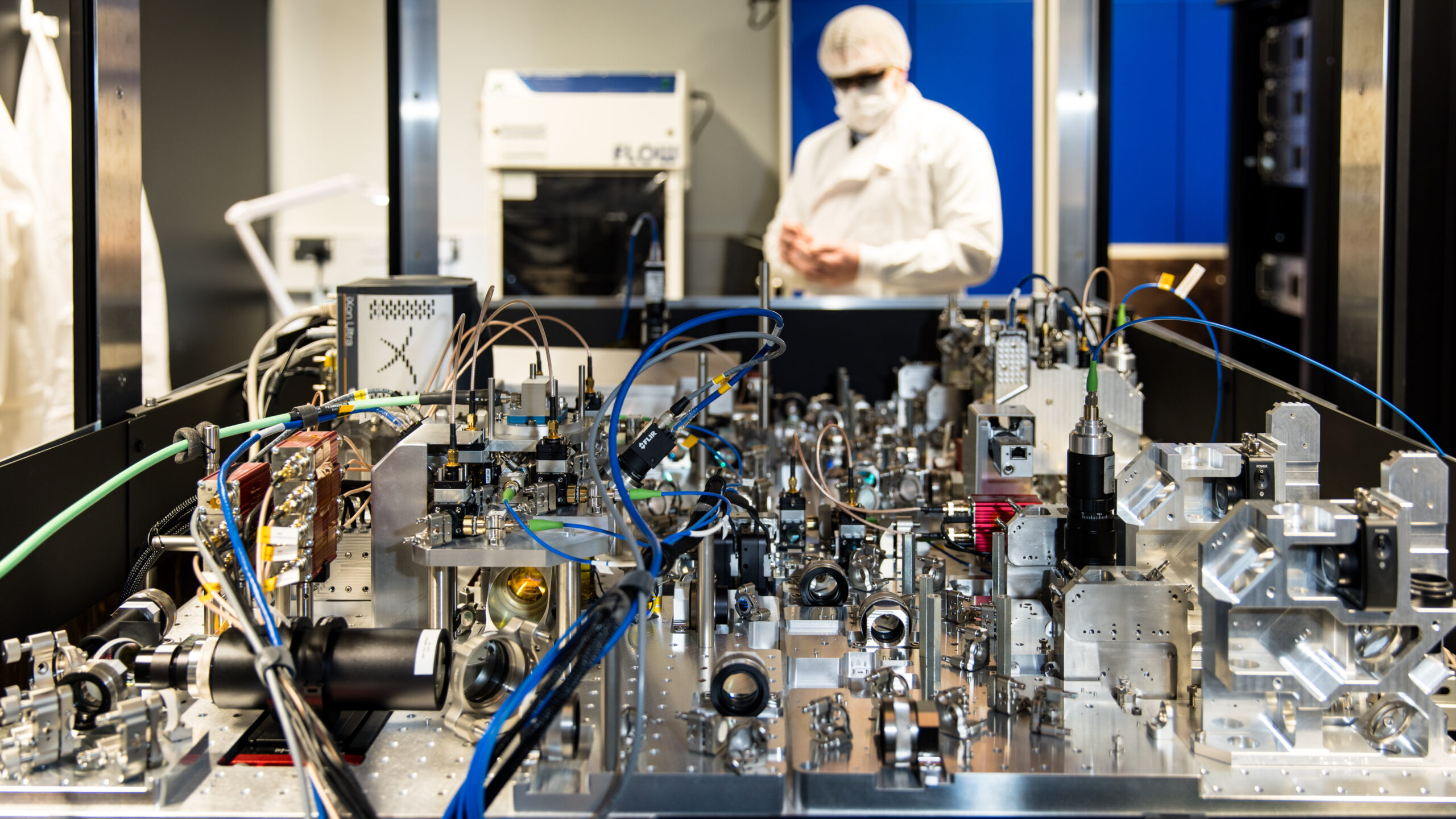
In October 2026, Infleqtion, Honeywell Aerospace and UC Santa Barbara announced an optical-cavity prototype fabricated on a silicon nitride chip. Such cavities stabilize lasers. Shrinking them addresses the awkward bulk of equipment that must eventually travel.
The transferable lesson is to find several paying uses for expensive expertise, then let customer requirements discipline the engineering. It depends on those uses sharing enough technology to justify the effort. For computing customers, the decisive test remains performance against classical alternatives. For a submarine clock, the question is more immediate: when the outside signal vanishes, does the instrument keep doing its job?