Five billion years is an awkward warranty period. In 2014, a team at JILA in Boulder reported a strontium atomic clock so precise that it would neither gain nor lose a second over roughly that interval, if it could keep running. Benjamin Bloom was a graduate student on the project. Most people would have considered the timekeeping question reasonably settled. Bloom went on to find other things for atoms to do.
Today, as founder and CEO of Atom Computing, he works on machines that use individual atoms to carry quantum information. The connection is practical. Before an atom can help with a calculation, someone must hold it, control it, and protect its delicate behavior from the surrounding world. Bloom’s career has involved learning that craft, then asking how to make a business out of it.
Five billion years is a long apprenticeship
Bloom earned his bachelor’s degree at MIT in 2008 and completed his physics doctorate at the University of Colorado Boulder in 2014. His dissertation had the unadorned title Building a Better Atomic Clock. There is something pleasing about a title that could belong to a weekend workshop, attached to research measuring time more carefully than almost anyone could imagine needing.
At JILA, the joint institute of CU Boulder and the National Institute of Standards and Technology, he worked under Jun Ye. The clock used strontium atoms confined in a lattice of laser light. Its performance depended on both precision and stability: how closely it approached the atoms’ reference frequency, and how consistently its ticks matched one another.
The work also gave Bloom a way to talk about the distance between research and its eventual uses. In a 2014 guest blog written with Ye, he began with the location shown on his smartphone. Atomic clocks, he observed, had helped make possible an everyday device that could locate its owner and play cat videos. Fundamental physics had acquired a surprisingly undignified entertainment department.
The reported precision of the strontium clock Bloom helped develop. A team achievement, and an education in controlling atoms.
A detour through the factory
After his doctorate, Bloom joined Intel, working on 10-nanometer semiconductor fabrication. He subsequently moved to Rigetti Quantum Computing, where he worked on superconducting qubits and was promoted to lead a group of researchers and engineers. His route into entrepreneurship passed through both conventional chipmaking and a competing approach to quantum hardware.
Intel supplied a perspective that a university laboratory could not reproduce at the same scale. Bloom later described how its R&D operations influenced Atom Computing’s approach to debugging. A mysterious result in a physics experiment and a problem in an industrial process both demand investigation. Industry adds the further question of whether the solution can be repeated reliably.
Those jobs make his eventual choice more interesting. He had worked with superconducting technology before committing to neutral atoms. In January 2018, he founded Atom Computing around his conviction that the latter offered a workable route to larger quantum systems. Jonathan King became the company’s co-founder. Ye would join its scientific advisers, extending a connection that began with clocks.
The bet on light
Atom’s approach uses light to trap and manipulate electrically neutral atoms. Each can serve as a physical qubit, a carrier of quantum information. Optical control provides a way to arrange and address the atoms without attaching an individual wire to every one. For a founder preoccupied with adding qubits, that architectural choice mattered from the beginning.
In an early interview, Bloom kept returning to two requirements: many qubits and enough time to use them. Quantum information is vulnerable to disturbances. A machine needs to preserve it while operations take place, and it needs a control scheme that remains manageable as the system grows. The difficulty increases well before a useful calculation is finished.
The company’s early milestones were wonderfully literal. It trapped its first atom in August 2019. In July 2021, it unveiled Phoenix, a 100-qubit prototype. By October 2023, it announced an array with 1,225 trapping sites, populated with 1,180 qubits. The distinction between available sites and occupied ones is worth keeping: empty seats do not do arithmetic.
A missing atom is a problem you can plan for
Adding atoms creates room for more ambitious work. It also leaves the machine with an unforgiving housekeeping problem. Atoms can disappear from the array. Operations can introduce errors. Checking what happened can itself disturb information that the calculation still needs. The computer must learn to inspect its work without knocking everything off the desk.
In May 2023, Atom described a demonstration of mid-circuit measurement: examining selected qubits while leaving others undisturbed. The team detected missing atoms and replaced them from a nearby reservoir. It also used a technique to shield data qubits from the light used to inspect their neighbors. The point was to make intervention possible while the calculation was underway.
These capabilities underpin the move to logical qubits. A logical qubit encodes information across physical qubits using an error-correcting code. The extra machinery aims to protect a calculation when individual components misbehave. Counting atoms alone therefore gives an incomplete picture of progress. The consequential question is how well the information survives.
Information encoded across physical qubits, with checks to detect and correct errors.
By June 2026, the company was reporting a toric-code quantum-memory experiment with up to 90 rounds of error correction. Its account distinguished shorter experiments from longer runs with continuous atom reloading, where the results suggested performance near the error-correction threshold. Such distinctions matter. Keeping an error-corrected memory running is a demanding engineering result, with further work needed toward general useful computation.
The founder changes seats
Bloom’s own job changed as the hardware grew. In July 2021, he moved from CEO to CTO, concentrating on technical development while Rob Hays led the business. Three years later, on July 2, 2024, Atom announced that Hays was stepping down and Bloom would resume the CEO role.
The sequence resists the tidy startup biography in which one person simply accumulates titles. Bloom spent a period directing the engineering, then returned to responsibility for the whole company. The technical plan still needed lasers, controls, software, and error correction. The organization needed people who could own those pieces without routing every decision through its founder.
“It’s all about finding the right team and giving them the responsibility and authority to get things done.”
Ben Bloom · 2025 interview
His account of leadership is grounded in that division of labor. As the company grows, each function becomes complicated enough to require dedicated attention. A founder’s expertise remains useful, but available hours have a stubbornly classical limit. In 2026, the Colorado Technology Association named him its APEX CEO of the Year, recognizing the executive alongside the physicist.
Next stop, Copenhagen
The business also began acquiring a more tangible destination. In research with Microsoft, first submitted in November 2024 and later revised, the teams demonstrated entanglement of 24 logical qubits. They also ran the Bernstein-Vazirani algorithm using up to 28 logical qubits, with error rates better than the corresponding physical implementation. Bloom was among the paper’s co-authors.
Then came Magne. In July 2025, Denmark’s export and investment fund EIFO and the Novo Nordisk Foundation announced QuNorth, a Nordic quantum initiative backed by an €80 million investment. Microsoft and Atom Computing were selected to supply its Copenhagen computer, combining Atom’s hardware with Microsoft’s software and error-correction technology.
The announced system specification included more than 1,200 physical qubits and 50 logical qubits. Its name comes from Magne, a son of Thor. Quantum computing had reached the stage where procurement included Norse mythology. The original plan called for the machine to be ready for its first tasks around the turn of 2026 to 2027.
For Bloom, the order puts customer use alongside laboratory demonstrations. A prospective user needs an entire working system, including controls and software. His stated ambition is to work more closely on particular applications, extending Atom’s role beyond supplying hardware. The machine must eventually earn its place by helping someone complete a worthwhile calculation.
The clock is running again
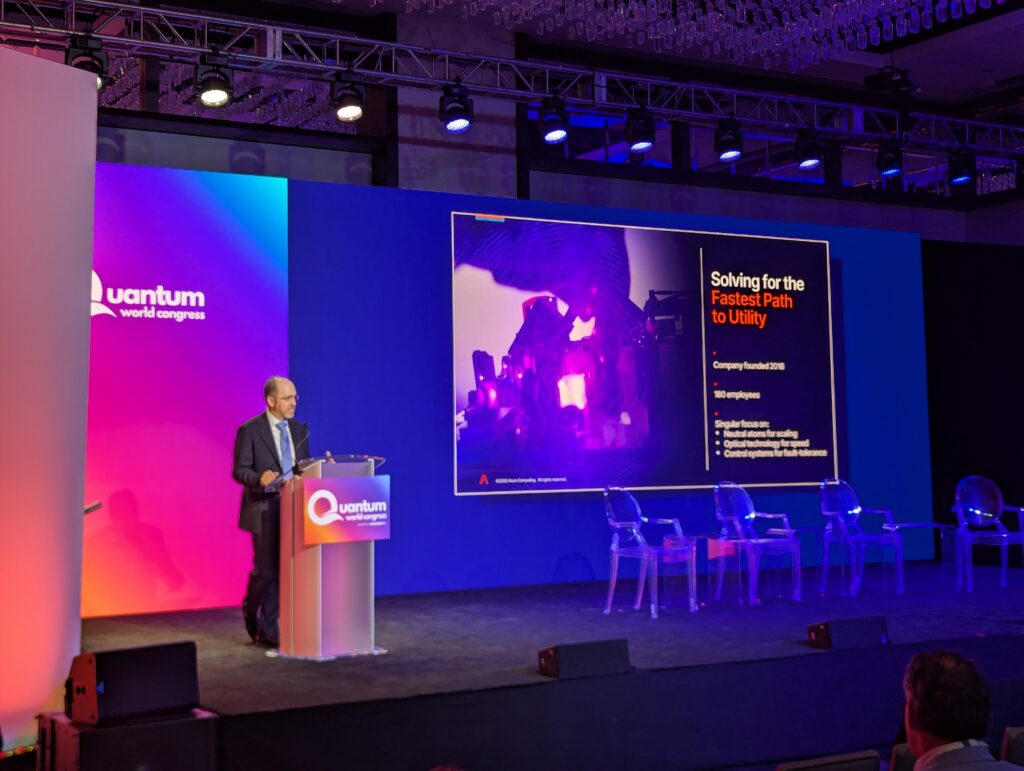
Bloom’s current argument returns to time, with a different unit of success. In October 2026, he described three challenges for useful quantum systems: scale, speed, and fault tolerance. His emphasis was on the time taken to finish a calculation. Connections between qubits, measurement, and the work required for error correction all affect that result.
His company’s roadmap targets more than 1,000 logical qubits by 2029, alongside tenfold increases in physical qubits per generation. Those are future goals. The intervening work spans optical technology, control electronics, and the coordination of operations across a growing machine. A fast component can help, but the whole computation has to arrive intact.
On October 7, 2026, Atom announced selection for the final stage of DARPA’s Quantum Benchmarking Initiative. An independent government team will examine whether its proposed utility-scale computer can be constructed and operated as intended. For a founder with a long technical roadmap, that brings another kind of scrutiny: a detailed outside examination of how the parts are supposed to become a working whole.
There is a pleasing continuity here. Bloom began by helping atoms tell time with extraordinary consistency. He is now trying to give them enough organization, protection, and useful work to justify a customer’s time. The five-billion-year clock was a memorable beginning. His next machine will face a more immediate appointment: someone waiting for an answer.