A taxi roof is a perfectly reasonable place to begin an advertising business. It moves. It attracts attention. It goes where people go. Jeremy Yang and his business partner, Mo Moubayed, wanted to put digital screens up there. Then the people they hoped would buy the advertising began asking about something rather less glamorous: how would they know their ads had played?
That question could have been filed under objections to overcome. Yang and Moubayed eventually treated it as a reason to change the business. The pitch for another place to advertise became a project to check what happened in the places advertisers already used. A taxi had brought them to the door. Verification gave them a reason to stay.
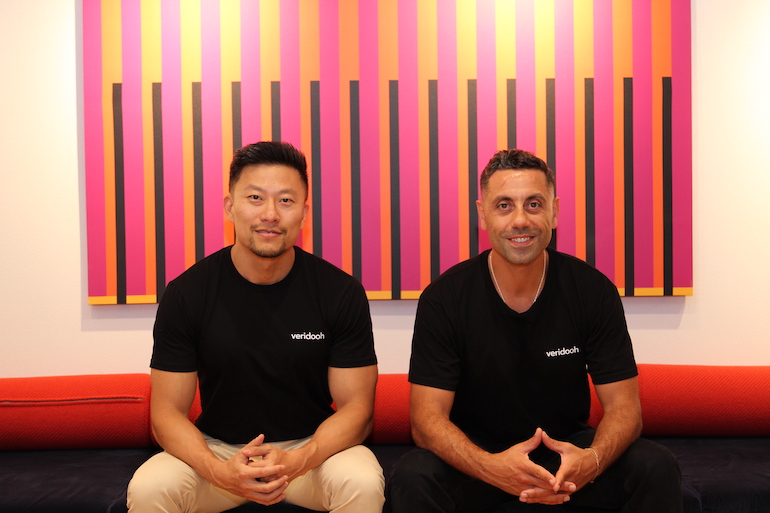
Today, Yang is co-founder and co-CEO of Veridooh, the Sydney company they launched in 2019. Its work is independent verification of out-of-home advertising: the billboards, street furniture and screens that make a city an advertising medium. Yang’s contribution has included leading product development and directing the software engineering team. Behind the large public display sits a quieter task: producing evidence a buyer can use.
The customer wanted a receipt
The early conversations began around a proposed digital advertising network. Agencies kept returning to delivery. The founders initially assumed the industry must already have an answer. In Moubayed’s account, a major agency and client team agreed to consider spending on their network if they could demonstrate that the ads ran. Yang and Moubayed came back with a proof of concept. The client then asked whether they could verify its existing digital outdoor spending.
There is a pleasing inconvenience in that sequence. The founders arrived with something to sell, and the prospective customer offered them a different job. Accepting meant letting go of the original plan. It also meant taking a recurring concern seriously enough to build around it. A question that sounded like a purchasing detail had become the basis of a company.
The difficulty was that this concern did not arrive with a tidy dataset. In his later account of the pivot, Moubayed described repeated complaints from brands and agencies, rather than a spreadsheet establishing the size of the problem. Their first product would have to create the evidence that could then test their conviction. For a business dedicated to measurement, the starting point was conversation.
“How would we know if our booked ads have actually been played?”
A prospective client’s question, recalled by Mo Moubayed
That distinction matters to Yang’s story. Listening can sound like a pleasant founder habit, suitable for a conference slide. Here it changed the proposed business. The founders had to hear the same concern often enough to recognise that their customers were asking for assurance, and then turn that request into working software. The useful part of the pitch meeting happened after the pitch.
Two founders, several attempts
Yang’s partnership with Moubayed predates Veridooh. By June 2022, the pair had worked together for more than a decade. Moubayed has described a shared history of launching businesses, failing at some and succeeding at others. They used proceeds from the exit of an earlier business to fund the new venture. The partnership had experience behind it before outside investors arrived.
It is an unusually practical origin for an advertising technology company. There was a previous business to sell, money to reinvest and a product to develop. The founders began investigating the outdoor opportunity in 2017; Veridooh launched in 2019. Those two dates mark different stages of the story. The idea took time to become the business that buyers eventually encountered.
The partnership also had to change shape as the company expanded. Moubayed relocated to the UK to establish the overseas operation. In his 2022 description of a London workday, he reserved at least half an hour in the morning for Yang. Before the UK day properly began, there was a conversation with his co-founder. International expansion had acquired a calendar appointment.
The engineering behind “it played”
Veridooh’s SmartCreative technology independently tracks, measures and verifies campaign delivery. Its dashboard gives buyers information including location, plays, exposure time and share of time. The technology can operate without integration into a media owner’s systems. That independence is central to the proposition: the buyer receives a check on delivery from a separate business.
The work is less theatrical than the advertising it checks. A campaign can go wrong through scheduling mistakes, hardware downtime or other operational failures. A photograph of a screen catches one moment. A report from the seller carries the seller’s perspective. Veridooh collects delivery information that lets the customer examine what happened across a campaign and seek compensation for failed elements.
In Yang’s case, the product responsibility made him a bridge between the industry’s practical questions and the engineering team’s work. Veridooh developed SmartCreative with launch partners PHD and Unilever. A buyer’s need for assurance had to become a product that could be used repeatedly. That is a demanding translation job: “did it run?” sounds short, while the answer requires considerable machinery.
Yang has described continued product improvement as the way Veridooh delivers value to clients. The wording is revealing because it gives the work an ongoing tense. Verification cannot live on the charm of its founding story. Agencies and advertisers need something they can use on the next campaign, then the next. The product has to keep earning its place.
“their hard work and passion.”
Jeremy Yang, May 2023
The cheque came after the work
In June 2022, Veridooh announced an A$5 million Series A, its first external capital raise. EVP led the oversubscribed round. Jelix Ventures participated, alongside the funds of Aconex co-founders Leigh Jasper and Rob Phillpot. The money was intended to develop the software and take the business into new markets. The first overseas team launched in the UK that year.
The investor cheque followed an operating business rather than merely an attractive idea. At the time of the funding announcement, Veridooh served more than 140 clients in Australia and New Zealand. The customer list included Google, Unilever, Amazon, McDonald’s and Canva. Those were company customers, but they also show the setting in which Yang’s product work had to function.
Yang won the Sydney Young Entrepreneur Award for Marketing in 2023 and was included in Campaign Asia’s 40 Under 40 class for that year. The recognition connected his name to the technology and the business built around it. Awards give a story a date and a photograph. The more interesting question is what a founder does as the organisation becomes larger than its original pair.
A playbook for the people building it
Yang helped write and launch Veridooh’s conscious culture playbook as the team grew. The company also introduced mentoring sessions in which employees could book time with either founder. These are concrete choices about access and working conditions. They belong in his story because product leadership involves the people doing the building, as well as the software they produce.
A playbook is a modest object compared with an international launch. It records expectations that might once have been passed around informally. Mentoring puts a conversation on the calendar. Both become useful when a company can no longer rely on everyone simply knowing the founders. Growth adds colleagues, distance and decisions; the familiar habits of a small team need somewhere to live.
Veridooh brought in Nick Parker as global president in April 2024 to work with both co-CEOs on expansion. His previous role was global chief operating officer at Kinetic. In August 2026, former Interpublic chief executive David Bell joined the advisory council to work alongside Yang and Moubayed. The founders were adding industry experience around their product and commercial ambitions.
From a taxi roof to the street
Yang’s public writing shows where he wants that work to lead. In an April 2025 article about political advertising, he argued for digital outdoor’s combination of public visibility, flexible delivery and measurement. In February 2026, he examined Nine’s A$850 million QMS acquisition and the possibility of connecting television with outdoor advertising across a person’s day.
The second article makes his ambition explicit: to grow the outdoor industry by making it more automated, trusted and effective. He treats accountability as part of the medium’s attraction to advertisers. Bigger screens and a wider network may create more opportunities to buy. Reliable delivery information helps a buyer decide what to do with those opportunities.
There is something fitting about the journey. Yang began with an advertising idea that would travel through streets on a taxi. He now works on the information behind the screens that populate those streets. The original plan survives as an anecdote, while the customer’s inconvenient question remains useful. Every new campaign gives Veridooh another occasion to answer it.
A founder can spend a great deal of time defending the thing he intended to build. Yang’s story offers another possibility: take the question seriously, change the plan and give the customer a receipt. The taxi did its job. It brought him to a better question.
Follow the question
More from Yang and the people building Veridooh.
Jeremy Yang on LinkedIn ↗Veridooh’s website ↗Yang’s “Sofa to Street” article ↗Moubayed on the taxi-screen pivot ↗News from Veridooh ↗