A supermarket is an unglamorous place to begin a technology story. That is part of its appeal. Among the early assignments Jegan Selvaraj has described is a point-of-sale system for a U.S. supermarket client. Before the portfolio of companies, before enterprise AI and passwordless identity, there was a customer with a shop to run and software that had to help run it.
Selvaraj discussed that beginning in a 2024 conversation with fellow entrepreneur Aditya Santhanam. He had graduated from college in 2005. In recalling his route into overseas work, he emphasized proactive communication and adaptability. The assignment crossed an ocean; the responsibility remained close enough to touch. A checkout system belongs to the part of business where a demonstration eventually has to become somebody’s working day.
Today, Selvaraj is founder and CEO of Entrans, a founder and CEO of Infisign, and CEO of Thunai AI. The vocabulary around his work has expanded considerably. His preferred account of building a business keeps returning to a smaller set of concerns: customers, useful products, spending discipline, and teams capable of delivering again.
The 90 percent turning point
Blisslogix supplied the first substantial chapter. Based in Chennai, the company worked on mobile applications, security, enterprise app distribution, and related software. These were practical assignments in the machinery of other businesses. An app could be attractive; somebody still needed to distribute it, secure it, and understand whether people used it.
By April 2016, the business had attracted TVS Infotech. It bought a 90 percent stake for ₹3.95 crore. At the time, Blisslogix’s reported revenue for 2014-15 was ₹3.56 crore, up from ₹2.41 crore the previous year. The figures give the transaction a useful sense of proportion: a software business with paying work, acquired for a specific price.
Equity stake acquired by TVS Infotech.
The company became TVS Next.
The acquisition took effect on April 11, 2016, and Blisslogix was renamed TVS Next. Selvaraj remained involved in the company’s next phase. On May 22, 2017, he signed its financial statements as whole-time director. The paperwork places him inside the continuing business after the transaction, dealing with the less photogenic business of being responsible for a company.
His own retrospective concentrates on how Blisslogix learned to operate. He describes growing from a small Chennai team to 120 employees and serving clients across continents. The earliest phase involved everyone doing everything. Later came a tighter focus on enterprise product engineering, documented processes, and small teams managing their work.
“Focus became our first profit center,” he wrote. In his telling, the ability to decline work mattered alongside the ability to win it. That is a particularly demanding kind of discipline for a young services business: the next project can be both welcome revenue and an invitation to become a different company.
A founder’s interest in the invoice
Selvaraj describes Blisslogix as a business built without investors and kept debt-free. He presents that experience as formative for the ventures that followed. His argument for bootstrapping is personal and practical: spending becomes more deliberate when customers must sustain the enterprise.
“Customers are your real investors,” is how he puts it. The line suits a founder whose early story features an overseas software assignment. It also explains why his public lessons spend so much time on delivery and reputation. A customer who returns has already examined the previous piece of work rather closely.
Entrans extends that engineering orientation. Its work spans software engineering, AI, cloud and data, and managed services. Its teams operate across India, the United States, the United Kingdom, and the UAE. Selvaraj leads a business concerned with making new systems work inside organizations that already have systems, people, and habits of their own.
That setting gives his interest in execution a concrete home. The company brings strategy, design, and engineering into the same delivery offering. Its stated concerns include disconnected systems and fragmented processes. The challenge for a services founder is to turn those broad descriptions into work a client can recognize as finished.
His public meeting profile gives a more granular view of the engineering business: frontend and backend development, mobile applications, cloud infrastructure, data engineering, and low-code tools. The list includes work across AWS, Azure, and Google Cloud. It helps explain the breadth behind the Entrans name. Much of the business involves entering a client’s existing technical environment and helping a product move forward, with several kinds of engineering involved in the same assignment.
The password problem gets a company
Infisign gave Selvaraj and his collaborators a product focused on digital identity. It launched its identity and access management platform on July 6, 2023, from Branchburg, New Jersey, and Chennai. The proposition centered on passwordless authentication, decentralized identity, and a Zero Trust approach to access.
At the launch, Selvaraj chose to make a financial point as well as a technical one. “We ensured that Infisign was revenue-generating from the start.” The comment fits his account of Blisslogix: paying customers belong near the beginning of the narrative.
“We ensured that Infisign was revenue-generating from the start.”
Jegan Selvaraj · Infisign launch, July 2023
Infisign’s leadership includes Aditya Santhanam and Kapil dev alongside Selvaraj. Its product areas include workforce and customer identity, privileged access management, and reusable identities. The subject has plenty of technical vocabulary, but the recurring problem is recognizable: deciding who should be allowed to do what, without making legitimate work unnecessarily awkward.
Selvaraj continues to write about that territory. In September 2026, an Infisign article under his name examined OAuth breaches and token theft. Its focus was access that persists through connected applications. The topic places him in the everyday complications of enterprise identity, well beyond the moment of introducing a product.
When the company forgets what it knows
Thunai brings another workplace frustration into his portfolio: knowledge scattered among tools and people. In his writing about knowledge management, Selvaraj describes reconsidering what he thought companies most needed. Better products had occupied his attention; information disappearing into separate systems, or leaving with experienced colleagues, became a central concern.
Thunai’s proposition is to connect organizational knowledge with AI agents that can support work across functions. Selvaraj’s explanation dwells on the distance between possessing information and being able to use it. The company may already have the answer somewhere. Unfortunately, “somewhere” is a difficult colleague to put on a meeting invitation.
This strand of his work also brings him into the public discussion of AI adoption. At the COGNI event in Chennai on June 6, 2025, he joined a panel with Aparna TA of ManageEngine, Manish Bafna of Responsive, and Raj Babu of Agilisium. The discussion considered AI’s role in business, including deployment, oversight, and access to knowledge.
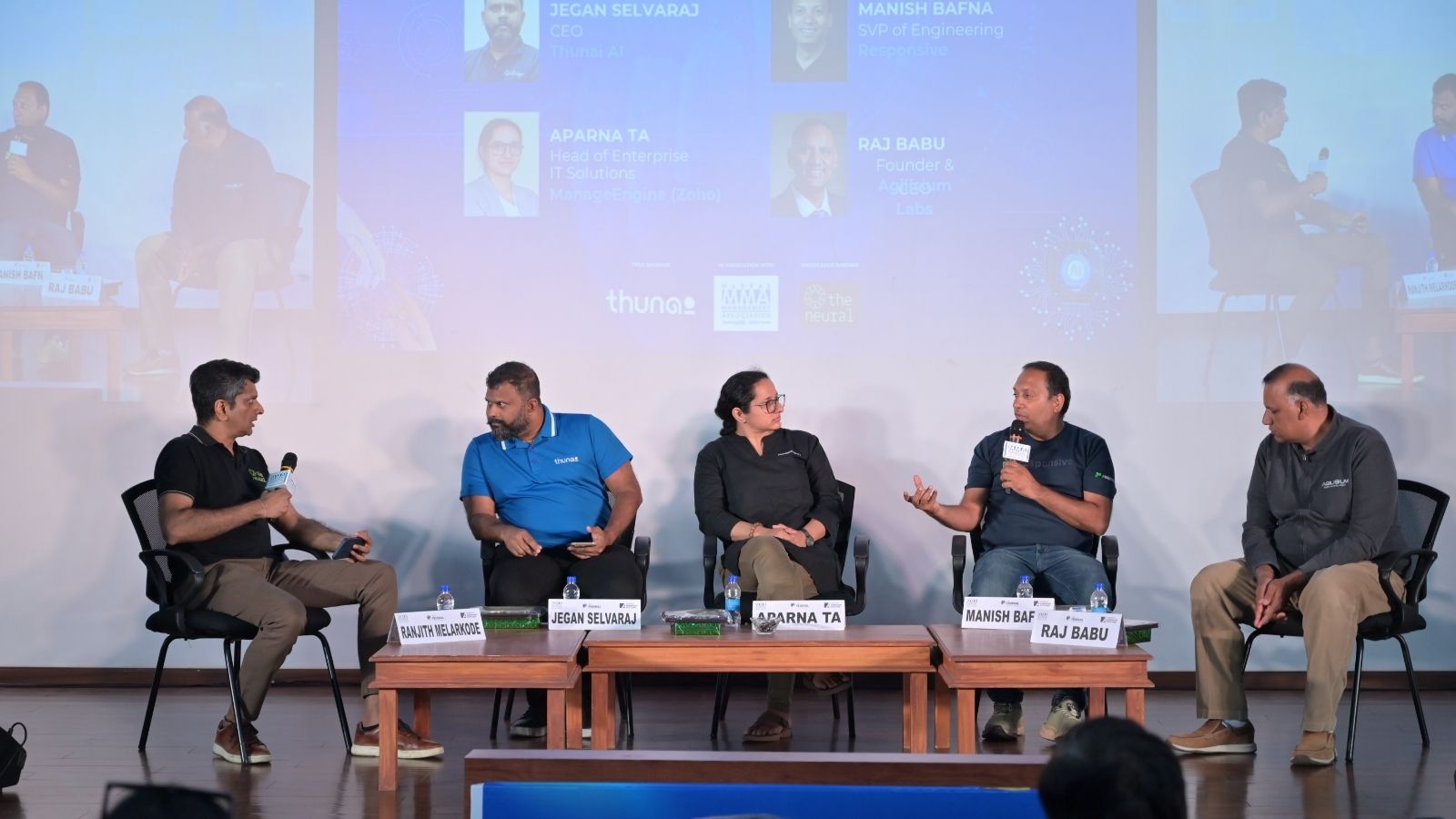
He spoke about opening opportunities for a Tamil Nadu business to compete internationally. It is a theme that connects naturally with his earlier overseas-client story. The market can be far away; the people building for it can remain close to home.
Back to the room where someone is starting
His speaking calendar in 2025 moved between established business audiences and people assembling their first commercial opportunities. At SaaS Connect in February, he and Santhanam led a session billed around the journey from zero to $1 million in annual recurring revenue. They also discussed Thunai.
A month later, the audience was Chennai Freelancers Club at IIT Madras Research Park. His scheduled session was titled “How we got overseas clients(Raw Unfiltered Story)”. There is something pleasingly direct about the title. No abstract summit vocabulary is needed when the question in the room is how to find someone who will buy your work.
The engineer becoming a founder is another theme he has addressed. He has described learning that clean, functional code still needs a business reason to exist. His advice asks engineers to consider context, ownership, and trade-offs. The early supermarket assignment offers a useful setting for that question: what happens to the customer’s working day because this software exists?
In February 2026, he announced another change in the working environment: a move to a larger office as Entrans, Thunai, and Infisign expanded. He framed the space around the team and the next generation of AI products. The announcement puts three company names into the same account of a working future. The physical office remains part of his language for growing a technology business, alongside the products and the international customer conversations.
The road keeps leading to Nazareth
For all the international work, Selvaraj repeatedly returns to Nazareth, his native town in Tamil Nadu’s Thoothukudi district. In 2020, he shared a Tamil-language interview about his entrepreneurial journey and his views for young people there. He also named people whose mentorship, inspiration, and support had helped him, including Suresh Sambandam and Dr. N. Marie Wilson.
The connection has acquired an office and an employment ambition. Announcing an extension to the Nazareth operation, he set a goal of creating 100 software and AI engineering opportunities locally. It is a hiring objective, with a place attached to it, rather than a vague promise to support talent somewhere.
Software and AI engineering opportunities.
A goal for the office’s growth.
When he celebrated four years of Entrans in Nazareth, Selvaraj credited the team with work on Infisign and Thunai. He described wanting the office to develop products for global customers and contribute to the surrounding area’s economy. The existing team gives the ambition a practical starting point.
His career can be followed through company names and transactions. The more personal route runs from learning to serve an overseas customer to wanting more engineers in his hometown to do international work. Between those points are teams, invoices, a majority acquisition, and several attempts to turn a familiar business problem into a product.
The next chapter has a number attached to it. One hundred opportunities in Nazareth would mean one hundred individual beginnings. For a founder who still tells the story of an early supermarket system, that seems an appropriate place to keep his attention.